
 Climate
Curriculum and TeachingTextbook
The Torch or The Firehose Text
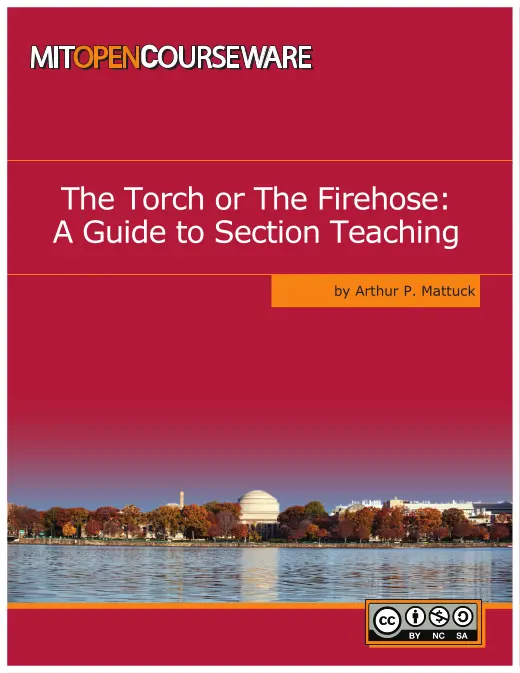
Not rated yetRate this bookArthur P. Mattuck’s The Torch or the Firehose is a practical guide to leading recitations and small teaching sections. Its central concern is helping students participate in mathematical and scientific reasoning, rather than simply watching an instructor solve problems. These instructions turn its classroom advice into preparation, observation, and reflection exercises.
Free reading is available at the official source. Opens in a new tab.
 Free
About this book
Arthur P. Mattuck’s The Torch or the Firehose is a practical guide to leading recitations and small teaching sections. Its central concern is helping students participate in mathematical and scientific reasoning, rather than simply watching an instructor solve problems. These instructions turn its classroom advice into preparation, observation, and reflection exercises.
How to study this book
Work through the guide alongside a section you teach, tutor, or observe. Before each meeting, choose one specific change to try; afterward, record what students actually did and what evidence showed understanding. Adapt the examples to your subject and institutional policies. The tasks below are supplementary practice, not exercises quoted from Mattuck.
Chapter-wise explanations and study tasks
Prologue — The purpose of a recitation
The opening establishes the teaching section as a place where students can speak, test ideas, and receive help that a large lecture cannot easily provide. Teaching advice becomes useful through practice, discussion with colleagues, and observation of real classes.
Study task: Write two learning outcomes for a section and explain why each requires student participation.
The Glass Wall — Encouraging Interaction
A class can appear orderly while a barrier separates the teacher’s explanations from students’ thinking. Mattuck explores how habits of questioning, eye contact, and personal interaction can make it easier to discover confusion and establish a working group.
Study task: Observe ten minutes of teaching and count student contributions that reveal reasoning rather than simple agreement.
Questions — Theirs and Yours
Questions are the main channel of two-way communication, but poorly framed prompts and rushed answers can close that channel. Pay attention to whether everyone hears a student’s question, whether an answer addresses the difficulty, and whether students have time to think.
Study task: Replace three vague checks such as asking whether everything is clear with questions that expose a specific misconception.
Before You Walk In
Preparation includes understanding the lecture context, working through problems, and anticipating where students may struggle. A useful section plan distinguishes essential ideas from optional material and leaves room to respond when a difficulty takes longer than expected.
Study task: Solve a selected problem in advance, mark two likely sticking points, and prepare a fallback explanation for each.
A Word About Pedagogy
The discussion asks teachers to think about how students learn rather than assuming that a clear performance automatically produces understanding. Connect explanations with students’ existing knowledge and give learners opportunities to reconstruct the argument themselves.
Study task: For one concept, design a sequence from an intuitive example to a formal statement and an independent application.
In the Classroom
The practical classroom advice concerns managing the meeting as a shared learning activity. An instructor must notice reactions, make transitions understandable, and adjust a plan when student responses show that an important step has not been understood.
Study task: Teach a short problem and pause at two planned checkpoints to ask students to supply the next step.
Off to a Good Start
Early meetings establish expectations about participation, preparation, and the relationship between teacher and students. Getting to know the group and creating a manageable first interaction can make later discussion less intimidating.
Study task: Draft an opening five-minute activity that introduces students to one another and reveals their prior knowledge.
Basic Communication Skills
Audibility, pace, language, and the organization of an explanation affect whether students can follow technical reasoning. Study communication as a skill that can be observed and improved rather than as a fixed personal trait.
Study task: Record a five-minute explanation and identify one unclear transition, one rushed passage, and one improvement.
Seeing Is Understanding — Using the Blackboard
Board work gives students a visible structure for a solution, but that structure disappears when notation, layout, or erasing is careless. Treat the board as a record of the reasoning, including the problem, intermediate steps, and conclusion.
Study task: Plan a complete board layout for a worked example and check that symbols and key assumptions remain visible.
Evaluating Your Students — Assignments, Exams, Grades
Assessment should connect course objectives with the work students are asked to produce. Pay attention to the role of assignments, the interpretation of exam performance, and the consistency of grading rather than reducing evaluation to a final mark.
Study task: Create a brief grading rubric for a multi-step problem and apply it to two differently reasoned solutions.
Evaluating You — Feedback
Feedback provides information about the effects of teaching that an instructor cannot reliably infer from effort alone. Student comments and classroom observation are most useful when they lead to a specific, testable change.
Study task: Ask students what most helps their learning and what remains confusing; choose one action and explain it at the next meeting.
Small Groups — Tutorials and Office Hours
Individual and small-group help can uncover a student’s particular reasoning more directly than a whole-class explanation. The challenge is to guide the learner without taking over the task and turning help into another demonstration.
Study task: Tutor one problem using prompts; record which prompt helped the learner make an independent decision.
Invisible Students
This section examines how students from underrepresented groups can be overlooked, underestimated, or discouraged in technical classrooms. Review participation patterns and expectations, using the historical discussion to examine the inclusiveness of your own setting.
Study task: Audit whom you call on, whose ideas you develop, and whom you interrupt; propose two changes grounded in your observations.
Teachers From Other Countries
Teaching across language and educational backgrounds involves expectations as well as pronunciation or vocabulary. The discussion encourages attention to classroom communication and local teaching conventions while recognizing the instructor’s own adjustment.
Study task: Explain one course procedure in plain language and ask a colleague to identify assumptions a newcomer might miss.
Problem Students and Students with Problems
Disruption, dominating participation, and personal difficulty call for different responses. Mattuck’s examples invite teachers to set boundaries while considering whether a student needs individual support or referral through appropriate institutional channels.
Study task: Write separate responses to an interrupting student and a student whose work has suddenly deteriorated; identify when to seek institutional help.
Epilogue — A Word About You
The closing reflection treats teaching as demanding personal work that develops over time. Examine your motivation, preparation, and reactions to difficulties while keeping improvement realistic and specific.
Study task: Write a reflection distinguishing one teaching habit you can change this week from a longer-term development goal.
Summary
The summary brings the book’s practical recommendations together for review. Use it to compare your intentions with observed classroom behavior, especially whether students have meaningful opportunities to think and speak.
Study task: Select five recommendations and attach a concrete piece of classroom evidence to each.
Classroom Observation Checklist
The checklist offers a structured way to observe teaching instead of relying on a general impression. Its value comes from recording specific behavior and discussing the observations constructively with the instructor.
Study task: Arrange a peer observation and agree in advance on two behaviors to track; finish with one achievable improvement.
Applied assignment
Prepare and teach a 30-minute recitation built around one difficult concept. Submit the lesson plan, board plan, two diagnostic questions, a short participation record, and a reflection explaining what you changed after observing students’ responses. If you are not teaching, use a simulated lesson with peers and identify that limitation.
Suggested reading plan
Use four stages: first read the prologue and interaction sections; next study preparation, classroom practice, and communication; then examine assessment, feedback, and individual support; finally use the summary and observation checklist during a second teaching attempt. Allow time between stages to try the advice.
Questions for reflection
- How can you distinguish a quiet but productive class from one in which students are lost?
- When does answering a question help learning, and when does it remove useful thinking?
- What classroom evidence would persuade you that a teaching change worked?
Edition and source notes
The linked MIT OpenCourseWare text is Mattuck’s guide to section teaching, with copyright dates 1981, 1995, and 2009. It is not a textbook on a particular mathematics subject. Some terminology and classroom examples reflect its publication context; apply current institutional rules for assessment, accessibility, and student support.
About access & copyright
This page provides book information and study material. Full-text access is provided by the original publisher or authorised source; a listing does not grant permission to republish the book.
Read our Library Access & Copyright policyExplore the contents
Check the chapters covered in this edition.
Visit the official source
See reading, preview or purchase options.
Save for later
Keep this textbook in your saved collection.
Reader ratings & reviews
Share your thoughts
Your review helps other students choose the right resources.
KEEP LEARNING
Your next great read
Climate Curriculum and Teaching
The Torch or The Firehose: A Guide to Section Teaching
View The Torch or The Firehose: A Guide to Section Teaching — book Education
START Handbook: How can I help my first-year students engage, persist and succeed?
View START Handbook: How can I help my first-year students engage, persist and succeed? — book Higher Education
Teaching in the University: Learning from Graduate Students and Early Career Faculty
View Teaching in the University: Learning from Graduate Students and Early Career Faculty — book Curriculum & Instruction
The Art and Science of Teaching Agriculture: Four Keys to Dynamic Learning
View The Art and Science of Teaching Agriculture: Four Keys to Dynamic Learning — book Education
Designing Arguments for Academic, Public, and Professional Audiences
View Designing Arguments for Academic, Public, and Professional Audiences — book Education
Action Research
View Action Research — book Education
Qualitative Research – a practical guide for health and social care researchers and practitioners
View Qualitative Research – a practical guide for health and social care researchers and practitioners — book Education
Critical Appraisal Practice: Systematic Reviews
View Critical Appraisal Practice: Systematic Reviews — book Education



