
 Religion
Textbook
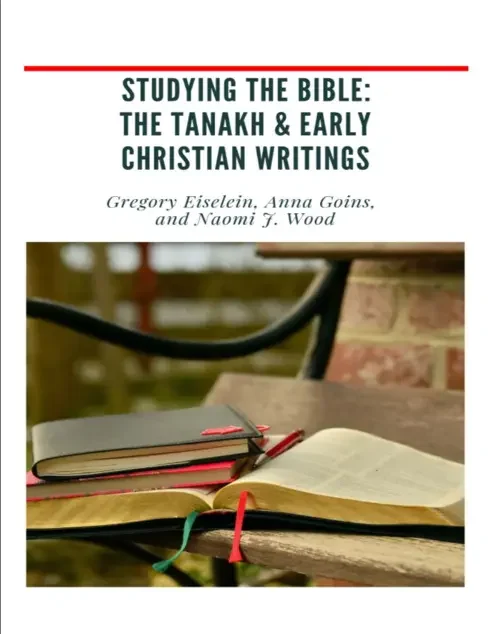
Studying the Bible: The Tanakh and Early Christian Writings
Not rated yetRate this bookStudying the Bible: The Tanakh and Early Christian Writings by Gregory Eiselein, Anna Goins, and Naomi J. Wood introduces biblical texts through literary form, historical setting, composition, and interpretation. This guide follows the 2019 textbook’s twelve chapters, covering the Hebrew Bible, apocalyptic and deuterocanonical writing, the Gospels, Acts, and letters. It supports close reading across religious and nonreligious perspectives, distinguishing what a text says, how it creates meaning, and what historical evidence can establish about its formation and reception.
Read on the publisher’s website. Opens in a new tab.
 Free
About this book
Studying the Bible: The Tanakh and Early Christian Writings by Gregory Eiselein, Anna Goins, and Naomi J. Wood introduces biblical texts through literary form, historical setting, composition, and interpretation. This guide follows the 2019 textbook’s twelve chapters, covering the Hebrew Bible, apocalyptic and deuterocanonical writing, the Gospels, Acts, and letters. It supports close reading across religious and nonreligious perspectives, distinguishing what a text says, how it creates meaning, and what historical evidence can establish about its formation and reception.
Book summary
Studying the Bible: The Tanakh and Early Christian Writings by Gregory Eiselein, Anna Goins, and Naomi J. Wood introduces biblical texts through literary form, historical setting, composition, and interpretation. This guide follows the 2019 textbook’s twelve chapters, covering the Hebrew Bible, apocalyptic and deuterocanonical writing, the Gospels, Acts, and letters. It supports close reading across religious and nonreligious perspectives, distinguishing what a text says, how it creates meaning, and what historical evidence can establish about its formation and reception.
Chapter-by-chapter summaries
Chapter 1 — The Bible and Literature
The opening chapter treats the Bible as a collection of texts with different genres, languages, styles, and histories. Canon and arrangement vary among traditions, so identifying the edition and community matters before making claims about what the Bible contains. Literary study attends to narrative, poetry, law, wisdom, prophecy, letters, and other forms rather than reading every passage by the same rules. Create a genre inventory from several short passages. Explain how recognizing a text’s form changes the questions you ask, while distinguishing literary interpretation from a personal statement of belief.
Chapter 2 — Composition, Editing, and Transmission
The chapter explains why the history of biblical texts involves writing, compilation, copying, translation, and decisions about authority. Different canons and arrangements reflect distinct communities and historical processes. Manuscript evidence and scholarship help investigate these processes without making every uncertainty disappear. Distinguish the setting described within a narrative from the possible period of its composition or editing. Compare two translations of a short passage and identify a meaningful difference. Ask whether that difference concerns vocabulary, interpretation, textual evidence, or a combination, and avoid treating one modern wording as an unmediated original.
Chapter 3 — The Torah
The Torah comprises Genesis, Exodus, Leviticus, Numbers, and Deuteronomy, bringing together origins, ancestral narratives, liberation, covenant, law, and community formation. The chapter discusses composite formation alongside the literary coherence readers can discover in the resulting work. Follow recurring relationships among promise, obligation, failure, and renewal. Compare narrative scenes with legal material and ask how each contributes to the collection’s larger concerns. Attend to repetition and variation rather than dismissing them as redundant. A strong reading explains how a specific structural or linguistic detail shapes the portrayal of human and divine relationships.
Chapter 4 — The Former Prophets
Joshua, Judges, Samuel, and Kings trace a narrative from entry into the land through monarchy, division, destruction, and exile. The chapter introduces the Deuteronomistic History as a framework for understanding how these books interpret events through covenantal and theological concerns. Read for the difference between narrating events and judging their significance. Compare the portrayal of a ruler with the consequences attached to that ruler’s choices, noting ambiguity and irony. Track the roles of prophets, institutions, and ordinary people, and consider how the narrative’s ending changes the meaning of its earlier promises and achievements.
Chapter 5 — The Latter Prophets
Prophetic books combine attributed speech, poetic language, visions, narrative, and editorial organization. The distinction between major and minor prophets concerns the relative length of their books rather than their spiritual importance. The chapter discusses recurring concerns such as justice, covenant, judgment, and restoration, with attention to historical settings and literary styles. Identify the speaker, addressee, situation, and rhetorical action of a passage before interpreting an image. Compare accusation with consolation and ask how each addresses a community’s circumstances. Recognize that compilation and later arrangement can shape how a prophet’s words are encountered.
Chapter 6 — The Writings
The Ketuvim gathers diverse works, including poetry, wisdom, stories, and historical writing. The chapter’s treatment of Psalms, Proverbs, Job, Ecclesiastes, Song of Songs, and other books emphasizes that this collection contains multiple ways of thinking about life and the divine. Compare the practical confidence of a proverb with the unsettling questions raised by Job or Ecclesiastes. Analyze parallelism, imagery, voice, and framing rather than reducing a poem to a single moral. Let differences among texts remain visible; a literary reading can examine a conversation among perspectives without forcing every passage into the same conclusion.
Chapter 7 — Apocalypse
Apocalyptic literature uses revelatory narratives, symbolic visions, and otherworldly perspectives to disclose meanings beyond ordinary observation. Daniel and Revelation provide the chapter’s central biblical examples. The authors connect their imagery with earlier traditions and the crises of the communities in which they were written. Distinguish the historical conditions of a text from later attempts to identify its symbols with contemporary events. Trace the relationship among suffering, judgment, endurance, and hope. Explain how a symbolic vision works within the text before deciding what it might mean for another setting or reader.
Chapter 8 — Apocrypha and Post-Exilic Literature
This chapter examines texts whose canonical status differs across Jewish and Christian traditions, including works often called apocryphal or deuterocanonical. Post-exilic settings, diaspora, translation, and Hellenistic influence help explain their forms and concerns. The terminology itself needs care: a community’s decision about scriptural authority is different from a simple judgment that a work has no historical or literary value. Compare a narrative such as Judith or Tobit with another biblical story, identifying both familiar themes and distinctive strategies. Record which tradition and edition you are discussing when describing a work’s place in a canon.
Chapter 9 — The Gospels
The chapter compares Matthew, Mark, Luke, and John as related but distinctive accounts of Jesus. The Synoptic relationship and Markan priority provide tools for investigating shared material and meaningful differences. Mark’s irony, Matthew’s framing, Luke’s narrative completeness, and John’s distinctive signs and theological language invite different close-reading questions. Compare the same episode across two Gospels without smoothing away differences. Ask what a changed detail, arrangement, or expression does for the narrative and its likely audience. Separate traditional author attributions from the evidence and uncertainties discussed by scholarship.
Chapter 10 — The Acts of the Apostles
Acts continues the narrative associated with Luke, depicting the spread of the Jesus movement through changing characters, places, and communities. The chapter considers plot, conversion, speeches, the role of the Holy Spirit, and the growing importance of Paul. Map a sequence of journeys or encounters, then explain how geographical expansion serves the book’s literary and religious purposes. Compare what a speech says with the situation in which the narrator places it. Ask how conflicts about belonging and practice are resolved within the narrative, and distinguish Acts’ portrayal of events from an independent historical verification of every detail.
Chapter 11 — The Pauline Letters
Pauline letters address communities and problems through the conventions and persuasive resources of ancient correspondence. The chapter distinguishes letters widely accepted as Paul’s from writings associated with a later Pauline school, while examining the vocabulary and arguments that became influential in Christianity. Identify the letter’s audience, occasion, and movement from opening to argument and exhortation. Compare a passage’s immediate function with a later reader’s broad theological use of it. A claim about faith, law, grace, or community should be interpreted within the letter’s reasoning rather than detached as an isolated slogan.
Chapter 12 — The General Letters
The final chapter concentrates on James, the Johannine letters, and the Petrine letters as voices addressing belief, conduct, identity, endurance, and communal boundaries. Their differing styles and emphases complicate the expectation that all early Christian writing uses one uniform argument. Compare how authors address their readers and what relationships those terms establish. Analyze how ethical exhortation, wisdom traditions, and expectations of the future support each text’s purpose. Distinguish literary authorship claims and traditional attributions from scholarly conclusions, and allow differences among the letters to become questions for interpretation rather than problems to erase.
Timeline, References, and Author Notes
The timeline, chapter references, and author notes support orientation and further inquiry. Keep three chronological tracks where possible: the events represented, the proposed composition or editing, and later transmission or reception. Record uncertainty instead of inventing precise dates where the source offers a range. Use the further-reading lists to follow a focused question about form, history, or interpretation. A final essay should make a bounded claim about a specific passage or comparison, support it through close reading, and identify where historical evidence or scholarly debate limits the conclusion.
Study instructions
- Read the assigned biblical passages alongside the textbook; identify the translation, canon, and numbering used in your notes.
- For each chapter, record genre, historical setting, composition questions, major interpretive concepts, and one passage for close analysis.
- Keep separate columns for textual observation, historical claim, interpretive inference, and personal response.
- Compare parallel passages or contrasting genres before constructing a thesis, preserving differences rather than harmonizing them automatically.
- Answer the source’s discussion questions with precise passage references and use its bibliography to investigate one unresolved issue.
Questions for reflection
- How does genre change the kind of evidence needed for an interpretation?
- Why are narrative setting, composition, and canonization different historical questions?
- What can a comparison of parallel Gospel passages reveal that reading only one cannot?
- How can readers respect religious traditions while examining texts through literary and historical methods?
Sources and coverage
This original reading guide follows the linked source edition’s chapter, module, unit, or lesson structure. Consult the source for full arguments, cases, worked examples, exercises, illustrations, and references. This guide follows the 2019 New Prairie Press textbook. The source PDF was reviewed through an institutional repository copy; the publisher remains the primary reading link. Read the source edition.
About access & copyright
This page provides book information and study material. Full-text access is provided by the original publisher or authorised source; a listing does not grant permission to republish the book.
Read our Library Access & Copyright policyExplore the contents
Check the chapters covered in this edition.
Visit the official source
See reading, preview or purchase options.
Save for later
Keep this textbook in your saved collection.
Reader ratings & reviews
Share your thoughts
Your review helps other students choose the right resources.
KEEP LEARNING
Your next great read
Religion Adult education
Creative and Inclusive Heritage Education: Handbook for Teachers and Trainers
View Creative and Inclusive Heritage Education: Handbook for Teachers and Trainers — book Administrative Law
First Amendment: Cases, Controversies, and Contexts
View First Amendment: Cases, Controversies, and Contexts — book Religion
Applied Developmental Systems Science: Everything You Always Wanted to Know About Theories, Meta-Theories, Methods, and Interventions but Didn't Realize You Needed to Ask. An Advanced Textbook
View Applied Developmental Systems Science: Everything You Always Wanted to Know About Theories, Meta-Theories, Methods, and Interventions but Didn't Realize You Needed to Ask. An Advanced Textbook — book Geography
International Relations
View International Relations — book Humanities
Intermediate Biblical Greek Reader: Galatians and Related Texts
View Intermediate Biblical Greek Reader: Galatians and Related Texts — book Humanities
Theological Questions
View Theological Questions — book Geosciences
An Introduction To Geology
View An Introduction To Geology — book Geosciences
Physical Geology (Sierra College Edition)
View Physical Geology (Sierra College Edition) — book Geosciences



