
Beyond Price: Essays on Birth and Death
PhilosophyTextbook
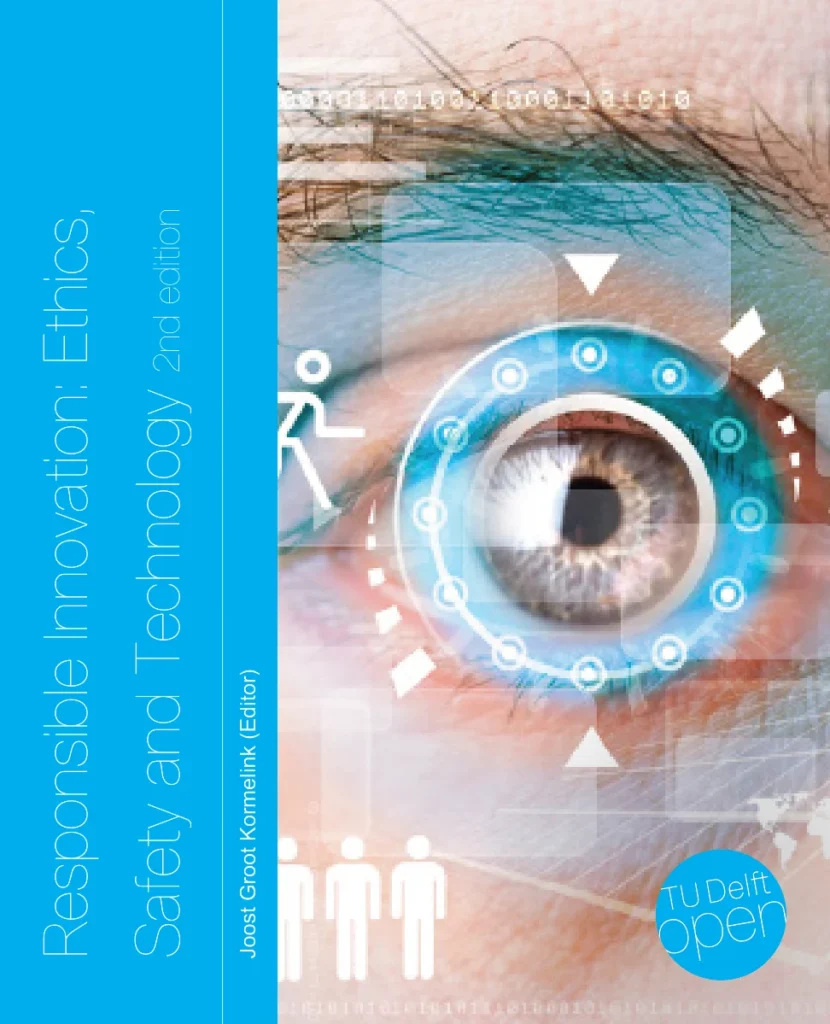
Responsible Innovation: Ethics, Safety and Technology
Not rated yetRate this bookResponsible Innovation: Ethics, Safety and Technology, second edition, brings ethical judgment into the development and governance of technologies. Edited by Joost Groot Kormelink, the September 2019 TU Delft book develops nine chapters and eleven embedded case studies from the university’s responsible-innovation course. Its central question is not merely whether a technology works, but how its purposes, risks, institutions, business practices, and design choices can serve society. This guide follows that edition, including its summary and four appendices. Historical standards, projects, and course links are identified as source-period material.
Read on the publisher’s website. Opens in a new tab.
 Free
About this book
Responsible Innovation: Ethics, Safety and Technology, second edition, brings ethical judgment into the development and governance of technologies. Edited by Joost Groot Kormelink, the September 2019 TU Delft book develops nine chapters and eleven embedded case studies from the university’s responsible-innovation course. Its central question is not merely whether a technology works, but how its purposes, risks, institutions, business practices, and design choices can serve society. This guide follows that edition, including its summary and four appendices. Historical standards, projects, and course links are identified as source-period material.
Book summary
Responsible Innovation: Ethics, Safety and Technology, second edition, brings ethical judgment into the development and governance of technologies. Edited by Joost Groot Kormelink, the September 2019 TU Delft book develops nine chapters and eleven embedded case studies from the university’s responsible-innovation course. Its central question is not merely whether a technology works, but how its purposes, risks, institutions, business practices, and design choices can serve society. This guide follows that edition, including its summary and four appendices. Historical standards, projects, and course links are identified as source-period material.
Chapter-by-chapter summaries
Introduction: When Is Innovation Good for Society?
Innovation is not automatically beneficial merely because it is new or technically impressive. The introduction uses examples of harmful or disappointing technologies to motivate responsible development alongside the need to address major societal challenges. Ethical questions arise during the choice of goals, the distribution of benefits, and the acceptance of uncertain risks. Define the proposed benefit of an innovation and identify who receives it, who bears costs, and whose perspective might be absent. This establishes a basis for evaluating responsibility before a product has already become difficult to change.
Chapter 1: Introduction to Responsible Innovation
The chapter connects practical dilemmas with definitions of responsible innovation and European responsible-research-and-innovation discussions. Substantive questions concern desirable outcomes and values, while process questions concern how people deliberate, participate, and respond during development. A responsible process and a favorable outcome are related but cannot simply be equated. Map the actors involved in a technology and identify where decisions are made. Then distinguish a disagreement about facts from disagreement about which values should guide the project. This makes responsibility a continuing practice rather than a final approval label attached after the technical work is complete.
Chapter 2: Applied Ethics for Responsible Innovation
Thought experiments introduce moral reasoning, followed by individual and collective responsibility, complex systems, emotions, value conflict, and moral overload. Responsibility can be difficult to allocate when many participants contribute to an outcome without controlling the whole system. Ethical reasoning therefore needs more than identifying one person to blame after failure. Smart-meter and medical-data cases illustrate competing values and the possibility of changing a design to reduce a conflict. State the relevant duties, consequences, relationships, and affected parties before proposing a solution. An innovative option may expand the available choices, but it still needs evidence that it addresses the conflict rather than merely renaming it.
Chapter 3: Institutional Context of Innovations
Rules, norms, organizations, and established practices shape which innovations can develop and how they are used. Institutions are not merely external obstacles to an otherwise finished design; they help define incentives, responsibilities, and expectations. The chapter connects technical change with the surrounding social arrangements and includes a self-driving-vehicle case in its broader discussion. For one proposed technology, list the formal rules and informal practices on which its operation depends. Then explain whether changing the artifact alone could achieve the desired outcome. This reveals why coordination and institutional adaptation can be as important as optimizing technical performance.
Chapter 4: Innovation and Business
Commercial development involves choices about strategy, investment, market adoption, and the wider consequences of business activity. A viable business model does not by itself establish that an innovation is responsible, while an attractive ethical aim does not guarantee implementation. The chapter connects these practical and evaluative concerns and uses television and coolant examples to examine development and diffusion. Trace the incentives faced by the organization and identify where a social benefit is or is not rewarded commercially. Discuss alternatives in both their financial and societal context rather than treating profitability and public value as interchangeable measurements.
Chapter 5: Frugal Innovation
Frugal innovation investigates solutions shaped by resource constraints and the requirements of users who may be underserved by conventional products. Lower cost is only one consideration: suitability, maintenance, access, local knowledge, and the conditions of use also matter. The TAHMO weather-station case makes these issues concrete. Identify the essential function before removing features or reducing expense, and ask who will operate, maintain, and benefit from the result. A simplified design can still fail if it assumes unavailable infrastructure or overlooks local priorities. The chapter links responsible innovation with inclusion and practical context rather than novelty alone.
Chapter 6: Implementation of Responsible Innovation by Companies
The chapter moves from general commitments toward organizational implementation and the standardization discussion presented in the edition. Responsibilities must be reflected in decision processes, documentation, participation, and the treatment of emerging concerns. A policy statement has limited practical meaning unless people know when it changes a project decision. Choose one development milestone and specify the evidence, stakeholders, and review questions that would be required there. Distinguish implementing a process from proving that every resulting product is ethically satisfactory. References to standards should be read as the 2019 source’s discussion, not as an unverified claim about the current edition of any standard.
Chapter 7: Understanding Risk
Risk analysis becomes more difficult when probabilities, consequences, or even possible outcomes are uncertain. The chapter distinguishes forms of uncertainty and introduces technology assessment as a way to examine wider implications. Nuclear-energy and big-data cases connect technical assessment with disagreement about acceptable consequences and social trust. State what is known, what is estimated, and what remains poorly characterized. A calculated expected value can assist a decision without resolving every question about distribution, irreversible harm, or consent. Avoid treating an unknown risk as zero simply because it cannot yet be assigned a precise probability.
Chapter 8: Risk Management and Safety Engineering
Risk-management definitions, cost–benefit reasoning, and methods for quantifying and comparing risks support choices about prevention and protection. Engineering safeguards address particular failure pathways under assumptions about use, maintenance, and organizational behavior. Monetary aggregation can make some comparisons easier while obscuring whose burdens are being combined. Draw a pathway from hazard to exposure and consequence, then identify where a proposed control acts. Explain what evidence would show that the control works and which residual uncertainties remain. A responsible comparison should make its value judgments visible instead of presenting them as consequences of arithmetic alone.
Chapter 9: Value Sensitive Design
Value Sensitive Design translates moral concerns into the conceptual, empirical, and technical work of developing an artifact or system. Identifying a value is only a beginning: it must be interpreted in context and connected with requirements or design choices that can be examined. Autonomous-weapons and care-robot cases expose tensions among competing aims and affected groups. Start with a value such as privacy or autonomy, identify stakeholders, and propose a specific design requirement. Then explain how it would be evaluated and what tradeoff it introduces. The process remains iterative because a concrete implementation can reveal conflicts that were invisible when the value was stated abstractly.
Embedded Case Studies and Closing Summary
The eleven cases are distributed through the chapters rather than form eleven additional numbered chapters. They connect smart meters, medical data, automated transport, television, coolants, weather stations, nuclear energy, big data, autonomous weapons, and care robots with the book’s main ideas. Use each as an exercise in applying a method, not as a universal verdict about a whole technology. The summary reconnects ethics, institutions, business, uncertainty, and design. Compare two cases by the structure of their value conflict and the point in development at which intervention remains possible.
Appendices 1–4
The appendices list responsible-innovation projects, questions for consideration, teachers and lecture links, and figure credits. Their purpose is extension, practice, navigation, and attribution. Project and web resources reflect the edition’s period and may need independent checking before reuse. Answer an appendix question using a clearly defined technology, explicit stakeholders, and a reasoned comparison of options. Record the source of an illustration or case rather than presenting borrowed material as newly created evidence.
Study instructions
- Read the introduction and Chapters 1–2 before selecting a case. Keep facts, uncertainties, and value judgments in separate notes.
- For each chapter, apply its method to the same innovation so that ethics, institutions, business, risk, and design become connected.
- Create a stakeholder map that includes users, nonusers, affected communities, operators, and decision makers.
- Translate one moral value into a design requirement and an evaluation method. Examine whether the chosen measure captures the value adequately.
- Use the embedded cases and appendix questions for discussion. Compare plausible alternatives and explain the assumptions behind your preferred option.
- Finish with a decision memo that identifies the societal aim, principal conflicts, evidence gaps, governance needs, and a plan for revisiting the design.
Questions for reflection
- Can a technically successful innovation fail its societal purpose?
- What would make a stakeholder’s participation meaningful?
- Which uncertainty cannot be resolved by simply assigning a more precise number?
- How does a moral value become a testable design requirement?
Sources and coverage
This original reading guide follows the linked source edition’s chapter, module, unit, or lesson structure. Consult the source for full arguments, cases, worked examples, exercises, illustrations, and references. Coverage follows the September 2019 second edition: introduction, nine chapters, eleven embedded case studies, closing summary, and four appendices. The original TU Delft cover is used. Read the source edition.
About access & copyright
This page provides book information and study material. Full-text access is provided by the original publisher or authorised source; a listing does not grant permission to republish the book.
Read our Library Access & Copyright policyExplore the contents
Check the chapters covered in this edition.
Visit the official source
See reading, preview or purchase options.
Save for later
Keep this textbook in your saved collection.
Reader ratings & reviews
Share your thoughts
Your review helps other students choose the right resources.
KEEP LEARNING
Your next great read
assisted suicide
 Philosophy
Arguments in Context - An Introduction to Critical Thinking
View Arguments in Context - An Introduction to Critical Thinking — book Ethics
Ethical Explorations: Moral Dilemmas in a Universe of Possibilities
View Ethical Explorations: Moral Dilemmas in a Universe of Possibilities — book Humanities
How to Think Critically
View How to Think Critically — book Berkeley
Modern Philosophy
View Modern Philosophy — book Ethics
Foundations for Moral Relativism: Second Expanded Edition
View Foundations for Moral Relativism: Second Expanded Edition — book critical statistical reasoning
The Philosophy of Econometrics: An Introduction
View The Philosophy of Econometrics: An Introduction — book philosophers
Second Thoughts: First Introductions to Philosophy
View Second Thoughts: First Introductions to Philosophy — book Humanities
Modern Philosophy
View Modern Philosophy — book Philosophy



