
ENGL 95S Corequisite
HumanitiesTextbook
Modern Philosophy
Not rated yetRate this bookModern Philosophy, assembled by Walter Ott and Alex Dunn, introduces early modern debates through primary readings rather than a single retrospective history. Its central question is how human beings can justify knowledge of a world that may differ from immediate experience. Read the selections as competing arguments about substance, causation, perception, and the limits of reason. This guide follows the nine main divisions of the BCcampus edition and distinguishes the editors’ instructional framework from the philosophers’ positions. The study tasks are designed to support close reading of the full texts.
Read on the publisher’s website. Opens in a new tab.
 Free
About this book
Modern Philosophy, assembled by Walter Ott and Alex Dunn, introduces early modern debates through primary readings rather than a single retrospective history. Its central question is how human beings can justify knowledge of a world that may differ from immediate experience. Read the selections as competing arguments about substance, causation, perception, and the limits of reason. This guide follows the nine main divisions of the BCcampus edition and distinguishes the editors’ instructional framework from the philosophers’ positions. The study tasks are designed to support close reading of the full texts.
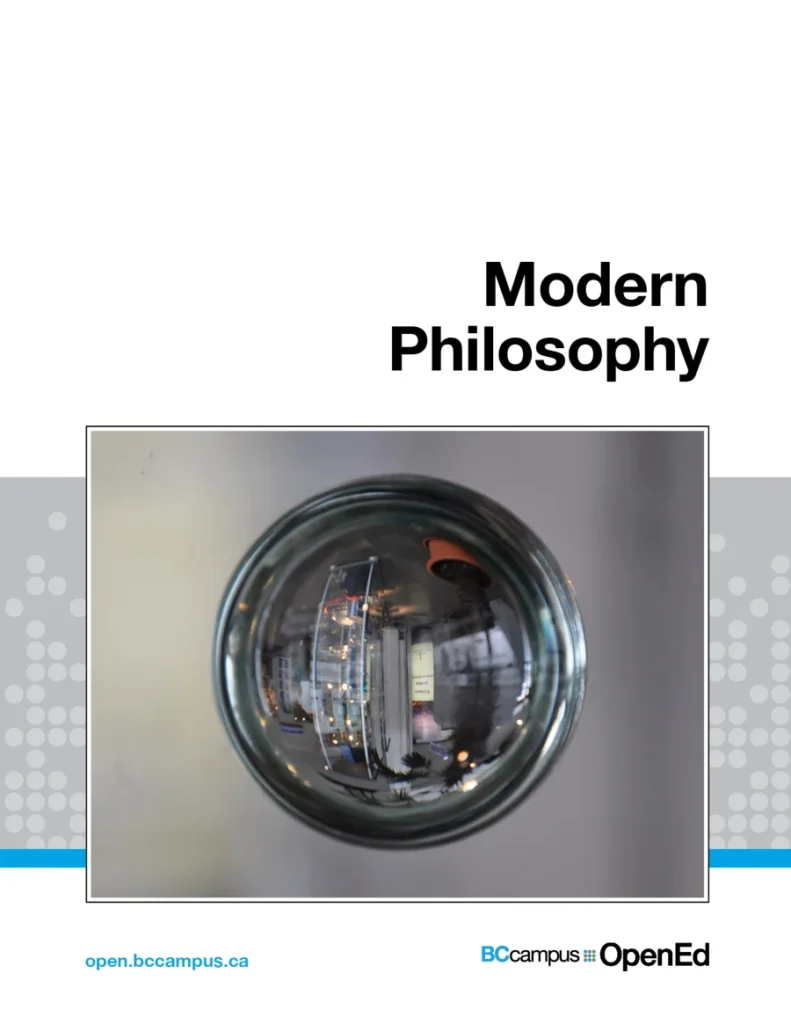
Cover: source-edition cover, displayed to identify the linked book.
Book summary
Modern Philosophy, assembled by Walter Ott and Alex Dunn, introduces early modern debates through primary readings rather than a single retrospective history. Its central question is how human beings can justify knowledge of a world that may differ from immediate experience. Read the selections as competing arguments about substance, causation, perception, and the limits of reason. This guide follows the nine main divisions of the BCcampus edition and distinguishes the editors’ instructional framework from the philosophers’ positions. The study tasks are designed to support close reading of the full texts.
Chapter-by-chapter summaries
1. Preface
The introductory material explains the anthology’s teaching purpose and prepares readers for difficult historical prose. A primary text often uses familiar words in unfamiliar technical senses, so a modern dictionary definition can mislead. Treat claims as parts of connected arguments: identify the question, proposed answer, and supporting premises. Separate the historical claim that an author held a view from the philosophical claim that the view is defensible. A useful first assignment is to state one passage’s conclusion in a single sentence before attempting criticism.
2. Minilogic and glossary
The logical tools distinguish an argument’s validity from the truth of its premises. A valid inference preserves truth if the premises are true; it does not establish those premises. An implication must also be distinguished from its converse. The glossary supplies conceptual handles for disputes over knowledge, reality, and mind. Translate a passage into numbered premises, mark unstated assumptions, and test whether its conclusion follows. This prevents agreement with an attractive conclusion from substituting for an assessment of the reasoning offered to support it.
3. Background to modern philosophy
Readings from Aristotle and Aquinas establish ideas against which early modern thinkers develop alternatives. Aristotle’s explanatory framework makes form, matter, purpose, and change central problems. Aquinas connects philosophical reasoning with theological questions while distinguishing ways of knowing and demonstrating. The modern period does not amount to an undifferentiated rejection of these predecessors. Ask which inherited resources later thinkers retain, transform, or reject. Compare explanations through a thing’s nature with the ambition to describe nature mathematically through matter and motion.
4. René Descartes
Descartes makes the search for secure foundations a method of inquiry. Methodical doubt suspends beliefs that could be mistaken before locating the thinking subject’s existence in the act of doubting. The challenge is then to rebuild knowledge beyond that first certainty. Clear and distinct perception, God, material substance, and the distinction between mind and body form interconnected parts of this reconstruction. Read objections and replies as tests of the argument. Examine whether the reasoning used to vindicate trustworthy cognition already depends on the reliability it seeks to establish.
5. Baruch Spinoza
The Ethics presents definitions, axioms, propositions, and demonstrations as a systematic account of reality. Substance is not a particular object among others; its independence supports a radically unified conception of God or Nature. Human thought and bodily existence belong within this necessary order. The reading task is to connect each demonstration with earlier definitions and results. Make a dependency diagram for several propositions and identify where the system’s strongest commitments enter. Then consider how the framework changes ordinary assumptions about freedom, individuality, and natural explanation.
6. John Locke
Locke investigates the origin and limits of understanding through ideas grounded in experience. Sensation and reflection supply materials that the mind combines and abstracts. The primary-secondary quality distinction asks which features belong to objects and which depend on their effects on perceivers. Substance and personal identity expose further limits to what experience supplies. Compare Locke’s rejection of innate ideas with Descartes’s foundational strategy. In every example, distinguish an explanation of how a belief develops from a justification of its status as knowledge.
7. George Berkeley
Berkeley challenges the assumption that sensible objects require a material substance beyond perception. His critique targets the separation of experienced qualities from possible experience and the explanatory value of an unknowable material support. Immaterialism preserves ordinary objects while reinterpreting their existence in relation to minds. Scientific prediction also raises the distinction between useful calculation and metaphysical commitment. Reconstruct the argument before dismissing it as a denial of everyday life. Ask what secures an object’s continuity when a particular human observer stops perceiving it.
8. David Hume
Hume asks what experience justifies about causation, induction, and necessary connection. Repeated sequences show what has happened, without deductively establishing what must happen next. Habit explains expectations, but explaining an expectation differs from proving its reliability. Distinguish relations of ideas from matters of fact and track how this constrains metaphysical claims. Try defending a familiar prediction without quietly assuming nature’s uniformity. The challenge concerns the grounds of inference, not the practical impossibility of expecting anything. Compare Hume’s account with the stronger causal claims made by earlier philosophers.
9. Immanuel Kant
Kant investigates the conditions that make experience and knowledge possible. The question shifts from whether thought copies an independently organized world to how forms of intuition and concepts of understanding structure experience. Synthetic a priori judgment becomes a central problem. The appearances-things-in-themselves distinction supports objective knowledge within experience while limiting speculative claims beyond it. Read the Prolegomena with the selected Critique material to separate the question from its proposed solution. Compare Kant’s response to Hume on causation without treating it as an unchanged restoration of older metaphysics.
Study instructions
- Create a concept-and-passage sheet for each philosopher, keeping textual evidence beside your definition.
- Reconstruct one argument in numbered premises before consulting interpretation; revise it after reading objections.
- Compare Descartes, Locke, and Hume on the same example of a supposedly justified belief.
- Write a final Kant response explaining both the reach and limits of knowledge.
Questions for reflection
- Does certainty about thinking establish knowledge of a mind as a substance?
- Can repeated observation justify necessary connection?
- What changes when the conditions of experience become the subject of inquiry?
Sources and coverage
This original reading guide covers the linked edition’s main chapters, or the principal sections of its two-chapter calculus text. Consult the source for full arguments, cases, worked examples, exercises, illustrations, and references. Read the source edition.
About access & copyright
This page provides book information and study material. Full-text access is provided by the original publisher or authorised source; a listing does not grant permission to republish the book.
Read our Library Access & Copyright policyExplore the contents
Check the chapters covered in this edition.
Visit the official source
See reading, preview or purchase options.
Save for later
Keep this textbook in your saved collection.
Reader ratings & reviews
Share your thoughts
Your review helps other students choose the right resources.
KEEP LEARNING
Your next great read
Humanities
LIBR 318: Library Research and Information Literacy
LIBR 318: Library Research and Information Literacy
View LIBR 318: Library Research and Information Literacy — bookReadings on Roman Men and Women
Readings on Roman Men and Women
View Readings on Roman Men and Women — bookBad Ideas About Writing
Bad Ideas About Writing
View Bad Ideas About Writing — bookDevelopmental Reading
Developmental Reading
View Developmental Reading — book Humanities
HUM 300: Classical Humanities Textbook
View HUM 300: Classical Humanities Textbook — book Humanities
SPAN 120: Advanced Elementary Spanish
View SPAN 120: Advanced Elementary Spanish — book Humanities
Português para principiantes
View Português para principiantes — book Humanities
A Guide to Successful College Writing
View A Guide to Successful College Writing — book Humanities



