
 History
BerkeleyTextbook
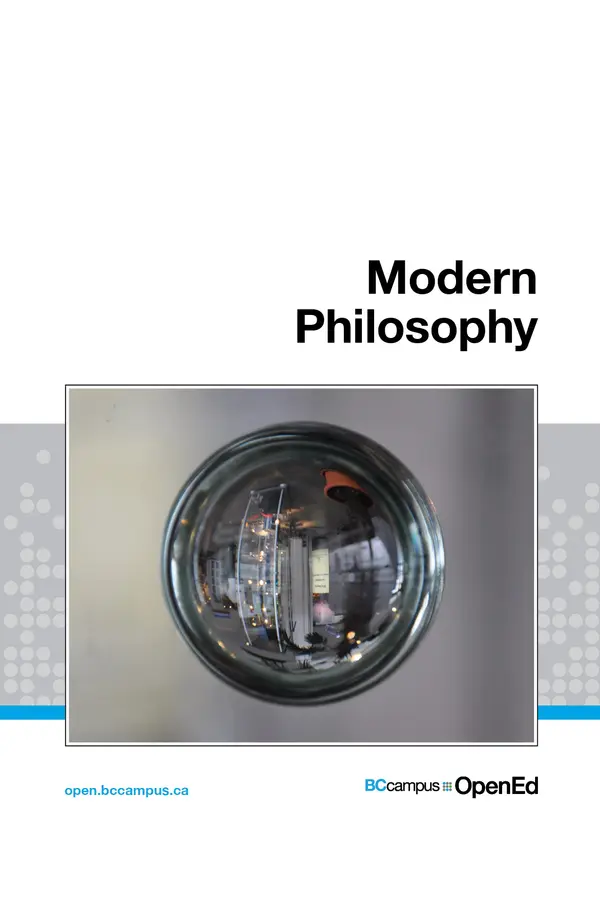
Modern Philosophy
Not rated yetRate this bookModern Philosophy introduces early modern debates through primary-source readings and argument-reconstruction exercises. The collection created by Walter Ott and adapted by Alex Dunn moves from logic and Aristotelian background to Descartes, Spinoza, Locke, Berkeley, Hume, and Kant.
Free reading is available at the official source. Opens in a new tab.
 Free
About this book
Modern Philosophy introduces early modern debates through primary-source readings and argument-reconstruction exercises. The collection created by Walter Ott and adapted by Alex Dunn moves from logic and Aristotelian background to Descartes, Spinoza, Locke, Berkeley, Hume, and Kant.
How to study this book
Read the preface before beginning the numbered sections. Separate editorial introductions from primary texts, annotate key terms, and reconstruct arguments as premises and conclusions. Present an author's strongest plausible argument before raising an objection, using the source's study questions to guide close reading.
Chapter-wise explanations and study tasks
Section 2 — Minilogic and Glossary
The introductory tools establish vocabulary for evaluating arguments and recognizing philosophical positions. Distinguish whether premises support a conclusion from whether those premises are true. These skills make later disputes easier to analyze without replacing an argument with agreement or disagreement about its conclusion.
Study task: Reconstruct a short argument with numbered premises and conclusion, then assess its inference separately from the plausibility of its premises.
Section 3 — Background to Modern Philosophy
Aristotle and Aquinas provide background on substance, change, explanation, causation, and knowledge. These selections help identify inherited assumptions that early modern thinkers revise or reject. Compare the meaning of a term within its argument before assuming that a later philosopher uses the same word in the same way.
Study task: Create a glossary of substance, cause, form, and knowledge using the assigned passages, then identify a question that carries into the modern selections.
Section 4 — René Descartes
Selections from the Discourse, Principles, Meditations, and objections and replies connect method, doubt, certainty, substance, mind, and body. Follow the order of the Meditations carefully because later conclusions depend on earlier steps. Distinguish methodological doubt from an assertion that knowledge is impossible, and examine objections as tests of the reasoning.
Study task: Reconstruct one argument from the Meditations, identify its dependence on earlier claims, and write an objection with a possible Cartesian response.
Section 5 — Baruch Spinoza
Part One of the Ethics develops claims about God and substance through definitions, axioms, propositions, and demonstration. Its geometrical presentation makes dependencies central to interpretation. Compare Spinoza's use of substance with Descartes's rather than reducing their difference to a slogan about the number of substances.
Study task: Choose a proposition, trace the earlier definitions or claims used to support it, and identify which dependency an objector might challenge.
Section 6 — John Locke's Essay Concerning Human Understanding
The selected passages examine innate knowledge, the origin and kinds of ideas, qualities, substance, natural kinds, mind, identity, and limits of knowledge. Track the distinction between the source of an idea and what can be known through it. The topical organization is editorial, so use the original book-chapter-section references when tracing a passage.
Study task: Compare Locke's account of primary and secondary qualities with his explanation of ideas, then analyze a personal-identity example using the relevant selection.
Section 7 — George Berkeley
The Principles selections challenge abstract ideas and accounts of material substance while developing Berkeley's alternative. Distinguish a denial of a particular philosophical conception of matter from a denial of ordinary experience. Reconstruct the reasoning about ideas, perception, and spirits before evaluating whether the account answers the problems it identifies.
Study task: Explain Berkeley's criticism of one Lockean distinction, give the argument's steps, and develop an objection that addresses those steps directly.
Section 8 — David Hume's Enquiry Concerning Human Understanding
Hume's selections examine ideas, association, causal inference, probability, necessary connection, liberty, testimony, and scepticism. Compare what reasoning establishes with the role custom plays in expectations. The source also includes a Treatise appendix, inviting attention to the scope and limits of Hume's account rather than treating scepticism as a simple rejection of everyday life.
Study task: Reconstruct the problem of inference from past experience to future events and explain how Hume's proposed account differs from a deductive proof.
Section 9 — Immanuel Kant
The Kant material centres on the Prolegomena with additional selections, asking how metaphysical, mathematical, and scientific knowledge are possible. Distinguish analytic from synthetic judgments and a priori from a posteriori knowledge before considering Kant's response to earlier debates. Track how conditions of experience limit what can legitimately be claimed.
Study task: Create a two-axis judgment table with justified examples, then explain one way Kant responds to a problem raised in the Hume selections.
Applied assignment
Write a comparative argument paper on knowledge, substance, causation, or mind using two philosophers in the collection. Reconstruct each position with passage references, explain a precise disagreement, and evaluate one objection without substituting biography for argument.
Suggested reading plan
Read Section 1, the preface, and Section 2 for method; Section 3 for background; Sections 4–5 together on substance and reason; Sections 6–8 on ideas and knowledge; and Section 9 as a response and synthesis.
Questions for reflection
- Which premise carries the main argumentative burden?
- Do two authors use the same key term differently?
- Does your objection challenge the actual argument or a simplified version?
Edition and source notes
Based on the Ott and Dunn collection, whose contents number the preface as Section 1 and substantive study material as Sections 2–9. This is an anthology of selected texts, not the complete works of the philosophers. Editorial passages and study questions should be distinguished from primary-source excerpts.
About access & copyright
This page provides book information and study material. Full-text access is provided by the original publisher or authorised source; a listing does not grant permission to republish the book.
Read our Library Access & Copyright policyExplore the contents
Check the chapters covered in this edition.
Visit the official source
See reading, preview or purchase options.
Save for later
Keep this textbook in your saved collection.
Reader ratings & reviews
Share your thoughts
Your review helps other students choose the right resources.
KEEP LEARNING
Your next great read
History General and Comparative Literary Studies and Linguistics
EmpoWORD: A Student-Centered Anthology and Handbook for College Writers
View EmpoWORD: A Student-Centered Anthology and Handbook for College Writers — book English
Provincial English
View Provincial English — book General and Comparative Literary Studies and Linguistics
Verb Tenses for English for Academic Purposes
View Verb Tenses for English for Academic Purposes — book Cultural Studies in the narrower sense
Historical and Contemporary Realities: Movement Towards Reconciliation
View Historical and Contemporary Realities: Movement Towards Reconciliation — book Ethics
Foundations for Moral Relativism: Second Expanded Edition
View Foundations for Moral Relativism: Second Expanded Edition — book critical statistical reasoning
The Philosophy of Econometrics: An Introduction
View The Philosophy of Econometrics: An Introduction — book philosophers
Second Thoughts: First Introductions to Philosophy
View Second Thoughts: First Introductions to Philosophy — book Humanities
Writing Guide with Handbook
View Writing Guide with Handbook — book Humanities



