
 Basic models of the enterprise
Associative Rings and AlgebrasTextbook
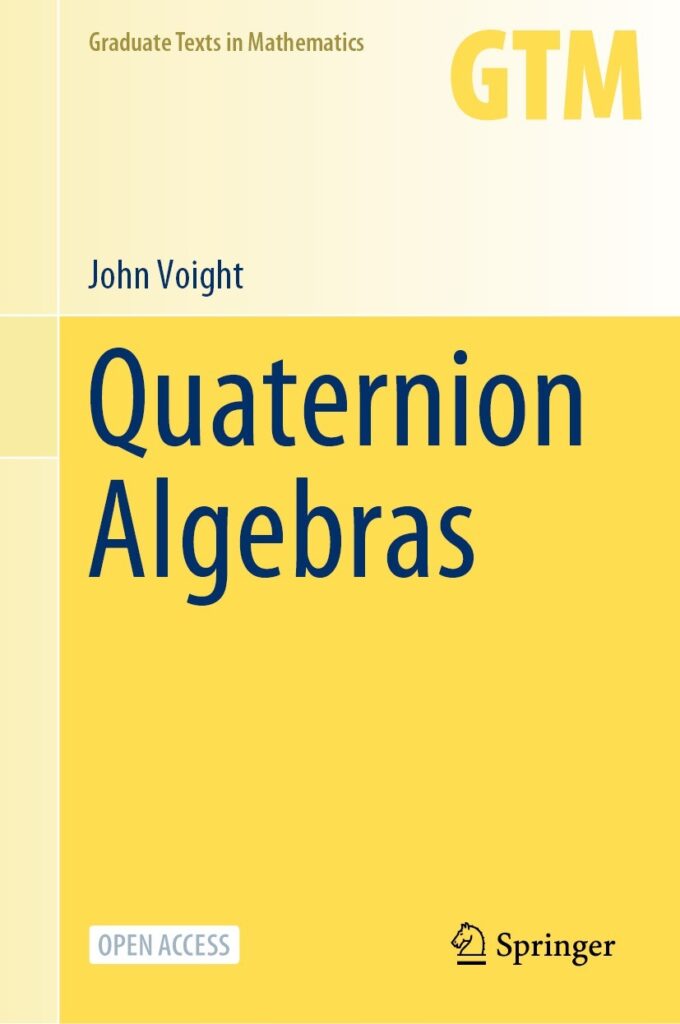
Quaternion Algebras
Not rated yetRate this bookJohn Voight’s Quaternion Algebras develops quaternion algebras from concrete calculations to arithmetic and geometry. This guide follows its 43 chapters, connecting quadratic forms, orders, local and global methods, arithmetic groups and modular forms. It is best used alongside the proofs and exercises, with explicit attention to the hypotheses behind every theorem.
Free reading is available at the official source. Opens in a new tab.
 Free
About this book
John Voight’s Quaternion Algebras develops quaternion algebras from concrete calculations to arithmetic and geometry. This guide follows its 43 chapters, connecting quadratic forms, orders, local and global methods, arithmetic groups and modular forms. It is best used alongside the proofs and exercises, with explicit attention to the hypotheses behind every theorem.
How to study this book
Review linear algebra, field extensions, rings, modules and elementary number theory. Keep a theorem ledger recording the base field, characteristic and finiteness assumptions. For each abstract construction, compute one example over the real numbers or a small arithmetic order before comparing the general statement.
Chapter-wise study guide
Chapter 1: Introduction
Voight begins with the historical development of quaternions and their place in mathematics. The history motivates a transition from a particular number system to algebras over general fields, with arithmetic, geometry and analysis eventually connected. Keep a map of those connections as you read. A concrete calculation in Hamilton's quaternions supplies intuition, but later claims require the stated base field and algebraic hypotheses.
Study task: Write a reading map linking rotations, quadratic forms, orders and modular forms.
Chapter 2: Beginnings
Generators and relations define the multiplication law, making noncommutativity explicit. Associativity still allows systematic calculation, but changing factor order can change a result. The rotation interpretation gives a geometric application of unit quaternions. Separate the algebra from its chosen coordinates and check how conjugation acts on a vector representation before interpreting a formula as a rotation.
Study task: Compute two reversed products and verify one conjugation-based rotation on a simple vector.
Chapter 3: Involutions
The standard involution reverses multiplication and provides trace and norm. These scalar-valued invariants connect inversion with algebraic structure. A nonzero element is not automatically invertible in every quaternion algebra, so distinguish a division algebra from a split matrix algebra. Check the involution identities directly in an example and follow how they support the characterization developed in this chapter.
Study task: Verify the trace and norm of a general Hamilton quaternion and derive its inverse when nonzero.
Chapter 4: Quadratic forms
Quadratic forms encode information that is not visible from multiplication tables alone. The chapter develops the language needed to compare forms and connect them with quaternion norms. A change of coordinates may alter coefficients while preserving the represented form. Keep equivalence, isotropy and nondegeneracy distinct, and identify which field assumptions are used in a calculation.
Study task: Compare two diagonal presentations and explain what must be preserved by an equivalence of quadratic forms.
Chapter 5: Ternary quadratic forms and quaternion algebras
The relationship with ternary quadratic forms supplies another description of quaternion algebras. The point is a correspondence between structures, not merely a resemblance between formulas. Track which part of the algebra produces the form and what additional information is required to recover an algebra. Examples help distinguish isomorphic objects from identical presentations.
Study task: Explain the steps of the algebra-to-form construction and identify the relevant notion of equivalence.
Chapter 6: Characteristic 2
Characteristic two changes familiar sign-based formulas and therefore needs its own treatment. The chapter extends earlier results rather than assuming that division by two or the usual presentation remains legitimate. Recheck every identity whose proof uses those operations. This provides a useful lesson in algebraic hypotheses: a theorem's restriction may reflect its formulation as well as its underlying phenomenon.
Study task: Find an earlier derivation using division by two and explain why it cannot be transferred unchanged.
Chapter 7: Simple algebras
Central simple algebras provide a structural characterization: quaternion algebras are central simple algebras of dimension four. Distinguish simplicity from being a division ring and centrality from commutativity. A matrix algebra illustrates why these distinctions matter. This viewpoint allows quaternions to be studied within a broader algebraic framework without discarding concrete examples.
Study task: Use a two-by-two matrix algebra to distinguish central, simple and division properties.
Chapter 8: Simple algebras and involutions
The chapter extends the interaction between simple algebras and involutions. An involution is extra structure, so classifying an algebra alone may not answer a question about the pair. Track how maps must interact with the involution as well as multiplication. Compare this structural viewpoint with the standard involution and norm calculations from earlier chapters.
Study task: State the compatibility a structure-preserving map should satisfy for algebras equipped with involution.
Chapter 9: Lattices and integral quadratic forms
Lattices introduce integral information inside vector spaces over fields. Integral quadratic forms bring arithmetic constraints into the earlier geometric and algebraic picture. A basis change allowed over the field need not be allowed over the underlying domain. Keep the ambient vector space and the lattice separate when discussing equivalence, index or a form's integral values.
Study task: Give an example of two lattices in one rational vector space and describe a change not preserving the lattice.
Chapter 10: Orders
An order is an integral lattice that is also closed under the algebra's multiplication and contains the required identity. Orders distinguish arithmetic structures inside the same algebra over a field. Verify both the module and multiplication conditions rather than calling any chosen lattice an order. Later notions of ideals, maximality and discriminants depend on precisely which order is fixed.
Study task: Check closure under multiplication for a proposed integral basis in a quaternion algebra.
Chapter 11: The Hurwitz order
The Hurwitz order provides a particularly concrete arithmetic example with exceptional symmetry. Use it to see why an integral structure larger than the most obvious integer-coordinate choice can matter. Norms, units and divisibility questions become accessible through explicit calculations. This chapter is a bridge between the familiar Hamilton setting and the general theory of orders.
Study task: Compare the obvious integer-coordinate order with the Hurwitz order and identify an element distinguishing them.
Chapter 12: Ternary quadratic forms over local fields
Local fields make classification problems more manageable, and ternary quadratic forms provide one route to quaternion classification. The local setting must be specified: conclusions about real fields and nonarchimedean fields need not have identical proofs. Relate a form's behavior to the algebra it represents rather than treating the classification as an isolated list.
Study task: Explain how a local question about a quadratic form can determine a property of its quaternion algebra.
Chapter 13: Quaternion algebras over local fields
A second approach to local classification uses valuations. Valuations organize arithmetic size and supply a different language for studying a local division algebra and its integral structures. Compare the two classification routes to identify what each makes explicit. Distinguish a valuation statement from an assertion about an ordinary absolute value on real coordinates.
Study task: Prepare a comparison of the quadratic-form and valuation approaches to local classification.
Chapter 14: Quaternion algebras over global fields
The global chapter assembles local information into the classification of algebras over global fields. Ramification records behavior at places, but not every arbitrary assignment is a valid global pattern. Follow the compatibility conditions in the theorem rather than assuming independent local choices always combine. The local-global viewpoint becomes a recurring method in later arithmetic chapters.
Study task: Describe the local data used to classify a global algebra and explain why a compatibility condition is needed.
Chapter 15: Discriminants
Discriminants measure arithmetic complexity while recording ramification and volume-related information. Definitions for an algebra and an order should not be conflated. Trace the role of a basis and pairing in a discriminant calculation and check how a basis change affects the result. An invariant should be independent of the arbitrary choices in its presentation.
Study task: Compute a simple trace-pairing matrix and describe the basis-change effect on its determinant.
Chapter 16: Quaternion ideals and invertibility
Quaternion ideals require attention to left and right multiplication. An ideal carries order information on both sides, and invertibility is a structural property rather than an automatic consequence of being nonzero. The chapter develops the tools needed to use ideals as arithmetic objects. Keep equality, principality and isomorphism separate throughout calculations.
Study task: For a one-sided ideal, identify which side acts and which associated order must be tracked.
Chapter 17: Classes of quaternion ideals
Ideal classes organize ideals up to the appropriate equivalence rather than by literal equality. The classification extracts global arithmetic information from objects that can have many presentations. Compare the role of a principal ideal with the obstruction measured by a nontrivial class. State the fixed order and side conventions before discussing a class set.
Study task: Explain why two unequal ideals can represent the same class and what data the class forgets.
Chapter 18: Two-sided ideals and the Picard group
Two-sided ideals behave differently from general one-sided ideals and support a Picard-group viewpoint. The analogy with commutative ideal theory is useful only when its hypotheses are checked. Track the multiplication and equivalence used to define the group structure. A statement about all quaternion ideals cannot be inferred from a result restricted to the two-sided case.
Study task: Compare the information needed to multiply two-sided ideal classes with that needed for arbitrary one-sided ideals.
Chapter 19: Brandt groupoids
Brandt groupoids organize multiplication when source and target orders matter. A groupoid allows composition only when the relevant objects match, reflecting structure that a single group may conceal. Follow both sides of each ideal and verify composability before multiplying. This perspective clarifies why naive multiplication on an unrestricted ideal-class set can be misleading.
Study task: Draw two composable ideal arrows and one noncomposable pair, labeling their orders.
Chapter 20: Integral representation theory
The module viewpoint broadens the preceding ideal theory. Projective lattices connect invertibility with integral representation theory, making it possible to compare different descriptions of the same arithmetic object. Distinguish freeness from projectivity and field-linear structure from integral structure. Identify which category a theorem concerns before transferring an intuition from ordinary vector spaces.
Study task: Explain why an argument valid for vector spaces may require a projectivity hypothesis for integral modules.
Chapter 21: Hereditary and extremal orders
Hereditary orders have particularly tractable module theory. The chapter gives characterizations and relates them to an extremal property involving the Jacobson radical. Do not treat hereditary, maximal and extremal as interchangeable labels without the precise implications. Use the characterizations as alternative tests, checking the setting in which each is valid.
Study task: Make an implication diagram for the order properties established in the chapter, with hypotheses attached.
Chapter 22: Quaternion orders and ternary quadratic forms
Ternary quadratic forms return in an integral setting to classify orders over a Dedekind domain. Passing from fields to domains introduces lattice and equivalence issues that the earlier classification did not have. Track the extra arithmetic data rather than assuming the field-level dictionary transfers verbatim. The chapter connects several earlier constructions into one classification method.
Study task: Compare the field-level and integral correspondences and identify one additional datum needed integrally.
Chapter 23: Quaternion orders
The first survey of quaternion orders distinguishes classes with useful local properties. The purpose is to navigate a family of structures after the general classification, not to memorize names without tests. For each class, record a definition, local criterion and example. Compare how its properties influence ideal or module behavior and which implications genuinely hold.
Study task: Build a small classification table with one example and one diagnostic property for each order type studied.
Chapter 24: Quaternion orders: second meeting
The second survey extends the discussion to more advanced order types. Use it as a comparison chapter: identify what new condition is imposed and which earlier tools test it. Avoid inferring a universal hierarchy from suggestive terminology. Connecting each class with a concrete arithmetic consequence makes the expanded taxonomy useful for later applications.
Study task: Choose two advanced order types and compare their defining conditions and one consequence.
Chapter 25: The Eichler mass formula
Analytic methods enter through zeta functions and a mass formula in a controlled arithmetic setting. A mass is a weighted count and should not be mistaken for the unweighted number of classes. Track the automorphism or unit contributions that determine the weights. The chapter illustrates how a generating or analytic object can encode a discrete arithmetic classification.
Study task: Explain the distinction between class number and mass using an illustrative weighted finite set.
Chapter 26: Classical zeta functions
Classical zeta-function methods extend the analytic treatment over totally real fields. Follow how local and global factors enter the formula and which normalization is being used. An analytic identity becomes arithmetic information only after these factors are interpreted. Keep the special-case motivation from the previous chapter visible while noting the additional field-level hypotheses.
Study task: Prepare a dependency chart from the arithmetic counting problem to the zeta-function ingredients.
Chapter 27: Adelic framework
Adeles and ideles package local information in a global framework. The restricted-product conditions are essential; this is not simply an arbitrary product of all completions. Relate the notation to the local-global calculations already encountered. Distinguish algebra elements embedded diagonally from general adelic points and explain what each represents in an arithmetic problem.
Study task: Describe the difference between a global element and a collection of compatible local data.
Chapter 28: Strong approximation
Strong approximation transfers local constraints into global existence statements under specified conditions. The theorem is powerful precisely because its hypotheses restrict where and how approximation is possible. Record the group, excluded places and topology involved before using it. Compare an existence conclusion with a constructive algorithm, which may require additional work.
Study task: State a representative approximation problem and identify the hypotheses needed before invoking the chapter's theorem.
Chapter 29: Idelic zeta functions
Idelic zeta functions place the analytic theory in the global framework of central simple algebras. Analytic continuation and functional equations connect initially defined expressions with a wider domain. Track measures, local factors and normalization rather than treating the result as a formal rearrangement of divergent expressions. This chapter strengthens the link between harmonic analysis and quaternion arithmetic.
Study task: Explain why defining a zeta function in a convergence region differs from continuing it analytically.
Chapter 30: Optimal embeddings
Optimal embeddings concern quadratic orders inside quaternion orders, with optimality controlling the intersection with the embedded field. An embedding of fields does not automatically give the desired embedding of integral orders. The idelic approach organizes local and global information. Keep conjugacy, existence and counting questions distinct when interpreting the results.
Study task: Distinguish a field embedding from an optimal order embedding and identify the extra integral condition.
Chapter 31: Selectivity
Selectivity refines the local-global picture by asking how embeddings are distributed among orders in a genus. Local compatibility need not imply uniform behavior for every global order. Separate the existence of an embedding somewhere from its existence in a particular class. This chapter explains why more refined arithmetic data are needed after a coarse classification.
Study task: Formulate three different questions: local existence, global existence and distribution among order classes.
Chapter 32: Unit groups
Unit groups connect arithmetic with geometric actions. The units of an order form a discrete arithmetic structure whose representations can act by isometries on suitable spaces. Norm conditions and central quotients matter for identifying the acting group. Track which units and equivalences are used before reading a geometric quotient as an arithmetic object.
Study task: Identify the group and kernel in a simple unit-group action and explain why the quotient matters.
Chapter 33: Hyperbolic plane
Hyperbolic-plane geometry supplies models and isometries for later arithmetic actions. Distances and geodesics belong to the hyperbolic metric rather than the Euclidean appearance of a drawing. Compare models by their structure-preserving maps and identify the boundary separately from the interior. These distinctions prevent visual intuition from misrepresenting group actions.
Study task: Sketch a hyperbolic geodesic in a chosen model and explain how its interpretation differs from a Euclidean line.
Chapter 34: Discrete group actions
Discrete group actions require topological conditions to obtain well-behaved quotients. The chapter introduces the context for proper actions and highlights potential pathologies. Discreteness of a group and good behavior of its action are related but should not be casually identified. State stabilizers and local behavior before interpreting a quotient as an ordinary manifold.
Study task: Explain how a nontrivial stabilizer can affect the local structure of a quotient.
Chapter 35: Classical modular group
The classical modular group gives a detailed model example of an arithmetic group acting on the upper half-plane. A fundamental domain provides orbit representatives and reveals group structure through identifications. It also motivates later quaternionic generalizations. Follow the boundary identifications and exceptional points rather than treating the region as an isolated polygon.
Study task: Describe how one fundamental-domain identification reflects a group element.
Chapter 36: Hyperbolic space
Three-dimensional hyperbolic space extends the geometric setting beyond the plane. Compare the models and isometry descriptions with the preceding two-dimensional case, noting what changes in the acting groups and domains. Similar notation should not obscure dimension-specific features. This chapter prepares a broader geometric interpretation of quaternionic arithmetic.
Study task: Compare a plane-model construction with its three-dimensional analogue and identify one new geometric feature.
Chapter 37: Fundamental domains
Fundamental domains provide systematic representatives for discrete isometry-group orbits. The construction requires a criterion for membership and an account of side identifications, not merely a plausible drawing. Such domains support structural and computational questions about the group. Track coverage and overlap conditions as separate requirements.
Study task: List the checks needed to establish that a candidate region is a fundamental domain.
Chapter 38: Quaternionic arithmetic groups
Quaternionic arithmetic groups apply the preceding geometry to unit groups arising from orders. The relationship depends on the algebra's behavior at the relevant places. Separate the arithmetic definition of the group from the geometric space on which it acts. The resulting quotient encodes number-theoretic structure through topology and geometry.
Study task: Trace the construction from a quaternion order to an acting group and its geometric quotient.
Chapter 39: Volume formula
A covolume formula quantifies the size of the quotient associated with a quaternionic group. The quantity depends on a chosen measure normalization, so numerical comparisons require consistent conventions. Follow how arithmetic invariants enter the geometric expression. Volume is an additional invariant, not a complete classification of the group or quotient.
Study task: Explain what normalization information must accompany a covolume value.
Chapter 40: Classical modular forms
Classical modular forms introduce functions constrained by the modular-group action together with appropriate analytic conditions. The transformation law alone is not the whole definition. The chapter supplies examples and motivation for quaternionic generalizations. Distinguish a function on the upper half-plane from its compatibility with a quotient and its behavior at the boundary.
Study task: Write a checklist of the conditions a candidate function must satisfy to be a modular form in the chapter's setting.
Chapter 41: Brandt matrices
Brandt matrices organize ideals of given norm by ideal class and connect arithmetic counting with modular forms. A matrix entry should be interpreted through its counting convention and equivalence relation. Compare this discrete construction with the analytic objects introduced earlier. It illustrates how finite arithmetic data can encode information with a modular interpretation.
Study task: Explain what one Brandt-matrix entry counts and why its normalization must be stated.
Chapter 42: Supersingular elliptic curves
Supersingular elliptic curves provide a geometric realization of quaternionic arithmetic. The chapter connects suitable curve categories with ideals in a maximal order, linking endomorphisms and arithmetic classification. State the characteristic and base-field setting before using the correspondence. The relationship is richer than a numerical coincidence between two class counts.
Study task: Map the objects and morphisms on the two sides of the curve–ideal correspondence.
Chapter 43: QM abelian surfaces
The final chapter interprets quaternionic quotients as moduli spaces for abelian surfaces with quaternionic multiplication. It draws together algebra, arithmetic, analysis and geometry and benefits from additional algebraic-geometric background. Distinguish an individual surface from the moduli problem classifying surfaces with extra structure. The point is a culminating connection, with hypotheses controlling what is parametrized.
Study task: Explain the extra structure in the moduli problem and identify three earlier parts needed to understand it.
Suggested reading plan
- Chapters 1–8: establish the algebraic language and relate norm forms to structure.
- Chapters 9–23: work through lattices, orders, ideals and their classification, retaining concrete examples.
- Chapters 24–31: connect counting, local-global methods, adeles and embeddings.
- Chapters 32–38: build the geometric picture of arithmetic groups and hyperbolic quotients.
- Chapters 39–43: synthesize modular forms, Brandt methods, elliptic curves and moduli.
Questions for reflection
- How does a norm form encode information about a quaternion algebra?
- Why does a left ideal need to be distinguished from a right ideal?
- Which local-global conclusions depend on global hypotheses?
- How do arithmetic and geometric descriptions reinforce each other?
Edition and source notes
This original study companion follows the 2021 source edition and its verified chapter sequence. It draws on publisher records, chapter descriptions or abstracts and accessible learning material. It is a conceptual reading guide rather than a reproduction of the source or a claim to have independently checked every proof, dataset or empirical finding. Study tasks are original prompts, not the book’s assigned exercises.
About access & copyright
This page provides book information and study material. Full-text access is provided by the original publisher or authorised source; a listing does not grant permission to republish the book.
Read our Library Access & Copyright policyExplore the contents
Check the chapters covered in this edition.
Visit the official source
See reading, preview or purchase options.
Save for later
Keep this textbook in your saved collection.
Reader ratings & reviews
Share your thoughts
Your review helps other students choose the right resources.
KEEP LEARNING
Your next great read
Basic models of the enterprise Climate Change and Ethics
Climate Change
View Climate Change — book Coronavirus
Cancer Care in the Post-COVID World
View Cancer Care in the Post-COVID World — book Body-mind-spirit
Health Promotion in Health Care – Vital Theories and Research
View Health Promotion in Health Care – Vital Theories and Research — book charged particle motion in Earth’s magnetosphere
Physics of Earth’s Radiation Belts
View Physics of Earth’s Radiation Belts — book burns
Textbook on Scar Management
View Textbook on Scar Management — book Biobased value chains
Bioeconomy
View Bioeconomy — book Diseases and disorders
Lung Cancer Navigation and Care
View Lung Cancer Navigation and Care — bookIntro to Optics and Photonics
Intro to Optics and Photonics
View Intro to Optics and Photonics — bookElectricity and Magnetism with Applications to Amateur Radio and Wireless Technology



