
 Classical mechanics
charged particle motion in Earth’s magnetosphereTextbook
Physics of Earth’s Radiation Belts
Not rated yetRate this bookPhysics of Earth’s Radiation Belts links particle motion, plasma behavior and wave interactions to the dynamics of near-Earth energetic populations. This guide follows all seven chapters by Hannu E. J. Koskinen and Emilia K. J. Kilpua. It supports a physical understanding of sources, transport, acceleration and loss while emphasizing the conditions behind models and the limits of observations.
Free reading is available at the official source. Opens in a new tab.
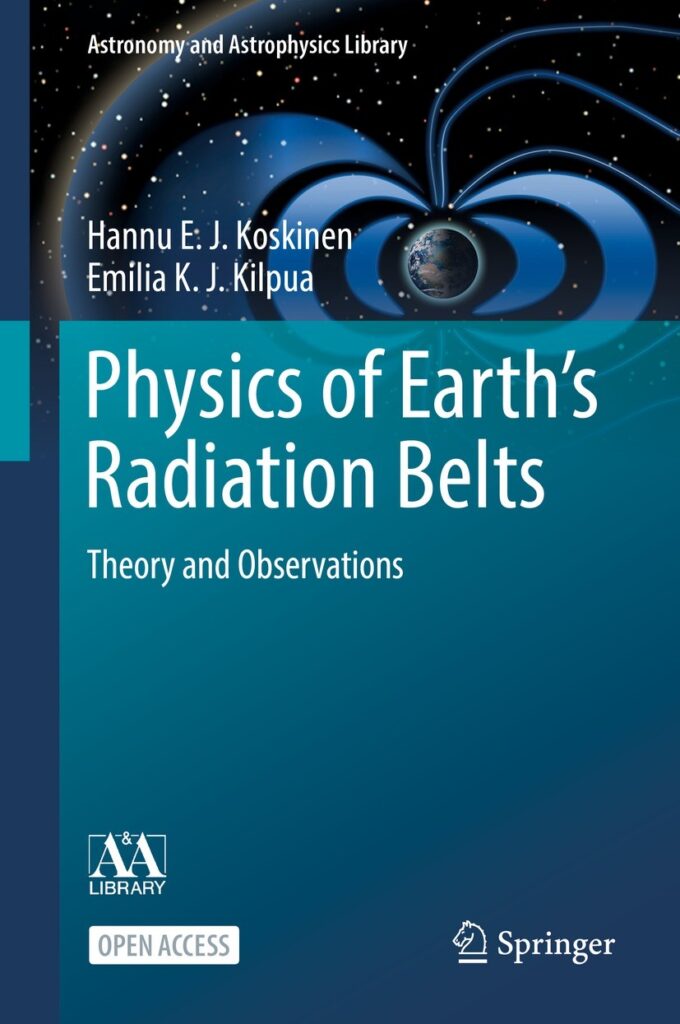 Free
About this book
Physics of Earth’s Radiation Belts links particle motion, plasma behavior and wave interactions to the dynamics of near-Earth energetic populations. This guide follows all seven chapters by Hannu E. J. Koskinen and Emilia K. J. Kilpua. It supports a physical understanding of sources, transport, acceleration and loss while emphasizing the conditions behind models and the limits of observations.
How to study this book
Review electromagnetism, vector calculus and basic mechanics. Maintain a table of scales, assumptions and conserved quantities. When interpreting a time series, record particle energy, observing location and magnetic conditions. Draw mechanisms before manipulating equations, then check dimensions and limiting cases.
Chapter-wise study guide
Chapter 1: Radiation Belts and Their Environment
Radiation belts belong to a coupled system linking the solar wind, magnetosphere and near-Earth plasma. Begin by locating the trapped populations relative to the geomagnetic field and the surrounding regions. Particle energies and distributions vary with location and time; a single diagram cannot represent every condition. The chapter supplies the environmental vocabulary needed to interpret later discussions of acceleration and loss. Keep the distinction between an external driver, a local wave and the resulting particle response explicit throughout your notes.
Study task: Draw a system map linking solar-wind forcing, magnetic configuration, plasma waves and energetic particles.
Chapter 2: Charged Particles in Near-Earth Space
Charged-particle motion provides the individual-particle foundation for belt physics. Resolve the motion into gyromotion, bounce and drift where the approximations permit, and identify the associated timescales. Adiabatic invariants are useful precisely because their validity has conditions: rapid or resonant changes may break them. Work from the Lorentz force to the physical meaning of a guiding center rather than memorizing orbit shapes. Changes in measured energy can otherwise be confused with changes caused by observing particles under different magnetic conditions.
Study task: Explain the three characteristic motions and state a situation in which an adiabatic description can fail.
Chapter 3: From Charged Particles to Plasma Physics
A plasma description connects many interacting charged particles with collective electromagnetic behavior. Follow the transition from trajectories to distributions and macroscopic quantities, noting which information each approximation retains or discards. This prepares the reader to understand waves, instabilities and energy exchange. A density or temperature is not a complete description of a nonthermal population, so compare the assumptions behind different representations. Use the chapter to connect microscopic motion with collective responses instead of treating plasma terminology as an unrelated second subject.
Study task: Compare a particle orbit, a distribution function and a fluid moment as descriptions of the same population.
Chapter 4: Plasma Waves in the Inner Magnetosphere
Wave modes organize the mechanisms through which electromagnetic fluctuations influence trapped particles. Distinguish low-frequency magnetohydrodynamic behavior from higher-frequency wave families, paying attention to polarization, propagation direction and plasma conditions. A frequency label alone does not establish a particular particle interaction. Build a mode table that connects the physical restoring mechanism with the relevant scales and possible resonances. The aim is to recognize what a dispersion relation says about propagation before using it in an acceleration or scattering argument.
Study task: For two wave families, compare frequency range, polarization and the particle properties relevant to resonance.
Chapter 5: Drivers and Properties of Waves in the Inner Magnetosphere
Identifying a wave is only the start; its generation and distribution require an energy source and a suitable environment. The chapter examines how drivers and plasma properties shape the waves encountered in the inner magnetosphere. Observations sample limited locations and times, so an inferred global wave environment has uncertainty. Keep measured characteristics separate from assumptions used to extrapolate them. This distinction matters when wave statistics become inputs to particle-dynamics models and when comparing conditions across different disturbances.
Study task: Design an observation checklist for testing a proposed wave-generation mechanism, including one alternative explanation.
Chapter 6: Particle Source and Loss Processes
Radiation-belt populations reflect competing supply, transport, energization and loss processes. Particles can enter from different source populations, while atmospheric precipitation and outward escape remove them through different routes. Distinguish movement through phase space from a net increase in particle number. Likewise, an observed decrease at one location does not by itself identify a loss mechanism. Use a balance diagram to ask what measurements would discriminate redistribution from removal and how wave-particle interactions enter the balance.
Study task: Construct a source–transport–loss budget and identify the observations needed to distinguish two competing explanations of a flux decrease.
Chapter 7: Dynamics of the Electron Belts
The final synthesis concerns the strongly variable electron belts. Solar-wind structures and geomagnetic disturbances change several processes at once, so similar-looking storms need not produce the same electron response. Interpret a flux time series alongside magnetic-field conditions, particle energy and other environmental evidence. The slot region and outer belt provide useful settings for comparing acceleration with loss. A convincing explanation follows the temporal sequence of drivers and responses and states where the available measurements leave ambiguity.
Study task: Annotate a hypothetical storm timeline with competing acceleration and loss processes and describe the evidence needed to favor one explanation.
Suggested reading plan
- Chapters 1–2: establish the environment and charged-particle motion.
- Chapters 3–4: connect collective plasma descriptions with wave modes.
- Chapter 5: examine generation mechanisms and observational constraints.
- Chapters 6–7: synthesize source, loss and dynamical explanations through a disturbance timeline.
Questions for reflection
- When does an adiabatic description cease to be reliable?
- What separates particle redistribution from net loss?
- Which observations could distinguish competing acceleration mechanisms?
- Why can similar storms produce different belt responses?
Edition and source notes
This original study companion follows the 2022 source edition and its verified chapter sequence. It draws on publisher records, chapter descriptions or abstracts and accessible learning material. It is a conceptual reading guide rather than a reproduction of the source or a claim to have independently checked every proof, dataset or empirical finding. Study tasks are original prompts, not the book’s assigned exercises.
About access & copyright
This page provides book information and study material. Full-text access is provided by the original publisher or authorised source; a listing does not grant permission to republish the book.
Read our Library Access & Copyright policyExplore the contents
Check the chapters covered in this edition.
Visit the official source
See reading, preview or purchase options.
Save for later
Keep this textbook in your saved collection.
Reader ratings & reviews
Share your thoughts
Your review helps other students choose the right resources.
KEEP LEARNING
Your next great read
Classical mechanics Earth Science
Evolution of Physical Oceanography
View Evolution of Physical Oceanography — book Earth Science
The Environment of the Earth's Surface
View The Environment of the Earth's Surface — book Earth Science
Introduction to Fluid Motions, Sediment Transport, and Current-Generated Sedimentary Structures
View Introduction to Fluid Motions, Sediment Transport, and Current-Generated Sedimentary Structures — book Air Pollution
Introduction to Environmental Economics and Policy in Japan
View Introduction to Environmental Economics and Policy in Japan — book Complaints; Family medicine; General practice; Symptoms; Primary care; Prognosis; Diseases; Practice
Morbidity in primary care
View Morbidity in primary care — book 4DVar
Data Assimilation Fundamentals
View Data Assimilation Fundamentals — book agriculture public-private parternship
Wheat Improvement
View Wheat Improvement — book bioinformatics
Systems Biology
View Systems Biology — book Capital Budgeting



