
 Nursing
Diseases and disordersTextbook
Lung Cancer Navigation and Care
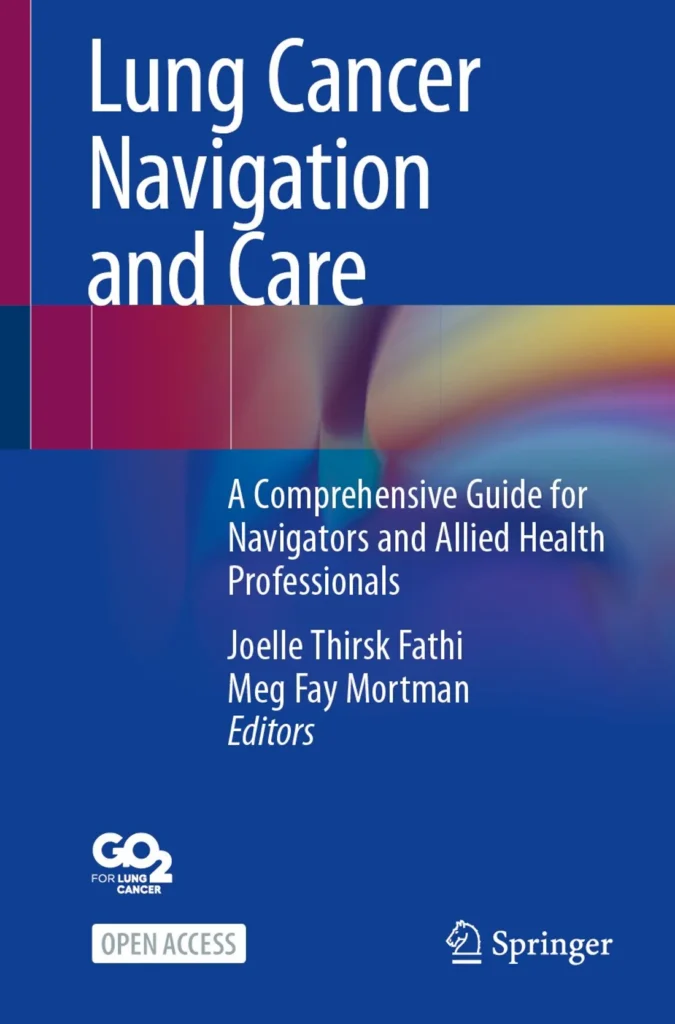
Not rated yetRate this bookLung Cancer Navigation and Care, edited by Joelle Thirsk Fathi and Meg Fay Mortman, follows the care continuum from prevention and early detection through diagnosis, treatment, supportive care, and survivorship. Twenty-two chapters connect clinical foundations with communication, coordination, equity, and advocacy. This guide summarizes their educational purpose and uses fictional navigation tasks; it does not select a treatment, interpret an individual’s tests, or replace current professional guidance.
Free reading is available at the official source. Opens in a new tab.
 Free
About this book
Lung Cancer Navigation and Care, edited by Joelle Thirsk Fathi and Meg Fay Mortman, follows the care continuum from prevention and early detection through diagnosis, treatment, supportive care, and survivorship. Twenty-two chapters connect clinical foundations with communication, coordination, equity, and advocacy. This guide summarizes their educational purpose and uses fictional navigation tasks; it does not select a treatment, interpret an individual’s tests, or replace current professional guidance.
Chapter-wise summaries and study tasks
1: The Stigma of Lung Cancer
Lung-cancer stigma can affect communication, support, and the experience of seeking or receiving care. The chapter examines blame-related assumptions and ways professionals can recognize and respond to them. A person’s exposure history does not reduce their claim to respectful care. Readers should distinguish asking clinically relevant questions from implying moral responsibility for disease. Language, organizational practices, and public narratives can reinforce or reduce stigma. The navigation task is to notice barriers and support a person’s stated needs without assuming every patient has the same experience. Reflection should lead to a specific change in interaction rather than a general expression of sympathy.
Study task. Revise a fictional intake conversation to remove blame while preserving relevant information. Identify an organizational practice that could discourage disclosure and a way to invite feedback without pressuring the person.
2: Advocacy for People at Risk or Living with Lung Cancer and Their Caregivers Across the Care Continuum
Advocacy connects the concerns of people at risk, those living with cancer, and caregivers with decisions across the continuum. The chapter distinguishes individual voice from broader collective efforts and considers how navigators can help people participate. Support involves clarifying options, questions, preferences, and barriers rather than speaking over someone in the name of helping. A caregiver’s needs may overlap with but not replace the patient’s choices. Readers should identify who has authority to decide and what information or access is missing. Advocacy becomes concrete when a concern reaches an accountable person or process and the response is followed through.
Study task. Create a fictional advocacy plan with the person’s goal, unanswered question, appropriate contact, and follow-up. Explain how consent and differing patient-caregiver preferences would be respected.
3: Navigation in Lung Cancer Prevention, Detection, and Care
Navigation addresses obstacles and handoffs across prevention, detection, and care. The chapter traces its development and connects individual support with community outreach and program design. Scheduling an appointment is only one part of a pathway that may involve transport, cost, language, information, and trust. Readers should distinguish a referral placed from a referral completed and communicated back. A navigator’s scope and role within the team should be explicit. A reliable process records responsibility and unresolved needs rather than assuming another service has taken over. Evaluation should examine access and continuity, not only the number of contacts made.
Study task. Map a fictional referral pathway with handoffs, barriers, owners, and confirmation points. Identify how the system would detect a missed follow-up without relying on the person to coordinate every service alone.
4: Multi-, Interdisciplinary, and Patient-Centric Team-Based Lung Cancer Care
Team-based care connects multiple professional contributions around the patient’s situation and priorities. The chapter distinguishes multidisciplinary participation from more integrated interdisciplinary work. Several appointments do not automatically create a coordinated plan. Readers should examine how information, decisions, and responsibilities are shared and how the person understands the result. Conflicting messages can arise even when each specialist acts competently within a narrow task. Navigation can help identify gaps and route questions, while treatment decisions remain with the relevant qualified professionals and the patient. A team process should make disagreement and follow-up visible rather than conceal them behind a list of names.
Study task. Design a fictional team handover showing the clinical question, relevant information, decision owner, patient concern, and next contact. Explain how conflicting instructions would be clarified within the appropriate roles.
5: Determinants of Lung Cancer, Disease Development, and Risk Assessment
Risk and disease development connect biological processes with exposures and wider determinants. The chapter considers carcinogenesis, risk factors, prevention, and assessment. A risk factor changes probability and does not establish the cause of one person’s disease. Screening eligibility, diagnostic evaluation, and a broad concern about risk are different questions. Readers should avoid reducing risk to one exposure or treating a model output as certainty. Social conditions can affect both exposure and access to evaluation. The educational aim is accurate, nonjudgmental communication and appropriate referral, with current criteria checked rather than copied indefinitely from a source example.
Study task. Explain risk versus diagnosis using a fictional example. List the information and current professional sources needed for an eligibility or assessment question without calculating a personal recommendation.
6: Critical Role of Genomics for Directed Therapeutic Management of Lung Cancer
Genomics provides information about molecular changes relevant to understanding disease and potential management. The chapter connects genomics, proteomics, analytic approaches, and therapeutic interpretation. Tumor testing and inherited-risk testing answer different questions, even when both concern genes. A result’s usefulness depends on specimen, method, interpretation, and the clinical setting. Readers should distinguish finding a variant from establishing that a particular therapy is appropriate. Navigation supports completion, communication, and access while routing interpretation to the treating team. A missing or delayed result is a process concern that should be tracked rather than silently treated as negative.
Study task. Build a fictional testing tracker with specimen, requested analysis, responsible team, status, and communication. Explain the difference between tumor profiling and inherited testing and identify a question requiring specialist interpretation.
7: Essential Components for the Development of an Early Lung Cancer Detection Program
An early-detection program requires an organized system, not simply access to a scanner. The chapter examines operational and clinical components, requirements, yield, and quality. Recruitment, eligibility review, shared decisions, imaging, results, follow-up, and links to further care must work together. A program can generate scans while failing people who need additional evaluation. Readers should distinguish a clinical recommendation from coverage or administrative conditions and verify each through current sources. Tracking should preserve responsibility and identify inequitable access. The program’s performance should be assessed through meaningful completion and quality measures rather than participation volume alone.
Study task. Outline a fictional detection-program pathway from outreach to closed-loop follow-up. Identify a clinical, administrative, and equity checkpoint and explain how a delayed result would become visible to an accountable team.
8: Imaging for Screening, Diagnosis, and Staging of Lung Cancer
Imaging serves different purposes in screening, diagnosis, and staging. The chapter compares how studies contribute to these questions and how findings enter a wider evaluation. An imaging abnormality is not automatically a confirmed cancer diagnosis, while a staging question concerns extent rather than merely detection. Readers should distinguish the purpose of an examination, the information it can provide, and its limitations. Navigation involves explaining the process at an appropriate level and ensuring orders, results, and follow-up reach the right people. Interpretation and selection of imaging belong to the qualified clinical team using current guidance.
Study task. Compare three fictional imaging requests by purpose rather than choosing a test. Identify the result, interpretation, and handoff information needed to prevent a screening finding from being mistaken for a final diagnosis.
9: Lung Cancer Screening and Early Detection
Screening and early detection connect evidence of benefit and harm with implementation and access. The chapter examines guidelines, models, disparities, and barriers. Screening generally addresses people without the symptom-driven diagnostic question, so it should not be used as a substitute for appropriate evaluation of symptoms. Eligibility and coverage are not always identical, and recommendations can change. Readers should explain uncertainty, possible follow-up, and the importance of informed choice without promising that screening prevents every death or eliminates risk. A navigation plan should consider who is not reached and why, as well as whether an invitation was sent.
Study task. Draft a fictional screening-discussion checklist covering purpose, informed choice, current criteria, possible downstream steps, and access barriers. Identify the distinction between screening and diagnostic evaluation.
10: Tobacco Dependence Treatment and Lung Cancer Control
Tobacco-dependence treatment is presented as supportive care rather than a test of deservingness. The chapter connects counseling, medication-related care, integration with detection services, and barriers at patient, clinician, and system levels. Dependence is not adequately addressed by repeating a warning. Readers should recognize an opportunity for a respectful referral and continued support while leaving treatment selection to the appropriate professionals. A person’s readiness or previous attempt should inform communication without closing access. Program integration requires ownership and follow-up, not merely recording that advice was given. The source’s clinical details must be checked against current guidance before practice.
Study task. Prepare a nonjudgmental fictional referral conversation and follow-up plan. Separate education, assessment, and treatment decisions and identify a system barrier that could prevent access even when a person wants support.
11: Clinical Manifestations and Presentations of Lung Cancer
Clinical presentations can arise from local disease, spread, or broader systemic effects. The chapter organizes intrathoracic, extrathoracic, and paraneoplastic manifestations. Symptoms can overlap with many conditions, so recognizing a possible concern is not the same as diagnosing its cause. Readers should avoid using a symptom list to confirm or exclude cancer independently. Navigation requires recording the reported concern, relevant context, and the pathway for timely clinical assessment within local procedures. Changes in function and distress also matter to communication. A careful account preserves uncertainty rather than translating a vague report into an unsupported clinical label.
Study task. Organize an invented symptom report into what was stated, relevant context, missing information, and the appropriate clinical contact. Explain why a list of possible presentations cannot determine the diagnosis.
12: Classification and Staging of Lung Cancer
Classification and staging organize information about type and extent of disease. The chapter connects histology, diagnostic evaluation, anatomical staging, nodes, small-cell frameworks, and molecular studies. These categories answer related but different questions and are not interchangeable labels. Clinical and pathological information may be obtained at different points. Readers should record the system and version used and distinguish a provisional result from an established assessment. Staging informs care discussions but does not replace the full clinical and personal context. The navigator supports clarity and completeness while the treating team determines and communicates interpretation.
Study task. Create a fictional record template separating histology, staging information, molecular testing, source, date, and responsible clinician. Identify an inconsistency to clarify rather than resolve it by guessing.
13: Surgical Interventions and Care for Lung Cancer Control
Surgical care involves evaluating the disease, the person’s functional situation, the proposed procedure, and recovery needs. The chapter discusses resectability, appropriateness, preoperative work, resection types, and postoperative care. A technically removable tumor and an appropriate operation for an individual are different judgments. Navigation supports preparation, communication, practical needs, and continuity rather than independently selecting an operation. Readers should distinguish the purpose of preoperative information from a guarantee of outcome. Recovery planning connects the hospital episode with home circumstances and follow-up. The educational task is to understand dependencies and questions, not reproduce operative or patient-specific instructions.
Study task. Map a fictional surgical-care pathway with decision owners, information needs, preparation, discharge support, and follow-up. Identify a practical barrier that could affect recovery despite a completed operation.
14: Biomarker-Directed Precision Medicine for Lung Cancer Control
Biomarker-directed precision medicine links relevant tumor findings with clinical options. The chapter compares strategic testing considerations, tissue and blood-based specimens, and test approaches. Different specimens and methods have different strengths and limitations; a negative or incomplete result requires contextual interpretation. A detected alteration does not automatically determine treatment in every disease stage or situation. Readers should distinguish the technical result, evidence of relevance, and the actual care decision. Navigation can help prevent delays, support access, and ensure that questions reach the appropriate specialists. Current professional recommendations and approvals are essential because this field changes.
Study task. Compare fictional tissue and liquid-biopsy process records by adequacy, turnaround, and unanswered questions. Explain which interpretation must be referred to the clinical team and how an incomplete result would be tracked.
15: Biology and Treatment Options for Non-small Cell Lung Cancer
Non-small-cell lung cancer management connects biology, symptoms, workup, stage, and molecular information with treatment options. The chapter provides a framework for understanding why people with the same broad diagnosis may receive different plans. Local and systemic approaches have different roles and may be combined under specific circumstances. Readers should distinguish treatment intent from treatment modality and avoid generalizing one vignette to every person. Navigation supports an understandable plan, coordinated appointments, practical resources, and communication of concerns. It does not replace specialist assessment or shared decision-making. Current guidance is necessary before applying a treatment detail from the text.
Study task. Write a fictional care-plan summary that identifies intent, responsible team, required results, practical support, and unanswered questions without selecting therapy. Explain why histology alone does not determine the whole plan.
16: Biology and Treatment Options for Small Cell Lung Cancer and Other Lung Neuroendocrine Neoplasm
Small-cell and other thoracic neuroendocrine malignancies require attention to their own pathology and behavior. The chapter examines presentation, staging, therapeutic approaches, and related categories. These diseases should not be treated as simply another name for non-small-cell cancer or as one uniform neuroendocrine group. Readers should identify what has actually been confirmed and how the clinical team explains the classification. Navigation helps coordinate the relevant evaluation and support while preserving urgency without making unsupported promises. The source provides educational context; current disease-specific guidance and the individual situation determine practical recommendations.
Study task. Compare two fictional diagnostic summaries by confirmed category, staging framework, and missing information. Identify where a referral or clarification is needed rather than borrowing a plan from a different lung-cancer type.
17: Clinical Trials in Lung Cancer
Clinical trials connect research questions with participant eligibility, consent, procedures, and ongoing responsibilities. The chapter explains trial development, the enrollment journey, communication, and equity-related concerns. A trial is not a guaranteed benefit, and choosing to participate should not be confused with losing the right to ask questions or decline. Readers should distinguish a study phase from the stage of a person’s cancer. Navigation can help identify appropriate discussion routes and practical barriers without promising eligibility or replacing research-team consent. Costs, travel, time, and caregiver needs can influence access as much as awareness.
Study task. Prepare a fictional trial-discussion question list covering purpose, alternatives, uncertainty, procedures, burdens, costs, and withdrawal. Identify one access barrier and who can provide authoritative study-specific information.
18: Evaluation and Management of Lung Cancer and Treatment-Related Side Effects and Symptoms
Symptoms and treatment-related effects require structured assessment and timely communication. The chapter connects history, presentation, diagnostic considerations, tissue information, and management across a broad care pathway. A new symptom may have several causes, including disease, treatment, another condition, or their interaction. Readers should not label every change as an expected effect or infer severity from one description alone. Navigation depends on clear documentation, the team’s escalation processes, and confirmation that a concern has been received. The study focus is recognition of information and coordination needs rather than independent prescribing or a substitute triage protocol.
Study task. Use an invented concern to document onset, change, context, functional effect, and responsible clinical contact. Explain how closed-loop communication differs from leaving a message and assuming the matter is resolved.
19: Supportive, Palliative, and Hospice Care
Supportive, palliative, and hospice care address needs and goals through different but related frameworks. Palliative support can accompany disease-directed treatment and should not be equated automatically with giving up. Hospice has a particular care context and eligibility arrangements that require current local information. The chapter emphasizes assessment, reassessment, and team involvement. Readers should consider physical symptoms, psychological distress, social needs, caregiver concerns, and the person’s priorities. Navigation supports access and communication rather than deciding goals on someone’s behalf. A plan should be revisited as circumstances change and information becomes clearer.
Study task. Compare a fictional need for supportive or palliative services with a question about hospice, identifying appropriate referral and clarification. Show how goals, consent, caregiver needs, and reassessment remain visible.
20: Best Practice Standards and Models of Care for High-Quality Survivorship
Survivorship concerns continuing physical, psychological, social, and care-coordination needs. The chapter examines standards, models, plans, follow-up, surveillance, and health promotion. A completed treatment episode does not mean all effects or uncertainties have ended. Surveillance decisions differ from general well-being support, and responsibilities can become unclear when care is shared among teams. Readers should distinguish a plan given to a person from a plan understood and implemented. Navigation helps identify late or ongoing concerns, practical barriers, and who will respond. Specific schedules and recommendations must come from the current treating framework.
Study task. Build a fictional survivorship handover with treatment summary, concerns, responsible contacts, planned follow-up sources, and communication needs. Identify how the system would detect a missed appointment or unresolved question.
21: Integrative, Complementary, and Alternative Therapies in Lung Cancer Care
Integrative, complementary, and alternative approaches require careful distinctions and evidence assessment. An intervention used alongside conventional care is different from one promoted as a replacement. The chapter examines potential supportive roles as well as harm from unsupported alternatives. Natural or familiar does not automatically mean effective, safe, or free of interactions. Readers should encourage open, nonjudgmental disclosure and route questions about products or practices to the relevant clinical professionals. A navigation conversation should protect informed choice without presenting an unproven cancer treatment as an equivalent option. Evidence, goals, and risks must be assessed for the specific intervention.
Study task. Analyze a fictional promotional claim by evidence, intended outcome, replacement-versus-complementary role, and possible interaction questions. Draft a respectful disclosure prompt and identify the professional review needed before use.
22: Policy and Advocacy in Lung Cancer
Policy advocacy connects individual barriers with institutional and public decisions. The chapter examines policy, a changing environment, and ways professionals and communities can participate. A repeated access problem may require more than repeated individual workarounds. Readers should identify which decision maker can change the mechanism and what evidence supports the proposed response. Advocacy should represent affected people’s priorities and preserve privacy rather than treat one story as permission to disclose everything. Evaluation asks whether the change improves access, quality, or equity in practice. The source’s policy examples must be updated before being described as current arrangements.
Study task. Turn a fictional recurring navigation barrier into a policy brief with evidence, affected groups, decision authority, proposal, and evaluation. Explain how personal accounts would be used with consent and appropriate privacy.
How to study this book
- Follow one fictional pathway across the twenty-two chapters, tracking questions, barriers, handoffs, responsible roles, and confirmation of completion. Keep clinical interpretation distinct from coordination.
- Read the source vignettes and references before applying a concept to a simulation. Check current professional, institutional, and jurisdictional guidance for screening, staging, treatment, and coverage details.
- Use authoritative update resources such as the NCI explanation of biomarker testing to clarify concepts; individual decisions remain with the person and qualified care team.
Questions for reflection
- Which handoff could leave an important result or concern without an owner?
- How can a process appear complete while the person still lacks access or understanding?
- What information must be interpreted by the clinical team rather than inferred by a navigator?
Source edition and coverage
This guide follows all twenty-two chapters of the publisher-linked open-access book, credited to editors Joelle Thirsk Fathi and Meg Fay Mortman and carrying a 2026 copyright. It provides original educational summaries and fictional navigation tasks, not a patient-specific care plan or a substitute for current clinical protocols. This guide provides original explanations and learning tasks. Read the complete book at the publisher’s official source.
About access & copyright
This page provides book information and study material. Full-text access is provided by the original publisher or authorised source; a listing does not grant permission to republish the book.
Read our Library Access & Copyright policyExplore the contents
Check the chapters covered in this edition.
Visit the official source
See reading, preview or purchase options.
Save for later
Keep this textbook in your saved collection.
Reader ratings & reviews
Share your thoughts
Your review helps other students choose the right resources.
KEEP LEARNING
Your next great read
Nursing Nursing
Medical-Surgical Nursing
View Medical-Surgical Nursing — book Nursing
Community and Public Health Nursing: A Call to Action
View Community and Public Health Nursing: A Call to Action — book Nursing
Strategies for Success in Nursing School From Start to Finish
View Strategies for Success in Nursing School From Start to Finish — book Nursing
 Advanced Skills
View Nursing Advanced Skills — book Nursing
The Complete Subjective Health Assessment
View The Complete Subjective Health Assessment — book Nursing
Interpreting Canada's 2019 Food Guide and Food Labelling for Health Professionals
View Interpreting Canada's 2019 Food Guide and Food Labelling for Health Professionals — book Nursing
Vaccine Practice for Health Professionals
View Vaccine Practice for Health Professionals — book Nursing
Leadership and Influencing Change in Nursing
View Leadership and Influencing Change in Nursing — book Nursing



