
 Biotechnology
Textbook
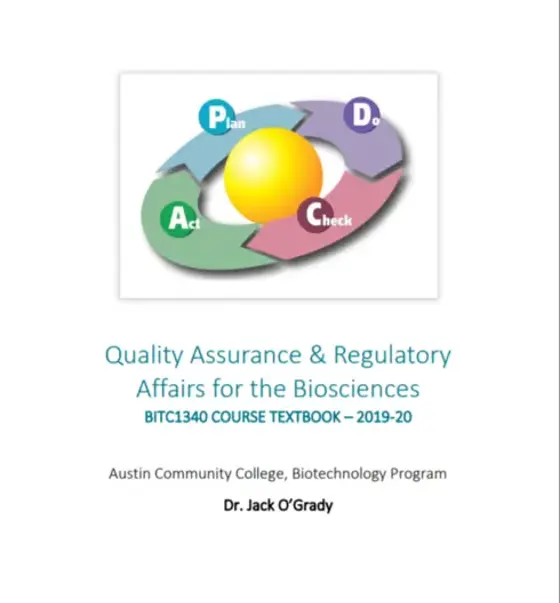
Quality Assurance and Regulatory Affairs for the Biosciences
Not rated yetRate this bookConnect biotechnology production with quality systems and regulatory reasoning in Jack O’Grady’s biosciences textbook. Ten chapters move from quality principles to product categories and enforcement. This page adds conceptual chapter guides and original documentation tasks, preserving the US and historical context of the source.
Read on the publisher’s website. Opens in a new tab.
 Free
About this book
Quality Assurance and Regulatory Affairs for the Biosciences by Jack O’Grady introduces the organizational and regulatory context in which biological products are developed. The LibreTexts version connects basic biotechnology with company-wide quality responsibilities before examining systems, practices and product oversight.
Its ten main chapters include quality principles, management systems, the FDA, GXP frameworks and the development or regulation of drugs, biologics, devices, foods and other products. Enforcement closes the sequence, linking quality claims with monitoring and accountability. This makes the resource useful for learning terminology and the relationships among evidence, records, responsibilities and review.
The guide below is based on reviewed chapter-opening sections and verified contents. Its tasks are fictional or conceptual exercises, not compliance instructions. Agency structures, legal requirements and product pathways described in an older text must be distinguished from the current requirements applicable to a particular product and jurisdiction.
AI-assisted book summary
Reading guide
Begin with the difference between a desired product characteristic and a system that consistently supports it. Track responsibilities, procedures and records as related but distinct elements.
For the regulatory chapters, build a comparison by product category, intended use, evidence question and authority described in the source. Keep laws, regulations, standards and guidance distinct. This page summarizes the textbook’s framework and historical context; a current product decision requires current authoritative documents rather than extrapolation from a chapter overview.
Chapter overviews and study tasks
The overviews describe the introductory material identified in the coverage note. Study tasks and reflection questions are original Academic Master editorial guidance, separate from the source’s exercises.
1: Introduction to Biotechnology and Quality Assurance
Biotechnology is introduced through the use of biological systems for practical purposes, with familiar historical products providing context for modern applications. The chapter links this subject with company organization and quality. Its learning value is to establish that a successful biological product involves coordinated responsibilities, rather than a discovery or laboratory method in isolation.
Study task Map the departments contributing to a hypothetical bioscience product and their quality responsibilities.
2: Introduction to Quality Principles
The history of quality begins with relationships between producers and consumers, then considers how growing trade changed feedback and accountability. Shared specifications and standards become more important when a buyer cannot rely on personal contact with the maker. The chapter’s later topics extend this framework to inspection, validation and responses to nonconformance.
Study task Write a measurable product requirement and distinguish it from a general claim of excellence.
3: Quality Management Systems
The reviewed introduction defines a quality system through structure, responsibilities, procedures, processes and resources. It distinguishes different organizational settings and different reasons for adopting a system. The central connection is between a stated intention, evidence that work followed it and a process for improvement, rather than documentation as an end in itself.
Study task Create a simple quality-system map linking responsibility, procedure, record and improvement action.
4: The Food and Drug Administration
This chapter introduces consumer protection through the historical development of product regulation. It places the FDA within a changing institutional and legal setting. The guide uses this as context for understanding why regulated products need evidence and accountability; it does not repeat the source’s historical legal statements as a current compliance determination.
Study task Separate a law, a regulation and an agency guidance document in a study glossary.
5: Good Guidance Practices (GXPs)
The reviewed GLP discussion distinguishes nonclinical study quality from human clinical research. The chapter’s wider sequence separates laboratory, clinical, manufacturing and documentation practices rather than treating GXP as one interchangeable label. The useful study question is which activity a framework addresses and what records support confidence in that activity.
Study task Compare the purposes of GLP, GCP, manufacturing and documentation practices without assuming identical scope.
6: The Drug Approval Process
The opening establishes terminology before discussing pharmaceutical development and review. It distinguishes categories such as a new drug, a generic product and a biological product, helping readers understand why different evidence or review discussions arise. Read the chapter as an account of the source’s US framework, with current requirements requiring separate authoritative verification.
Study task Draw a conceptual development-and-review timeline and label the purpose of each evidence stage.
7: The Regulation of Biologics
Biologics are introduced through their range of biological materials and therapeutic or preventive purposes. The historical discussion explains why product categories and oversight can overlap. The chapter encourages separating the nature of a product from the regulatory pathway described for it, rather than assuming that a familiar name alone determines all requirements.
Study task Compare two hypothetical biological products by their intended use and evidence questions.
8: Medical Device and Combination Products
The opening introduces the diversity of medical devices and explains why classification and intended function matter to regulatory discussion. Combination products add another layer because several product roles may be joined. The guide stays at the conceptual level and preserves the US context of the source rather than prescribing a submission route.
Study task Write an intended-use statement for a fictional product and identify unanswered classification questions.
9: Regulation of Food and Other Products
This chapter broadens the account to food, agricultural biotechnology, veterinary products and cosmetics. The reviewed food-safety opening emphasizes that responsibilities are divided among institutions and product categories. Agency structures and requirements can change; the educational task is to trace the source’s distinctions and identify which authority must be checked for a current claim.
Study task Build a product-category comparison and mark the authority and date needed for each entry.
10: FDA Enforcement
The closing chapter connects regulation with monitoring, inspection, communication and enforcement. Its opening emphasizes the protection of consumers from problematic products and misleading presentation. For study, distinguish the evidence of a problem from the action taken in response and from the legal authority supporting it; these are related but separate questions.
Study task Analyze a fictional quality incident by separating observation, investigation, corrective response and regulatory questions.
How to study this book
Create a glossary distinguishing assurance, control, validation, inspection and audit. Use a fictional product to connect each quality claim with a record that could support it. Label regulatory notes by jurisdiction and source date, and mark facts that would need a current check before practical use.
Reflection questions
- Why is a quality system more than a set of inspection results?
- How does intended use influence the questions asked about a product?
- Why must a historical regulatory example be distinguished from a current requirement?
Sources and coverage
Consulted 18 November 2026: the official LibreTexts version of Quality Assurance and Regulatory Affairs for the Biosciences and its linked full-book PDF. Verified contents and the introductory text of sections 1.1–10.1. Detailed legal provisions and present-day requirements were not independently validated; this guide describes the source and is not a current compliance manual. PDF compilation dates have not been used as edition publication years. Consult the original text for the complete explanations and resources.
About access & copyright
This page provides book information and study material. Full-text access is provided by the original publisher or authorised source; a listing does not grant permission to republish the book.
Read our Library Access & Copyright policyQuality organization
Connect responsibilities, procedures and evidence.
Product distinctions
Compare regulatory questions without assuming identical pathways.
Documentation reasoning
Separate records, interpretations and corrective actions.
Reader ratings & reviews
Share your thoughts
Your review helps other students choose the right resources.
KEEP LEARNING
Your next great read
Biotechnology Geosciences
An Introduction To Geology
View An Introduction To Geology — book Geosciences
Physical Geology (Sierra College Edition)
View Physical Geology (Sierra College Edition) — book Geosciences
Introduction to Oceanography (Sierra College Edition)
View Introduction to Oceanography (Sierra College Edition) — book Geosciences
Physical Geography: our Beautiful World
View Physical Geography: our Beautiful World — book Communication
Professional Communications Foundations
View Professional Communications Foundations — book Statistics
PSY 190: Statistics for the Behavioral Sciences
View PSY 190: Statistics for the Behavioral Sciences — book Statistics
Applied Statistics for Social Science
View Applied Statistics for Social Science — book Social Sciences
Persuasion
View Persuasion — book Social Sciences



