
 Social Sciences
Textbook
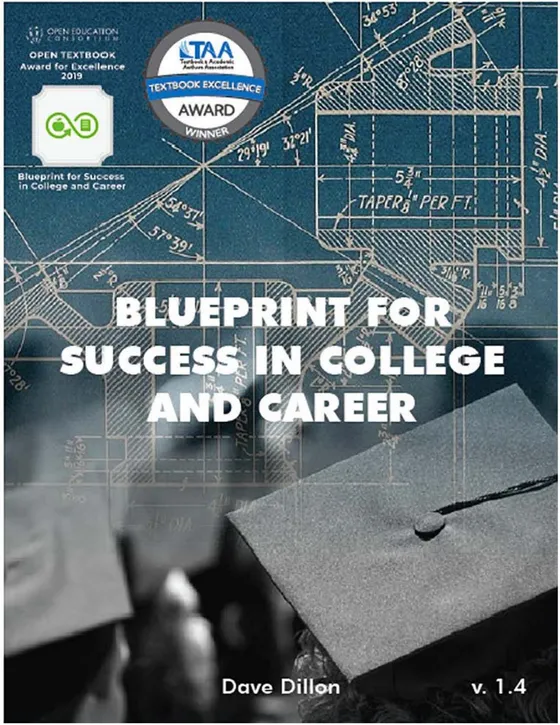
COUN 7: Blueprint for Success in College and Career
Not rated yetRate this bookExplore ten college-success units on study habits, career exploration, participation and resources. Original tasks support realistic planning and reflection while keeping personal stories in context.
Read on the publisher’s website. Opens in a new tab.
 Free
About this book
COUN 7: Blueprint for Success in College and Career is the Solano Community College course collection based on Dave Dillon’s college-success resource. Ten units connect the transition to college with time management, reading, note-taking, memory and testing. Career exploration, social participation, health and financial resources broaden the discussion beyond isolated study techniques.
The collection combines explanatory material with contributor experiences and reflection activities. Individual stories can open a useful question without guaranteeing that the same path will work for another student. This guide adds original planning and review tasks that ask learners to test a manageable change and examine the result. Unit overviews reflect selected substantive openings and verified contents, not every personal account, exercise or linked resource. Course requirements, financial-aid details and health examples should be checked in the reader’s current institutional and personal setting rather than generalized from historical textbook examples.
AI-assisted book summary
Reading guide
Begin with purpose and college expectations. Build a weekly study routine using the middle units, then connect career and resource questions with that plan. Revisit choices after observing how they work.
Chapter and section guide
Unit 1: Launch
Launch connects motivation with the transition to college and unfamiliar expectations. The opening invites readers to examine what matters to them. Personal reasons for studying can guide questions without determining one correct educational path.
Study task: Write a learning-purpose statement and identify one college question to clarify.
Unit 2: Time, Tools, and Study Environment
Time, tools and environment connect planning with actual behavior and barriers. A schedule is a proposal to test rather than proof that enough study has occurred. Compare the intended routine with what is feasible.
Study task: Draft a realistic fictional week and identify one commitment requiring adjustment.
Unit 3: College Level Critical Thinking and Reading
Critical thinking and reading connect evaluation with understanding a text. Strategies help readers distinguish the author’s claim from their own response. A close reading should retain evidence that could challenge an initial interpretation.
Study task: Annotate a short passage for claim, support and an unanswered question.
Unit 4: Listening and Note-Taking
Listening and note-taking require selecting important information rather than transcribing everything. Spoken words and other contextual cues can affect interpretation. Notes should make the relationship among ideas recoverable afterward.
Study task: Turn a short fictional explanation into structured notes and a clarifying question.
Unit 5: Memory Principles and Techniques
Memory principles introduce a model for considering how information is retained. A model organizes questions but does not describe every detail of cognition. Use practice results to evaluate a strategy instead of assuming recognition equals durable learning.
Study task: Design a delayed self-check for a small set of course concepts.
Unit 6: Test-Taking Strategies
Testing strategies span preparation, the assessment itself and review afterward. Preparation begins with learning rather than a final-night routine alone. An error can reveal a gap in content, interpretation or preparation.
Study task: Classify three fictional test errors and plan a different review response for each.
Unit 7: Career Exploration
Career exploration combines personal accounts with documents, interviews, majors and professional development. Exploration requires information about roles as well as reflection on interests. No single story establishes a guaranteed employment outcome.
Study task: Compare two possible career questions and identify a reliable source for each.
Unit 8: Social Interaction and Diversity
Social interaction and diversity connect participation with interdependence and accessibility. Learning can involve giving and receiving support. Respectful collaboration asks about people’s needs rather than assigns them through assumptions.
Study task: Plan a fictional group task with clear roles and an accessible way to participate.
Unit 9: Health
Health connects student life with topics such as food, activity, sleep and stress. These are educational themes rather than an individualized care plan. Keep a learning question separate from a diagnosis or a promise about an outcome.
Study task: Identify one campus-support question and the appropriate current service to consult.
Unit 10: Finances and Resources
Finances and resources combine personal experience with expenses, scholarships and institutional support. A past example does not determine present eligibility or cost. Compare information needs before making a practical decision.
Study task: Build a fictional expense checklist and mark which figures require current verification.
How to study this book
Choose one small learning goal, plan an action, record what happened and revise. Separate a contributor’s experience from your circumstances. Use current institutional sources for requirements, services and financial-aid information.
Reflection questions
- What manageable action supports the goal?
- How will you know whether the change helped?
- Which detail needs checking with the current institution?
Sources and coverage
Original source and online reader. This original guide is based on the verified source structure and the selected material described below. Study tasks are original additions, not exercises or answers attributed to the source.
Coverage uses verified unit contents and selected substantive openings, not every contributor story, exercise or support link. Financial-aid rules, institutional services and health claims were not independently updated; no individualized financial or clinical plan is supplied.
About access & copyright
This page provides book information and study material. Full-text access is provided by the original publisher or authorised source; a listing does not grant permission to republish the book.
Read our Library Access & Copyright policyPractice
Learning strategies can be tested and revised.
Connection
Academic, career and resource decisions interact.
Context
A personal story is not a universal prescription.
Reader ratings & reviews
Share your thoughts
Your review helps other students choose the right resources.
KEEP LEARNING
Your next great read
Social SciencesANTHRO 130: Intro to Cultural Anthropology
ANTHRO 130: Intro to Cultural Anthropology
View ANTHRO 130: Intro to Cultural Anthropology — bookCOMS 120: Small Group Communication
COMS 120: Small Group Communication
View COMS 120: Small Group Communication — bookCollege Success
College Success
View College Success — bookCOMS 105: Fundamentals of Public Speaking
COMS 105: Fundamentals of Public Speaking
View COMS 105: Fundamentals of Public Speaking — bookResearch Methods in Psychology
Research Methods in Psychology
View Research Methods in Psychology — bookPrinciples of Psychology for Life 1e
Principles of Psychology for Life 1e
View Principles of Psychology for Life 1e — bookAbnormal Psychology: An Introduction
Abnormal Psychology: An Introduction
View Abnormal Psychology: An Introduction — book Social Sciences
Psychology 2e
View Psychology 2e — book Business



