
 English Literature
Plays
King Richard III
William Shakespeare; complete source text.
Not rated yetRate this bookRichard III begins with a speaker who tells the audience about his intentions before concealing them from other characters. Shakespeare’s history play offers a forceful opening for studying persuasion, dramatic irony, political fear, and the performance of personal identity.
 Free
About this book
Richard, Duke of Gloucester, introduces himself during an apparent transition from war to peace. His public interactions then give readers an immediate opportunity to compare what he says privately with what he tells others. The scene is useful for close reading because its political action depends on differing levels of knowledge: Richard, his listeners, and the audience do not understand events in the same way. His language about his body is part of his self-presentation and should not be treated as evidence that disability causes moral wrongdoing. Historical claims made by the play require separate historical evaluation.
This page follows Project Gutenberg eBook #1503, first released in 1998, which supplied the text reformatted in the existing hosted PDF. The date describes the electronic edition, not the work’s original publication. The recorded 143 pages refer to that formatted PDF. Course evidence concerns the work and may prescribe a different edition.
Youngstown State University’s Fall 2026 ENGL 4881 syllabus lists this play.
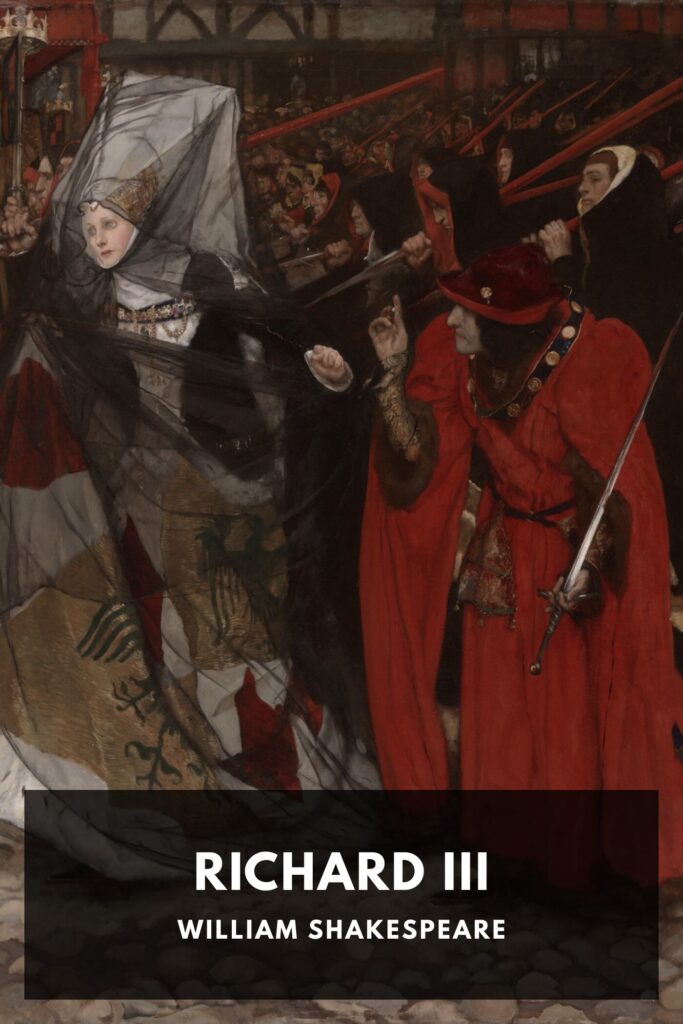
Cover image: Standard Ebooks edition. The hosted PDF remains the edition described above.
Source licence: Full Project Gutenberg License. Required source notices and licence terms are retained in the downloadable files.
Book summary
Study overview of the reviewed opening
Richard describes a world turning from military conflict towards celebration, then portrays himself as excluded from its pleasures. He uses that account to introduce his decision to pursue harmful schemes. The audience is therefore invited into a confidential relationship with a speaker who is also shaping the terms in which his motives will be understood.
Clarence’s arrival shows the practical consequences of political suspicion. He explains his imprisonment through an interpretation of a prophecy involving the letter G. Richard responds as an apparently sympathetic brother and directs attention towards other people at court. Because the audience has already heard his private declaration, this exchange produces a gap between reassurance and intention.
After Clarence leaves, Richard’s words expose the contradiction in his promised help. Hastings’s arrival then extends the atmosphere of imprisonment, uncertain favour, and competing explanations. The reviewed opening demonstrates how manipulation can work through selective information and a performed alliance. It does not provide an overview of Richard’s subsequent career or the play’s ending.
Independent study suggestions
Academic Master editorial guidance: Create a chart with separate columns for what Richard tells the audience, what he tells Clarence, and what Clarence appears to believe. Distinguish a self-description from an independently established fact. Perform a brief exchange twice, with Richard’s friendliness appearing sincere in one version and visibly calculated in the other. Explain how each choice changes the audience’s relationship to the scene.
For an essay, begin with a question about a specific passage, make a provisional claim, and test it against details that might complicate it. Cite the text and any commentary separately. Performance choices and thematic interpretations suggested here are starting points for your own analysis, rather than statements supplied by the author.
Discussion questions
- How does an opening confidence affect the audience’s role?
- What information allows the audience to recognise dramatic irony?
- How should a reader evaluate Richard’s explanation of his own behaviour?
Contents and reading sequence
Read the work in its source order. The contents link below opens the identified source edition; the study overview above covers only the passages stated in the coverage note.
Sources and coverage
Approximately the first 1,100 words of Act I, scene I, plus edition-identifying front matter and the act structure. The source text matches the imported original used for the hosted PDF. This is selected-passage coverage, not a whole-work or act-by-act review. Opening events are discussed; later plot outcomes are not summarised.
About access & copyright
Check this edition’s source and licence before reusing its files or content. A library listing does not grant additional rights.
Read our Library Access & Copyright policyDramatic irony
Track knowledge withheld from other characters.
Self-presentation
Read Richard’s explanation as a persuasive construction.
Political suspicion
Examine how ambiguous signs become accusations.
Performed alliance
Compare apparent support with concealed intention.
Reader ratings & reviews
Share your thoughts
Your review helps other students choose the right resources.
KEEP LEARNING
Your next great read
English Literature English Literature
Thomas Lord Cromwell
View Thomas Lord Cromwell — book English Literature
Sir John Oldcastle
View Sir John Oldcastle — book English Literature
The Merry Devil of Edmonton
View The Merry Devil of Edmonton — book English Literature
The Puritan Widow
View The Puritan Widow — book English Literature
The London Prodigal
View The London Prodigal — book English Literature
King Edward III
View King Edward III — book English Literature
Fair Em
View Fair Em — book English Literature
Arden of Feversham
View Arden of Feversham — book English Literature



