
 English Literature
Plays
King Henry VI, Part 2
Traditionally included among Shakespeare’s plays; collaborative authorship or later revision has been identified or proposed. Attribution should not imply sole authorship.
Not rated yetRate this bookKing Henry VI, Part 2 moves from a royal marriage settlement to the first major military confrontation between the rival dynastic factions. Gloucester's destruction, popular rebellion, and York's changing claims expose a government unable to reconcile public responsibility with private ambition. This guide covers all five acts and distinguishes the play's political representations from a verified historical chronology.
 Free
About this book
King Henry VI, Part 2 moves from a royal marriage settlement to the first major military confrontation between the rival dynastic factions. Gloucester's destruction, popular rebellion, and York's changing claims expose a government unable to reconcile public responsibility with private ambition. This guide covers all five acts and distinguishes the play's political representations from a verified historical chronology.
This page follows Project Gutenberg eBook #1501, first released in 1998, which supplied the text reformatted in the existing hosted PDF. The date describes the electronic edition, not the work’s original publication. The recorded 116 pages refer to that formatted PDF. Course evidence concerns the work and may prescribe a different edition.
The Spring 2013 HIST 482/ENGL 382 syllabus offers this play as a research-paper reading choice.
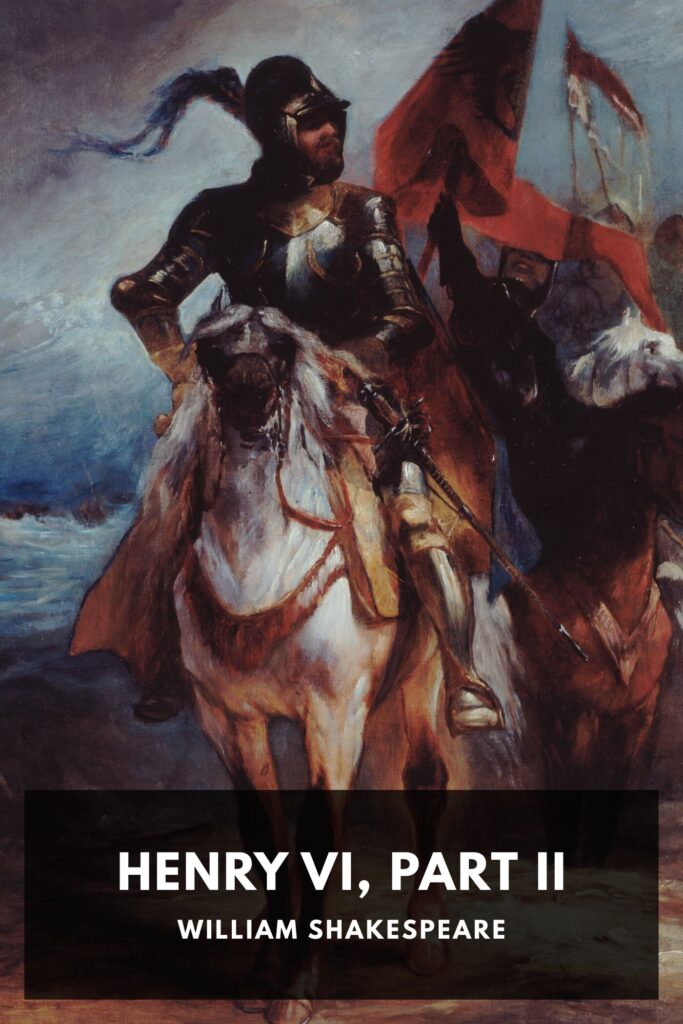
Cover image: Standard Ebooks edition. The hosted PDF remains the edition described above.
Source licence: Full Project Gutenberg License. Required source notices and licence terms are retained in the downloadable files.
Book summary
About this work
King Henry VI, Part 2 moves from a royal marriage settlement to the first major military confrontation between the rival dynastic factions. Gloucester's destruction, popular rebellion, and York's changing claims expose a government unable to reconcile public responsibility with private ambition. This guide covers all five acts and distinguishes the play's political representations from a verified historical chronology.
Act-by-act summaries
Act I — A marriage that divides the governing elite
Suffolk presents Margaret as Henry's bride under terms that surrender English claims to Anjou and Maine rather than supplying a dowry. Gloucester protests the settlement, while competing nobles interpret his authority as Protector through their own ambitions. His wife Eleanor imagines a royal future and becomes vulnerable to a staged encounter with practitioners of forbidden divination. Margaret resents the power exercised around her husband and develops a political partnership with Suffolk. York privately weighs his hereditary claim and looks for opportunities to advance it. The opening creates several different struggles over the same state: a dispute about French territory, rivalry over access to the king, an ambitious household's vulnerability, and the longer succession conflict. Neither marriage nor the king's piety establishes agreement about who should govern.
Act II — Exposure and punishment are unevenly distributed
At St Albans, Gloucester exposes Simpcox's fraudulent claim of restored sight, displaying practical skepticism that Henry does not independently supply. The combat between the armorer Horner and his apprentice Peter converts a treason accusation into an unstable public test, with drink and chance complicating the supposed revelation of truth. York explains his lineage to Salisbury and Warwick and obtains their support. Eleanor's involvement in conjuration brings disgrace and public penance, removing a source of power around Gloucester. He must watch his wife humiliated while recognizing the political vulnerability the case has created. Compare the various forms of judgment: exposing fraud, staging combat, enforcing penance, and privately endorsing a hereditary claim do not operate by the same standards of evidence or impartiality.
Act III — The destruction of Gloucester
Gloucester is arrested under accusations his opponents have assembled. Henry believes him loyal but lacks the capacity to protect him. Suffolk and allied interests move beyond removal toward murder, and Gloucester is killed before the planned proceedings can establish his guilt. Warwick interprets the body's condition as evidence of violent death, bringing physical observation into conflict with official explanations. Public anger forces Suffolk's banishment, while Margaret grieves the departure of a man whose relationship with her exceeds ordinary service. Cardinal Beaufort's deathbed distress gives Henry another scene of judgment he resists turning into a simple verdict of damnation. The act exposes both the danger of a ruler who cannot defend an innocent servant and the difficulty of assuming that every claim about hidden guilt is independently established.
Act IV — Popular grievance and its exploitation
Suffolk is captured at sea and killed, his rank proving unable to guarantee protection. Jack Cade leads a rebellion whose grievances mix material resentment with fantasies of status and attacks on literacy and legal institutions. York has encouraged the uprising as a test of political conditions, so popular action is connected to elite manipulation without becoming wholly identical to it. The rebels kill figures including Lord Say and threaten an order they regard as exploitative. Buckingham and Clifford persuade the crowd to return to royal allegiance, and Cade escapes alone. He later dies fighting Alexander Iden after entering his garden in hunger. The sequence moves from public insurgency to bodily need, showing how grand claims of entitlement end without food, allies, or institutional protection.
Act V — The claim becomes open war
York returns from Ireland with an army, presenting opposition to Somerset as the reason for his force. When the king's assurances fail to remove that grievance, York openly asserts his claim and gathers supporters. Henry attempts to maintain the language of lawful authority, but battle determines the immediate outcome at St Albans. Richard kills Somerset; York kills Clifford, whose son responds by embracing a more ruthless retaliatory purpose. The Yorkists win and pursue the king toward London. The ending therefore establishes neither a final deposition nor a lasting peace. It exposes how a dispute once conducted through counsel, petition, and concealed plans has become a military struggle in which family deaths will provide motives for further violence.
Law, piety, and the problem of effective government
Henry's reluctance to condemn others can express charity, but it does not necessarily protect them from people willing to act without such restraint. Gloucester's effectiveness in exposing a fraud similarly does not give him immunity from a political prosecution. Track these differences before equating moral intention with public success. The Cade scenes also require double attention: the rebels can identify real vulnerability within the social order while their punishments and attacks on knowledge create new forms of arbitrary power. York's role links their unrest to a succession strategy that will not deliver their imagined commonwealth. Across court and rebellion, the play asks who turns injury into authority and who actually benefits when judgment is enforced.
Study instructions
- Map the political interests of Gloucester, Eleanor, Suffolk, Margaret, Beaufort, and York at the beginning and after Gloucester's death.
- Compare the Simpcox episode, the trial by combat, and Warwick's reading of Gloucester's body as tests of evidence.
- Separate Henry's belief in Gloucester's innocence from the actions he is able to take.
- Annotate Cade's demands for both concrete grievance and fantasies of arbitrary command.
- Trace York's public explanations for having an army alongside his private declarations.
- Read the younger Clifford's response to his father's death as preparation for the next play, rather than a completed resolution.
Questions for reflection
- When does restraint become a failure to exercise necessary protection?
- How do literacy and law become symbols within the rebellion, and who can exploit those symbols?
- Why does the military victory leave the succession problem open?
Sources and coverage
This original study guide follows the complete work in the linked Project Gutenberg edition and includes the ending. Poem numbers and act divisions follow that source; thematic reading groups are editorial aids, not additional chapters of the original. Plot summary and interpretation are distinguished through the reading questions. Historical title-page attributions do not by themselves settle authorship. Read the source text; Edition details.
About access & copyright
Check this edition’s source and licence before reusing its files or content. A library listing does not grant additional rights.
Read our Library Access & Copyright policyCeremony and disagreement
Look beyond a collective public welcome.
Documents in drama
Examine how reading terms aloud creates conflict.
Political valuation
Compare the costs different speakers recognise.
Courtly perspectives
Distinguish royal satisfaction from other interests.
Reader ratings & reviews
Share your thoughts
Your review helps other students choose the right resources.
KEEP LEARNING
Your next great read
English Literature English Literature
Thomas Lord Cromwell
View Thomas Lord Cromwell — book English Literature
Sir John Oldcastle
View Sir John Oldcastle — book English Literature
The Merry Devil of Edmonton
View The Merry Devil of Edmonton — book English Literature
The Puritan Widow
View The Puritan Widow — book English Literature
The London Prodigal
View The London Prodigal — book English Literature
King Edward III
View King Edward III — book English Literature
Fair Em
View Fair Em — book English Literature
Arden of Feversham
View Arden of Feversham — book English Literature



