
Beginning Spanish ¡Empecemos por aquí!
HumanitiesTextbook
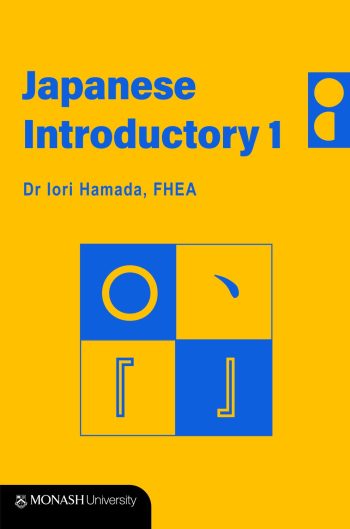
Japanese Introductory 1
Not rated yetRate this bookJapanese Introductory 1 is Iori Hamada’s beginning Japanese textbook, published by Monash University Library. Its opening introduces hiragana, the relationship among Japanese writing systems, and the value of combining written practice with the online edition’s audio and interactive material.
Read on the publisher’s website. Opens in a new tab.
 Free
About this book
The publisher lists a March 13, 2024 publication date, ebook ISBN 978-0-6457554-1-1, and DOI 10.60754/d0h4-3t80. The source includes English explanations alongside Japanese material. Although an older recommended citation on the website uses 2023, the publication field and title-page information identify 2024; this record follows those edition details.
The current PDF contains 533 sheets including preliminary pages. It explicitly omits some interactive and audio elements and directs readers to the online version. Readers studying pronunciation or practising with feedback should therefore use the official web edition as well as the downloadable text. The contents show a gradual course structure, while the overview here remains focused on the opening treatment of writing and reading.
Book summary
Study overview of the reviewed opening
Chapter 1 begins by positioning hiragana as a useful foundation for reading Japanese. The opening explains that modern written Japanese combines hiragana, katakana, and kanji, with different but overlapping functions. Learning the first script is therefore an entry into a broader writing system rather than a complete solution to reading every Japanese text.
The discussion relates hiragana to grammatical information and explains how kanji can help readers recognise meaning and boundaries within sentences. It also introduces the idea that pronunciation involves rhythmic units called morae. This connects character recognition with timing in speech, encouraging learners to attend to sound as well as visual shape.
The section does not require beginners to memorise the full script before continuing. Romanised support offers a bridge while students develop familiarity with the characters. At the same time, examples show why relying on a single representation can hide distinctions that matter in normal writing. The reviewed PDF points to audio on the official site; this overview describes that availability without claiming to have assessed the recordings or completed the interactive exercises.
Independent study suggestions
Academic Master editorial guidance: Keep a small practice record with separate columns for recognition, writing, and listening. For a few newly learned characters, check each skill independently rather than assuming that recognising a symbol means you can produce or pronounce it. Use the official audio alongside the written examples when available, and revisit difficult items after a delay. As you read further, note occasions when kanji or katakana clarifies meaning that an all-hiragana version would leave less obvious.
Discussion questions
- What different reading tasks are supported by hiragana, katakana, and kanji?
- Why should pronunciation practice include timing as well as individual sounds?
- When is romanisation helpful, and what might it conceal about normal Japanese writing?
Book contents and further reading
Use the official contents to choose a reading sequence and consult the original text before citing or applying a specific chapter.
Official contents in the publisher PDF
Sources and coverage
Title and licensing pages, contents, Introduction, and Chapter 1 sections 1.0–1.1 (printed pages 6–10). Online audio and interactive activities were not evaluated; later language modules were not reviewed.
About access & copyright
This page provides book information and study material. Full-text access is provided by the original publisher or authorised source; a listing does not grant permission to republish the book.
Read our Library Access & Copyright policyWriting systems work together
Learn hiragana within the wider Japanese script system.
Sound and rhythm
Connect character study with pronunciation and timing.
Gradual progression
Use early support while building direct script recognition.
Online resources matter
Consult the web edition for material omitted from the PDF.
Reader ratings & reviews
Share your thoughts
Your review helps other students choose the right resources.
KEEP LEARNING
Your next great read
Humanities
Theological Questions
Theological Questions
View Theological Questions — bookAmerican Encounters: Art, History, and Cultural Identity
American Encounters: Art, History, and Cultural Identity
View American Encounters: Art, History, and Cultural Identity — book Humanities
Reading Social Science Methods
View Reading Social Science Methods — book Humanities
Creative Translation for Real-World Contexts: English ↔ Spanish
View Creative Translation for Real-World Contexts: English ↔ Spanish — book Humanities
French OER 1
View French OER 1 — book Humanities
French OER 2
View French OER 2 — book Languages
Beginning Korean 1
View Beginning Korean 1 — book Humanities
Elementary Swahili: Lugha na Utamaduni
View Elementary Swahili: Lugha na Utamaduni — book Humanities



