
 Cultural & Ethnic Studies
Journalism, Media Studies & CommunicationsTextbook
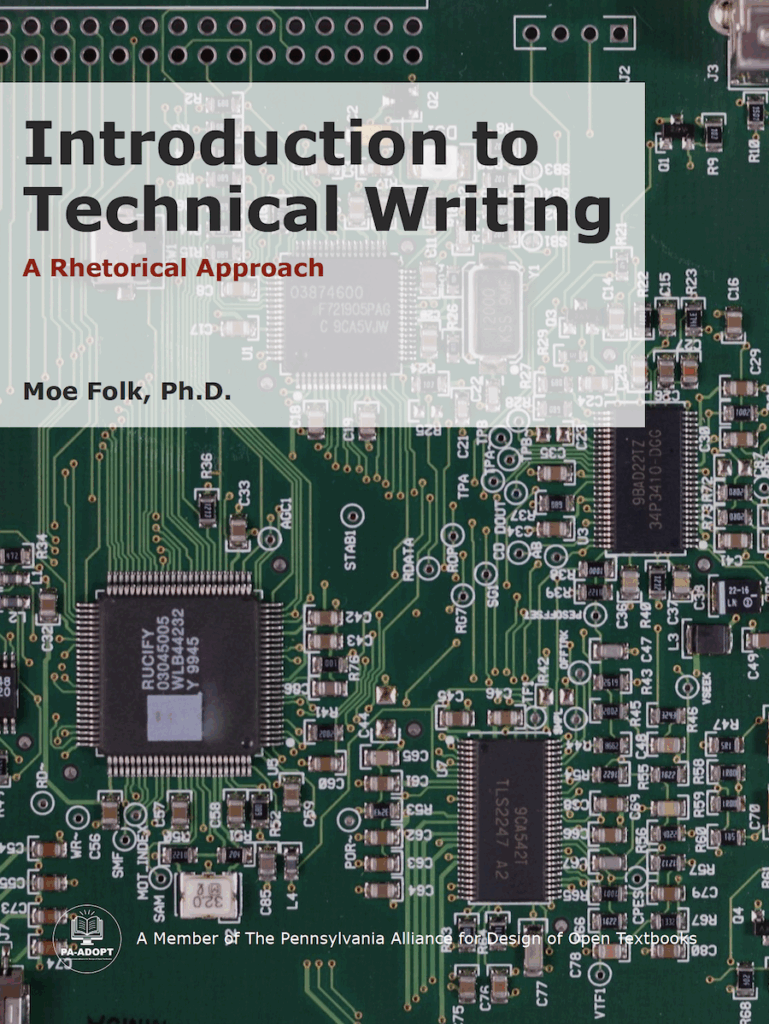
Introduction to Technical Writing: A Rhetorical Approach
Not rated yetRate this bookAn introduction to technical writing that connects useful communication with audience, purpose, format, and the situations in which people need information.
Free reading is available at the official source. Opens in a new tab.
 Free
About this book
An introduction to technical writing that connects useful communication with audience, purpose, format, and the situations in which people need information.
This page introduces the source edition and offers a focused reading route. Use the linked original resource for the complete text, references, activities, and the author’s full explanation. The overview below is limited to the sections identified in the coverage note.
Contents and further reading
Consult the official book or repository page for the resource’s contents and publication information. Open the source PDF to read the complete available edition.
Sources and coverage
This original overview is based on the opening discussion of technical writing and communication (PDF sheets 9–11), with front matter and contents checked. It is not a whole-book review. The verified source PDF contains 138 PDF sheets, including preliminary or repository pages; this may differ from its printed pagination. The source retains its own authorship, rights notices, and any separately credited third-party material.
Book summary
Moe Folk’s Introduction to Technical Writing organizes a rhetorical approach around four chapters and three major assignment types. Summarizing, visualizing, and persuading are treated as decisions made for a particular audience and task. The guide follows this assignment-centered design rather than inventing a broader reference-book structure.
Chapter-by-chapter summaries
Chapter 1: What Technical Writing Is and Why It Matters
The opening connects technical writing with helping people understand and act in specific situations. A document's effectiveness depends on audience, purpose, context, and constraints, not merely on the use of specialized vocabulary. The rhetorical approach asks why information is selected and arranged in a particular way. This foundation makes later assignments exercises in judgment: the writer must understand the reader's task well enough to decide what the document needs to do.
Chapter 2: Summarizing—Patent Summary Assignment
Summarizing requires accurate selection and re-expression of another text's important information. The patent assignment makes purpose and audience especially consequential because technical detail can overwhelm an unfamiliar reader. A useful summary preserves the relationships needed to understand the source while avoiding both indiscriminate compression and unsupported explanation. The chapter connects reading with writing: before deciding what can be omitted, the writer needs to understand what the original document claims and how its parts relate.
Chapter 3: Visualizing—Warning Sign Assignment
A warning sign must communicate a relevant condition and an interpretable message within limited space and attention. The assignment connects visual choices with the context in which a reader encounters them. Typography, arrangement, symbols, and language work together rather than functioning as separate decoration. The chapter develops the habit of testing what a design actually conveys to its audience, instead of assuming the designer's intention guarantees that the intended action or meaning is obvious.
Chapter 4: Persuading—Recommendation Report Assignment
A recommendation report connects a problem with alternatives, criteria, evidence, and a justified choice. Persuasion depends on a transparent comparison, not simply confident preference. The assignment brings earlier rhetorical decisions into a longer document: readers need to understand the issue, locate the support, and see why the recommendation follows. Revision should check the connection between evaluation criteria and the final conclusion, including tradeoffs that a favored option does not eliminate.
Study instructions
- Write an audience-and-purpose brief before each of the three major assignments.
- Check a summary against the source for both accuracy and the effect of omissions.
- Test a warning design by asking a reader to explain its meaning without prompting.
- For a report, make a comparison table and trace every recommended action back to a stated criterion and supporting evidence.
Sources and coverage
This original study guide follows the linked source edition and its chapters or explicitly identified sections. It condenses the main ideas and their relationships; examples and practice directions are for study alongside the complete text. Complete source edition.
About access & copyright
This page provides book information and study material. Full-text access is provided by the original publisher or authorised source; a listing does not grant permission to republish the book.
Read our Library Access & Copyright policyAudience
Begin with the reader’s needs and existing knowledge.
Purpose
Judge a document by the task or understanding it supports.
Multimodal communication
Words and visual design can work together.
Rhetorical choice
Select a form that fits the communication situation.
Reader ratings & reviews
Share your thoughts
Your review helps other students choose the right resources.
KEEP LEARNING
Your next great read
Cultural & Ethnic Studies Business
Communication for Business Success
View Communication for Business Success — book Humanities
Stand up, Speak out - The Practice and Ethics of Public Speaking
View Stand up, Speak out - The Practice and Ethics of Public Speaking — book Journalism, Media Studies & Communications
Communication in the Real World - An Introduction to Communication Studies
View Communication in the Real World - An Introduction to Communication Studies — book Journalism, Media Studies & Communications
Communication, Affect, & Learning in the Classroom
View Communication, Affect, & Learning in the Classroom — book Humanities
Arguing Using Critical Thinking
View Arguing Using Critical Thinking — book Humanities
Writing Fabulous Features
View Writing Fabulous Features — book Journalism, Media Studies & Communications
Preparing to Publish
View Preparing to Publish — book Journalism, Media Studies & Communications
Workplace Writing: A Handbook for Common Workplace Genres and Professional Writing
View Workplace Writing: A Handbook for Common Workplace Genres and Professional Writing — book Journalism, Media Studies & Communications



