
 Cultural & Ethnic Studies
Journalism, Media Studies & CommunicationsTextbook
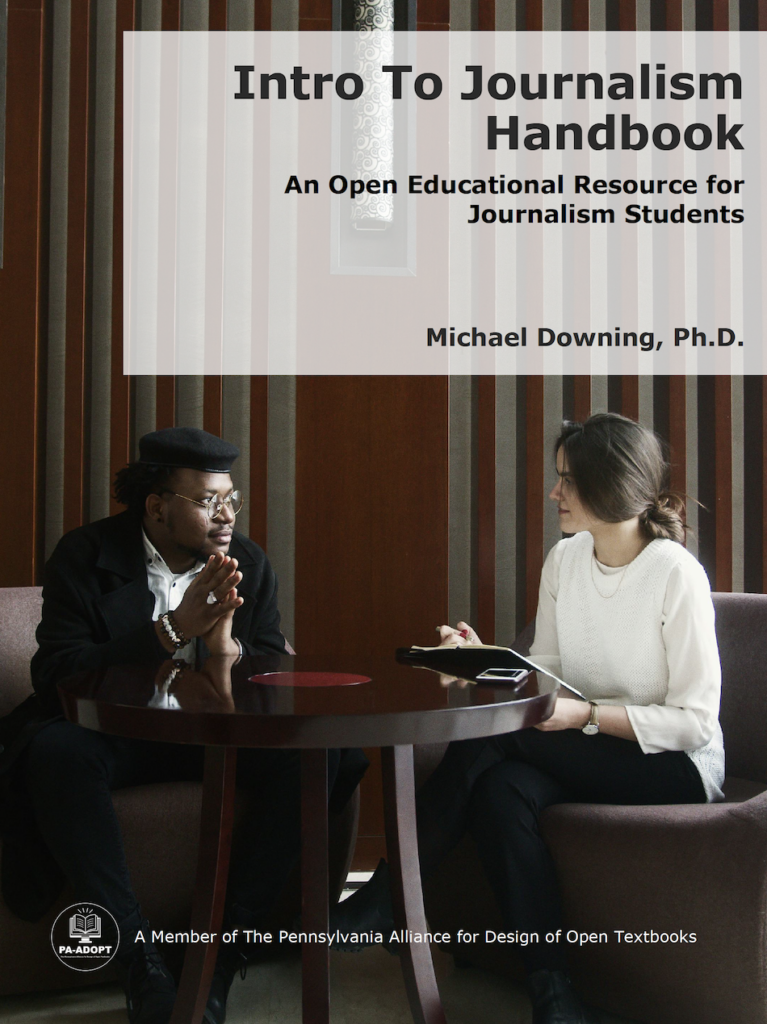
Intro to Journalism Handbook: An Open Educational Resource for Journalism Students
Not rated yetRate this bookMichael Downing’s journalism handbook prepares beginners to report, write, revise, and edit for a campus publication. Its introduction puts preparation, human sources, and background reading behind the production of a useful news story.
Free reading is available at the official source. Opens in a new tab.
 Free
About this book
The PA-ADOPT PDF identifies itself as the fifth edition, 2024. Downing explains that its structure follows writing-intensive journalism classes connected with Kutztown University’s student newspaper, The Keystone. Topics include reporting concepts, format, style, story types, coverage checklists, social media, AI, ethics, and careers. The introduction emphasizes practical preparation rather than an exhaustive history or treatment of constitutional cases. This page covers that opening purpose and learning approach.
Sources and reading coverage
Edition and rights pages, contents, and selected introductory passages on PDF sheets 8–9 were reviewed. Later reporting, legal, AI, and ethics chapters were not fully reviewed.
See the official publication record for edition details. The external PDF provides the available source text.
The consulted PDF contains 86 sheets, including preliminary material; this count can differ from printed pagination.
Book summary
Michael Downing’s Intro to Journalism Handbook combines introductory concepts, newsroom forms, reporting checklists, ethics, and practice. Its thirteen parts make a compact course in producing and evaluating journalism. The reviewed fifth-edition PDF includes material on social media and artificial intelligence; those discussions should be read in their publication context. The guide follows the actual parts rather than inventing a conventional chapter structure.
Chapter-by-chapter summaries
Part One: Introduction
The introduction establishes the handbook's practical purpose and invites active participation in reporting. Journalism becomes a process of finding, checking, organizing, and communicating information. The opening frames later exercises as opportunities to practice judgment, rather than treating knowledge of terminology as sufficient preparation to publish.
Part Two: Key Concepts in Journalism
Core concepts explain the role of news, its relationship to audiences, and the professional decisions involved in selecting and presenting information. The distinction between a claim and a verified fact is central to reading the later examples. Learners should connect definitions with the work a reporter must actually perform.
Part Three: Format and Style
Format and style create consistency and help readers find important information quickly. The handbook connects newsroom conventions with clear presentation rather than decorative writing. A reporting task requires decisions about what belongs first, what background is necessary, and how to preserve accuracy while making the account concise.
Part Four: Obituaries, Hard News, Press Releases, Sports, and Opinions
Different forms serve different purposes. A hard-news report, an obituary, and an opinion piece cannot be assessed by one interchangeable template. Press releases also require attention to their source and promotional purpose. The part explains genre expectations so a writer can adapt structure and voice without confusing reporting with advocacy.
Part Five: Checklists for Covering Various Stories
Checklists translate a broad assignment into questions and observations that should not be overlooked. Their value lies in preparation: identifying participants, chronology, context, and unanswered questions before drafting. A checklist supports inquiry but does not establish that a source's answer is reliable or that every story needs identical treatment.
Part Six: The Impact of Social Media on Journalism
Social platforms affect how information is discovered, circulated, and discussed. Speed and public participation create opportunities alongside problems of verification and context. The part encourages attention to the relationship between a platform post and a reportable claim. Popular circulation is not itself evidence that an item is accurate.
Part Seven: Artificial Intelligence and Journalism
The AI discussion brings production tools into the larger questions of accuracy, responsibility, and editorial judgment. Tool assistance does not remove the reporter's obligation to verify the resulting material. Read the examples as an introduction to evaluating use, and distinguish a claim about capability from evidence that a particular output is trustworthy.
Part Eight: Journalistic Code of Ethics
Ethical guidance concerns the treatment of facts, sources, subjects, and audiences. It requires judgment when legitimate interests conflict, rather than operating only as a list of forbidden acts. The code provides a basis for explaining a reporting decision and for assessing whether the method of obtaining attention respects the public purpose of journalism.
Parts Nine and Ten: Careers and Occupational Information
These parts connect classroom work with journalism roles and occupational information. The career discussion helps learners identify skills and possible work settings. Bureau of Labor Statistics material supplies a dated employment context, not a promise about future opportunities. Compare the responsibilities described with the practical evidence a portfolio could demonstrate.
Part Eleven: Exercises, Self-Tests, and Useful Tools
Practice activities turn concepts into observable work. Exercises are useful when followed by explanation: which fact was established, why a sentence was revised, or what information remains missing? Self-tests can reveal weak areas, but completed answers should lead back to reporting and editing habits rather than remain isolated scores.
Parts Twelve and Thirteen: Resources and Appendix
The closing material provides routes to further learning and supplementary reference. Use it to investigate a defined difficulty arising from a draft or assignment. A reference tool supports judgment when the learner understands the question being asked; it cannot replace identifying the source, purpose, and context of a claim.
Study instructions
- Choose an event and prepare a reporting plan using the relevant checklist. Separate verified information from questions that still need answers.
- Draft a news account, then rewrite the same subject as an opinion piece. Identify the differences in purpose and attribution.
- Keep a correction log explaining each factual, structural, and style change.
- Use the ethics part to justify one difficult editorial decision, including a plausible objection.
Sources and coverage
This original study guide follows the linked source edition and its chapters or explicitly identified sections. It condenses the main ideas and their relationships; examples and practice directions are for study alongside the complete text. Complete source edition.
About access & copyright
This page provides book information and study material. Full-text access is provided by the original publisher or authorised source; a listing does not grant permission to republish the book.
Read our Library Access & Copyright policyPreparation
Identify information gaps.
Sources
Connect claims with verifiable reporting.
Revision
Treat editing as part of journalism.
Scope
Seek fuller references for specialized questions.
Reader ratings & reviews
Share your thoughts
Your review helps other students choose the right resources.
KEEP LEARNING
Your next great read
Cultural & Ethnic Studies Business
Communication for Business Success
View Communication for Business Success — book Humanities
Stand up, Speak out - The Practice and Ethics of Public Speaking
View Stand up, Speak out - The Practice and Ethics of Public Speaking — book Journalism, Media Studies & Communications
Communication in the Real World - An Introduction to Communication Studies
View Communication in the Real World - An Introduction to Communication Studies — book Journalism, Media Studies & Communications
Communication, Affect, & Learning in the Classroom
View Communication, Affect, & Learning in the Classroom — book Humanities
Arguing Using Critical Thinking
View Arguing Using Critical Thinking — book Humanities
Writing Fabulous Features
View Writing Fabulous Features — book Journalism, Media Studies & Communications
Preparing to Publish
View Preparing to Publish — book Journalism, Media Studies & Communications
Workplace Writing: A Handbook for Common Workplace Genres and Professional Writing
View Workplace Writing: A Handbook for Common Workplace Genres and Professional Writing — book Humanities



