
 Cultural & Ethnic Studies
Journalism, Media Studies & CommunicationsTextbook
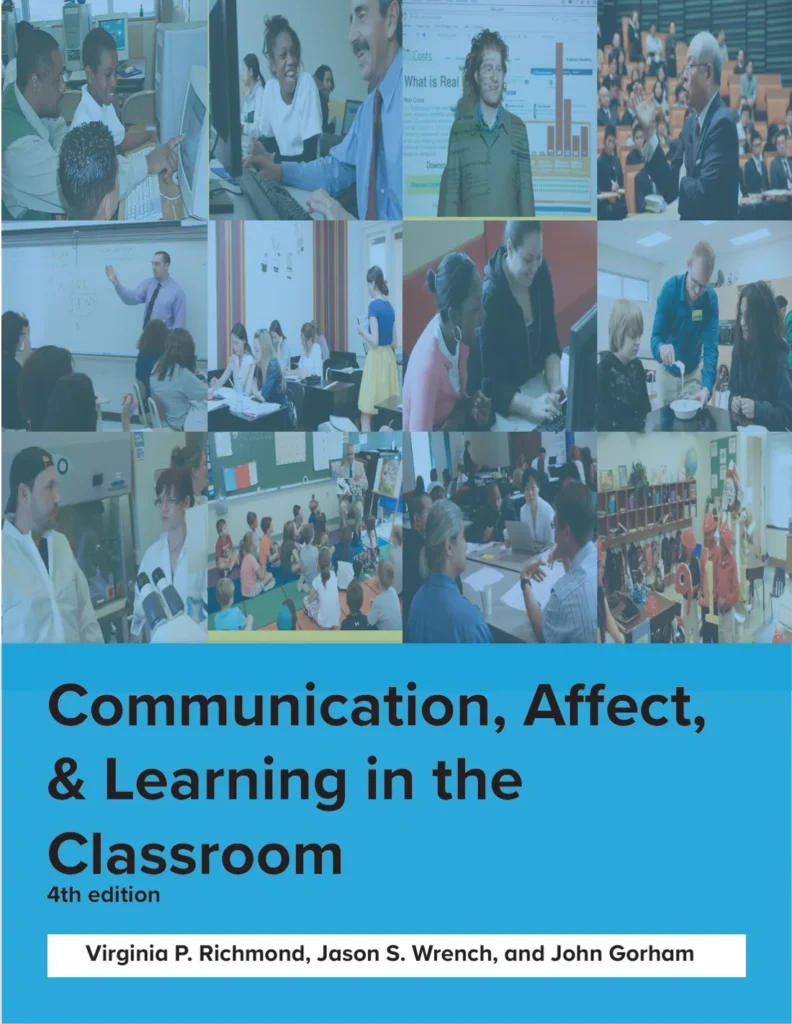
Communication, Affect, & Learning in the Classroom
Not rated yetRate this bookCommunication, Affect, & Learning in the Classroom, fourth edition, examines teaching as an interaction among content, strategy, learners, feedback, and the learning environment. The 2020 title and copyright pages credit Virginia Peck Richmond, Jason S. Wrench, and Joan Gorham. Its fifteen chapters connect instructional design with student and teacher perceptions, relationships, assessment, management, and professional performance. This guide follows the source PDF, including activities, Appendix A, and the glossary. Models of styles and temperament are presented as frameworks discussed in the text, not as fixed diagnoses or proof that matching instruction to a label guarantees learning.
Free reading is available at the official source. Opens in a new tab.
 Free
About this book
Communication, Affect, & Learning in the Classroom, fourth edition, examines teaching as an interaction among content, strategy, learners, feedback, and the learning environment. The 2020 title and copyright pages credit Virginia Peck Richmond, Jason S. Wrench, and Joan Gorham. Its fifteen chapters connect instructional design with student and teacher perceptions, relationships, assessment, management, and professional performance. This guide follows the source PDF, including activities, Appendix A, and the glossary. Models of styles and temperament are presented as frameworks discussed in the text, not as fixed diagnoses or proof that matching instruction to a label guarantees learning.
Book summary
Communication, Affect, & Learning in the Classroom, fourth edition, examines teaching as an interaction among content, strategy, learners, feedback, and the learning environment. The 2020 title and copyright pages credit Virginia Peck Richmond, Jason S. Wrench, and Joan Gorham. Its fifteen chapters connect instructional design with student and teacher perceptions, relationships, assessment, management, and professional performance. This guide follows the source PDF, including activities, Appendix A, and the glossary. Models of styles and temperament are presented as frameworks discussed in the text, not as fixed diagnoses or proof that matching instruction to a label guarantees learning.
Chapter-by-chapter summaries
Chapter 1: Teaching as a Communication Process
Teaching involves more than sending content toward a passive receiver. The chapter connects cognitive, affective, and psychomotor learning with instructional strategy, student characteristics, feedback, and context. Objectives, preassessment, instructional procedures, and evaluation form a feedback cycle, while ADDIE provides another organizing framework. Analyze one lesson by identifying what learners should know, feel or value, and be able to do. Then describe how communication and evaluation reveal whether those aims were achieved. A clearly delivered explanation can still be unsuitable if it assumes missing prerequisite knowledge or offers no opportunity for learners to respond.
Chapter 2: Communicating with Instructional Objectives
Objectives clarify the intended learning and help align teaching, activities, and assessment. The chapter considers resistance to objectives alongside their practical value and their application across learning domains. An objective should communicate more than the topic to be covered. Compare an intention such as understanding a concept with an observable task that would provide evidence of that understanding. Keep the educational purpose visible so that a narrow measurement does not quietly replace the larger aim. The activity invites readers to formulate objectives and assess whether students could understand what successful performance would involve.
Chapter 3: Instructional Communication Strategies
The teacher can function as speaker, moderator, trainer, manager, coordinator, and innovator, with each role suggesting different communicative choices. No single strategy is suitable for every content, learner, or objective. A discussion intended to develop reasoning has different needs from supervised practice of a skill. Choose a strategy for a particular objective and explain the participation it requires. Then consider what the teacher must communicate before, during, and after the activity. This makes strategy selection a reasoned design decision rather than a preference for whichever format the instructor finds most comfortable.
Chapter 4: Communication, Affect, and Student Needs
Students’ responses to learning involve academic and interpersonal needs as well as information processing. The chapter discusses ways to examine affect and introduces need frameworks concerned with inclusion, control, affection, safety, belonging, and success. These models can prompt useful questions without establishing that every learner has identical priorities. Identify what a classroom routine communicates about participation and whether students can seek clarification without humiliation. Distinguish an educator’s friendly intention from evidence of how learners experience the interaction. The goal is to connect relational conditions with access to the work of learning.
Chapter 5: Learning Styles
The chapter surveys ways of describing differences in learning and distinguishes styles from related concepts. Such inventories can stimulate reflection about preferences and variety in instruction, but they should not be treated as permanent categories that determine capability. A student’s reported preference does not by itself establish the best method for learning every subject. Compare what a model claims to describe with the evidence needed to justify an instructional decision. Use varied representations when they serve the content and provide accessible practice, rather than limiting students to a label. Assess the resulting learning directly instead of assuming that a style match proves effectiveness.
Chapter 6: Classroom Anxieties and Fears
Communication, listening, writing, teacher interaction, and evaluation can each become sources of apprehension. The chapter distinguishes these concerns and explores ways instructional communication may reduce avoidable uncertainty or pressure. Observable reluctance to participate does not reveal its cause automatically. Examine the demands of a task, the clarity of expectations, and the opportunities for gradual preparation and supportive feedback. A classroom measure or discussion can support educational reflection without functioning as a clinical diagnosis. Persistent or severe difficulties may require appropriate support beyond changes in one lesson’s communication.
Chapter 7: Communication and Student Self-Concept
Messages from others can influence how students interpret their abilities, belonging, and prospects. The chapter connects self-perception with classroom interaction and the educational consequences of repeated responses. Feedback that identifies a specific performance and a path forward communicates something different from a global judgment about a learner’s worth. Rewrite a response so that it addresses the task, acknowledges relevant effort or strategy, and supplies a useful next step. Then examine whether it inadvertently reinforces a fixed identity. A supportive self-concept and accurate feedback should work together rather than require pretending that every attempt is already successful.
Chapter 8: Instructional Assessment — Feedback, Grading, and Affect
Assessment includes collecting information and making judgments, while feedback communicates information that can guide subsequent learning. Formative and summative purposes differ, and grades do not automatically explain how to improve. The chapter also considers how evaluation influences students’ orientations toward learning. Align the assessment with the objective and identify what the learner will be able to do with the feedback. Separate a judgment of current performance from a prediction about permanent ability. A well-designed feedback process also gives the teacher evidence about whether instruction or assumptions need revision.
Chapter 9: Traditional and Mastery Learning Systems
The chapter compares arrangements in which time, progression, assessment, and opportunities for correction are organized differently. Mastery-oriented approaches emphasize reaching defined learning criteria with feedback and additional practice, rather than assuming that identical time produces identical outcomes. The comparison requires attention to resources and implementation, not merely favorable terminology. Map how a student moves through one unit, what happens after an unsuccessful attempt, and what evidence permits progression. Then identify which parts of the system actually support further learning. Repeated testing without meaningful feedback is not automatically a mastery system.
Chapter 10: Student Misbehavior and Classroom Management
Behavior is examined through a communication perspective, including its effects on instruction and on other students. The chapter considers management choices and issues such as bullying rather than treating disruption as an isolated teacher–student contest. Describe observable conduct and its impact before assigning an intention or character label. Establish clear expectations and responses that can be explained consistently. Then ask whether the procedure supports appropriate participation or merely interrupts one unwanted act temporarily. Management decisions also communicate whose learning and safety matter and whether learners can trust the classroom’s boundaries.
Chapter 11: Teacher Misbehaviors and Communication
Teachers can undermine learning through actions involving preparation, responsiveness, clarity, fairness, competence, or treatment of students. The chapter makes educator conduct part of classroom analysis instead of attributing every problem to learners. A practice can be harmful even when the teacher does not intend the effect. Examine a case by identifying the action, the message students may receive, and the consequence for participation or trust. Then propose an observable change. Professional reflection is more useful when it goes beyond defending intention or assigning blame and identifies what can actually be improved.
Chapter 12: Teacher Self-Concept and Communication
Educators’ perceptions of themselves can influence how they interpret feedback, relate to colleagues, and respond to difficulties. The chapter explores teacher self-concept and activities for identifying strengths, achievements, and goals. Reflection should connect confidence with realistic evidence and opportunities for development. List a specific teaching strength and an instance that supports it, then identify a growth area with an attainable practice goal. This avoids replacing either self-criticism or self-praise with an unsupported general label. Professional identity can develop through feedback and experience rather than remain fixed by one difficult lesson.
Chapter 13: Increasing Classroom Affect through Teacher Communication Style
Clarity, immediacy, humor, and other communicative behaviors influence how students experience instruction. Verbal and nonverbal messages can make an instructor seem accessible or distant, while organization and examples affect comprehensibility. The appropriateness of a behavior depends on context and the learners involved; humor that embarrasses a student can defeat its intended purpose. Observe one lesson for concrete behaviors rather than assigning a broad personality judgment. Then select a change that improves access or clarity and gather feedback about its effect. A friendly style supports learning most effectively when paired with well-designed content and practice.
Chapter 14: Teacher Temperament in the Classroom
The text uses temperament and personality frameworks to discuss differences in teacher and student behavior. These models can encourage flexibility and reflection, but broad types should not become clinical diagnoses or rigid explanations of individual conduct. Identify a behavior and its context before interpreting it through a category. Consider how the same preference could be an advantage in one task and a limitation in another. Then design a classroom arrangement that permits different forms of participation while preserving the learning goal. The useful question is how to respond thoughtfully to variation, not how to place every person permanently into one box.
Chapter 15: Teacher Communication — Performance and Burnout
Professional demands, strain, support, and communication interact with teacher performance. The chapter discusses burnout, coping, and coaching across learning domains. Individual strategies matter, but workload and organizational conditions also shape what is feasible. Identify a concrete demand, its impact, and the resources or changes needed rather than treating exhaustion as a simple lack of commitment. A coaching plan should specify the skill, feedback, and opportunity for practice. Distinguish reflective educational activities from assessment or care that requires appropriate professional support.
Appendix A, Activities, and Glossary
The supporting materials consolidate vocabulary and provide opportunities to examine objectives, needs, feedback, management, self-perception, and professional practice. Measures reproduced in the text may have their own attribution and licensing conditions. Use an activity as a starting point for reflection and comparison rather than treating a score as a definitive description of a learner or teacher. The original cover is retained, including its printed spelling; the title and copyright pages provide the verified credit to Joan Gorham.
Study instructions
- Map a lesson through content, learner, strategy, feedback, and context before selecting a communication technique.
- Write objectives across relevant learning domains and align the activity and assessment with them.
- Keep an observation journal of actual messages and responses. Separate intention from the effect that learners report or demonstrate.
- Use style and temperament frameworks critically; assess learning directly and avoid fixed labels.
- Practice writing feedback that identifies evidence, explains the gap, and gives a feasible next step.
- Review one classroom routine and one professional-support arrangement, then specify a change and how its effect will be evaluated.
Questions for reflection
- What does the learner understand about the purpose and success criteria?
- Does feedback guide another attempt or merely announce a judgment?
- Which behavior is observed, and which interpretation is being added?
- How do teacher and organizational practices contribute to the learning climate?
Sources and coverage
This original reading guide follows the linked source edition’s chapter, module, unit, or lesson structure. Consult the source for full arguments, cases, worked examples, exercises, illustrations, and references. Coverage follows all fifteen chapters, their activities, Appendix A, and the glossary in the 2020 fourth edition. Authorship follows the title/copyright pages. Original cover artwork and printed wording are preserved. Read the source edition.
About access & copyright
This page provides book information and study material. Full-text access is provided by the original publisher or authorised source; a listing does not grant permission to republish the book.
Read our Library Access & Copyright policyExplore the contents
Check the chapters covered in this edition.
Visit the official source
See reading, preview or purchase options.
Save for later
Keep this textbook in your saved collection.
Reader ratings & reviews
Share your thoughts
Your review helps other students choose the right resources.
KEEP LEARNING
Your next great read
Cultural & Ethnic Studies Business
Communication for Business Success
View Communication for Business Success — book Humanities
Stand up, Speak out - The Practice and Ethics of Public Speaking
View Stand up, Speak out - The Practice and Ethics of Public Speaking — book Journalism, Media Studies & Communications
Communication in the Real World - An Introduction to Communication Studies
View Communication in the Real World - An Introduction to Communication Studies — book Humanities
Arguing Using Critical Thinking
View Arguing Using Critical Thinking — book Humanities
Writing Fabulous Features
View Writing Fabulous Features — book Journalism, Media Studies & Communications
Preparing to Publish
View Preparing to Publish — book Journalism, Media Studies & Communications
Workplace Writing: A Handbook for Common Workplace Genres and Professional Writing
View Workplace Writing: A Handbook for Common Workplace Genres and Professional Writing — book Journalism, Media Studies & Communications
Intro to Journalism Handbook: An Open Educational Resource for Journalism Students
View Intro to Journalism Handbook: An Open Educational Resource for Journalism Students — book Humanities



