
Bridges: United States Academia for First-Generation and International College Students
EducationTextbook
How to Learn Like A Pro
Not rated yetRate this bookHow to Learn Like A Pro introduces study strategies for college and returning learners. Phyllis Nissila connects time management, goals, reading, note-taking, memory and exam preparation with opportunities to reflect on which approaches help a particular learner.
 Free
About this book
The introductory material describes a resource developed for Lane Community College’s Effective Learning course. It considers learners with varied ages, work commitments and educational histories. Lessons are organised into units with objectives, activities and portfolio work, making the text usable within a course or for selected practice. Its course outcomes emphasise monitoring progress as well as practising particular strategies. Some later units present learning-style and other theoretical models; those should be read as the book’s historical content rather than treated here as independently established scientific conclusions.
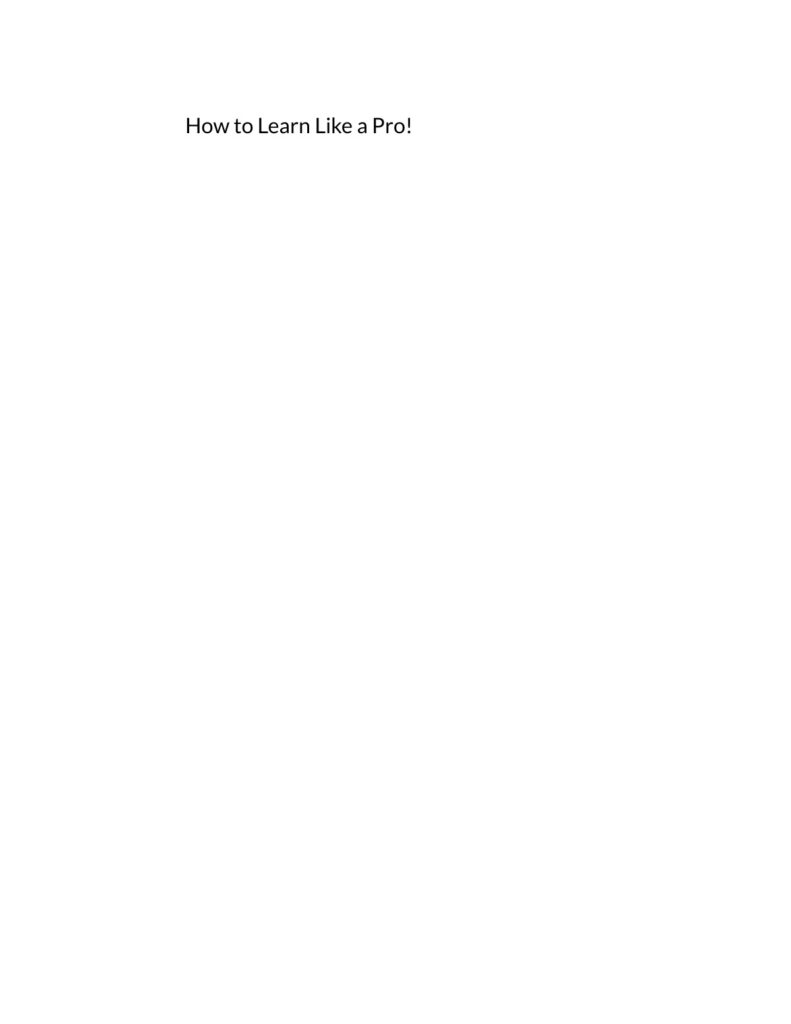
The attached edition contains 111 PDF pages, including front matter. Cover: source edition title page rendered from the PDF. The textbook and its original notices are retained; Academic Master’s study material is separate from the source text.
Book summary
Study overview of the reviewed opening
Nissila’s welcome challenges the assumption that successful learning is simply a fixed personal advantage. The resource presents study as something that can be investigated and improved through deliberate practice. Its intended learners include new students, returning adults and people combining education with employment or family responsibilities.
The introduction connects effective learning with several kinds of work: managing time, setting goals, taking notes, reading critically, using memory techniques and preparing for examinations. Portfolio projects ask students to gather and reflect on strategies, rather than only complete a sequence of disconnected exercises. The stated outcomes also include monitoring progress and using library resources.
The instructor guidance describes a flexible course structure with unit overviews, lessons, activities and assessment rubrics. It links study skills with critical thinking and the ability to identify comprehension problems. This guide summarises the reviewed welcome and objectives, not the evidence for every psychological model discussed later. Readers should separate the resource’s practical activity design from claims about learning styles or brain models that would require their own source evaluation.
Book contents
- Learn Like a Pro! Welcome to Effective Learning (EL115)--for Students and Instructors
- Course Objectives and Outcomes
- Acknowledgments
- Unit 1 Overview--Learning Styles and Preferences; Unit Terms
- Unit 2 Overview--Management of Time, Tools, and Study Environment; Unit Terms
- Unit 3 Overview--College Level Critical Thinking and Reading; Unit Terms
- Unit 4 Overview--Listening and Note-Taking; Unit Terms
- Unit 5 Overview--Memory Principles and Techniques; Unit Terms
- Unit 6 Overview--Test-Taking: Pre, Mid, and Post; Unit Terms
- GRAPHIC ORGANIZERS for Reading/Writing Patterns
Questions for study
The following prompts are Academic Master’s editorial material.
- What evidence could show whether a study strategy helps you?
- How does a portfolio support reflection on learning?
- What differs between practising a technique and establishing a theory’s validity?
Sources and coverage
Welcome and Course Objectives and Outcomes read in full (PDF pages 7–11); contents checked.
About access & copyright
Check this edition’s source and licence before reusing its files or content. A library listing does not grant additional rights.
Read our Library Access & Copyright policyDeliberate study
Recognise learning strategies as practices to examine.
Self-monitoring
Relate progress checks to study planning.
Portfolio reflection
Connect activities with evidence of what works.
Critical reading
Evaluate theoretical claims separately from useful exercises.
Reader ratings & reviews
Share your thoughts
Your review helps other students choose the right resources.
KEEP LEARNING
Your next great read
Student Success
Self-directed multimodal learning in higher education
Self-directed multimodal learning in higher education
View Self-directed multimodal learning in higher education — bookKnowing Home: Braiding Indigenous Science with Western Science
Knowing Home: Braiding Indigenous Science with Western Science
View Knowing Home: Braiding Indigenous Science with Western Science — bookTeaching Early and Elementary STEM
Teaching Early and Elementary STEM
View Teaching Early and Elementary STEM — bookGame Based and Adaptive Learning Strategies
Game Based and Adaptive Learning Strategies
View Game Based and Adaptive Learning Strategies — book Student Success
Writing for Inquiry and Research
View Writing for Inquiry and Research — book Curriculum & Instruction
The Asynchronous Cookbook
View The Asynchronous Cookbook — book Curriculum & Instruction
Using Open Educational Resources to Promote Social Justice
View Using Open Educational Resources to Promote Social Justice — book Curriculum & Instruction
Intersections of Open Educational Resources and Information Literacy
View Intersections of Open Educational Resources and Information Literacy — book Social Sciences



