
 General and Comparative Literary Studies and Linguistics
HumanitiesTextbook
Français interactif
Not rated yetRate this bookFrançais interactif is a beginning French resource developed at the University of Texas at Austin. Its fourth-edition textbook connects classroom activities with online vocabulary, pronunciation, grammar and video materials. The PDF and multimedia website serve complementary purposes.
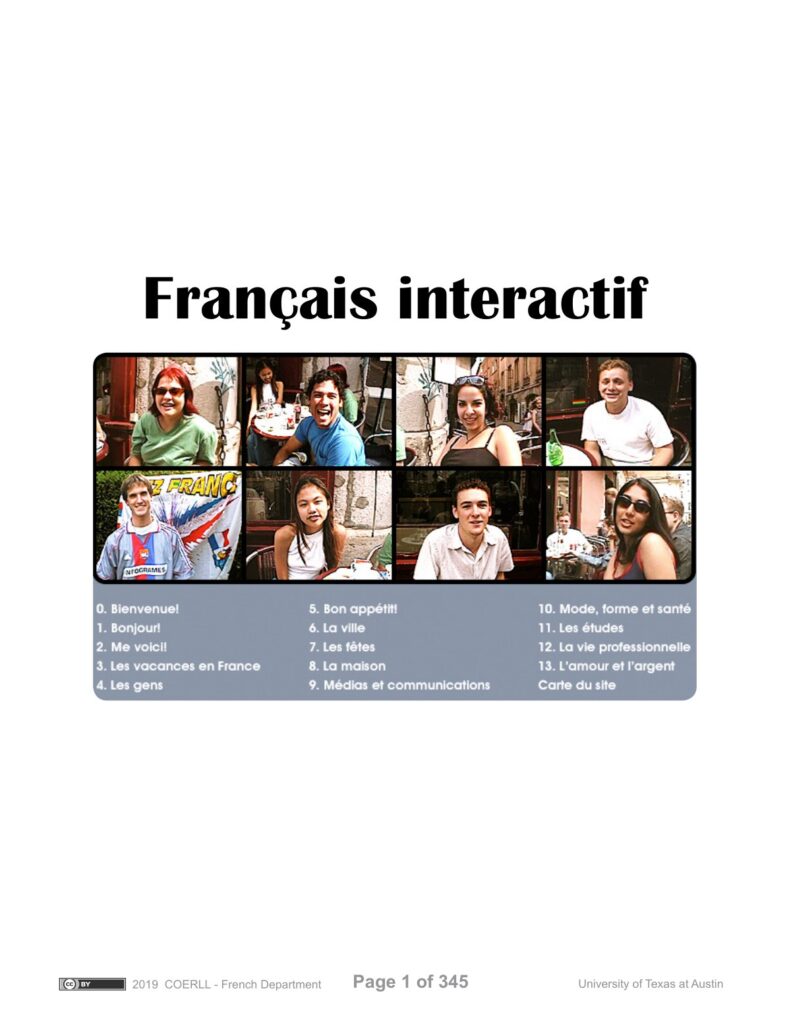 Free
About this book
The 2019 fourth edition is the classroom and homework companion to a larger multimedia French programme. Its front matter documents development within the University of Texas at Austin’s Department of French and Italian and COERLL. Chapters are organised around situations and themes, including introductions, travel, food, home, study and professional life. The guidance for using the resource distinguishes vocabulary preparation, pronunciation, video work and online grammar from in-class practice. The PDF contains the printed learning activities; the programme’s recordings and interactive exercises are accessed through the official website.
The attached edition contains 345 PDF pages, including front matter. Cover: source edition cover rendered from the PDF. The textbook and its original notices are retained; Academic Master’s study material is separate from the source text.
Book summary
Français interactif is an English-supported introductory French course by Karen Kelton, Nancy Guilloteau, and Carl Blyth. This guide follows the 2019 fourth edition: an orientation followed by thirteen thematic chapters. The PDF supplies classroom activities and vocabulary, while the University of Texas companion website supplies important audio, video, phonetics, and linked grammar practice. Meaningful conversation, listening, and cultural observation should accompany written grammar work throughout.
Chapter-by-chapter summaries
Chapter 0: Bienvenue
The orientation introduces the course community and its combination of printed activities and online materials. Learn how to find vocabulary recordings, interviews, phonetics, and grammar explanations before treating the textbook as a sequence of written assignments. The course uses encounters with speakers and their everyday experiences to give language a social setting. Start a learning record with pronunciation questions and useful phrases, then establish a routine for listening, speaking, reading, and writing. The English support helps you understand tasks; repeated engagement with French develops the ability to carry them out.
Chapter 1: Bonjour!
Introductions and classroom communication establish a practical first repertoire. Subject pronouns and être support simple statements about identity; nouns, articles, and grammatical gender shape the phrases around them. The distinction between voilà and il y a introduces different ways to present people or things. Dates and numbers make classroom interactions more specific. Practice brief exchanges from memory, then change names, dates, and objects rather than repeating a fixed script. Attend to written accents and the sound of complete phrases. The goal is to participate in a short interaction and recognize the same language when another person uses it.
Chapter 2: Me voici!
Personal information expands into family, friends, pastimes, nationality, and time. Avoir and regular -er verbs make descriptions more varied, while possessives connect people and objects to speakers. Questions, basic negation, adverbs, and adjective formation help move beyond isolated affirmative statements. Phonetic work on elision and liaison connects word boundaries in writing with actual speech. Build a short personal profile and interview a partner whose answers you cannot predict. Record the difference between asking a question, understanding the response, and reporting that response about someone else. These related tasks reveal whether the grammar is becoming usable.
Chapter 3: Les vacances en France
Weather, seasons, geography, transport, and activities frame the planning of a trip. Faire and its expressions, aller, selected irregular verbs, and stem-changing -er verbs broaden present-tense communication. The near future allows speakers to describe intentions, while place prepositions locate destinations. Practice choosing activities in response to weather and explaining where you are going and how you will travel. Pronunciation work on stress and intonation supports questions and longer utterances. Distinguish a present habit from an upcoming plan so that using a new verb form changes the meaning of the message.
Chapter 4: Les gens
Physical appearance, personality, and routines provide opportunities for richer description. Adjective placement and irregular forms show why a dictionary form is not sufficient for constructing a sentence. C’est and il or elle est organize descriptions differently, while pronominal verbs express routine activities. Comparisons allow descriptions to become relational rather than a list of traits. The chapter also invites attention to stereotypes: language about people can carry assumptions that deserve examination. Describe a person using several kinds of evidence, ask follow-up questions, and distinguish an observable characteristic from an evaluative generalization.
Chapter 5: Bon appétit!
Food, shopping, and meals introduce the language of quantities and preferences. Partitive articles and quantity expressions are central because talking about food often means describing an unspecified amount rather than counting whole objects. Regular -ir verbs and selected irregular verbs extend what speakers can order, buy, drink, see, or believe. Question words and inversion offer additional ways to seek information. Prepare a shopping exchange or meal discussion with real choices and quantities. Then vary the situation so the response requires listening rather than recalling a rehearsed line. Compare cultural practices without assuming that a single speaker represents every household.
Chapter 6: La ville
Places, shops, services, and directions support navigation through a town. Contractions with à and de and demonstrative determiners help specify locations and objects. The introduction of the passé composé with avoir and être makes it possible to recount completed events as well as describe current surroundings. Link these functions by explaining where you went and what you did there. Attend to auxiliary selection and the relevant agreement patterns when revising written work. A useful task is to compare a planned itinerary with a report of the actual outing, making the time reference clear in each sentence.
Chapter 7: Les fêtes
Celebrations, rituals, and customs provide material for discussing gifts, participants, and memories. Direct and indirect object pronouns reduce repetition, but only when the listener can identify the referent. The imparfait introduces descriptions of states and habitual past actions. Rather than replacing every past verb with the new form, ask what role each clause plays in the account. Describe a recurring childhood celebration and explain who gave or received something. Use the cultural material to compare practices and meanings, recognizing variation among families and communities. Successful narration depends on organizing experience as well as choosing endings.
Chapter 8: La maison
Rooms, furnishings, domestic tasks, and living arrangements anchor this chapter. The passé composé of pronominal verbs extends accounts of completed routines. Y and en allow references to places, quantities, and previously mentioned material, while the imperative supports instructions and requests. Venir adds another useful movement verb. Describe a home, discuss responsibilities, and negotiate a sequence of chores with a partner. When a pronoun causes uncertainty, restore the full expression first to check its meaning. Household language becomes more useful when connected to purposes and preferences rather than learned solely as labels attached to objects.
Chapter 9: Médias et communications
News, entertainment, the internet, and telephone exchanges introduce varied channels of communication. Relative pronouns qui and que connect descriptions into more developed sentences. Expanded negation, modal verbs, and dire, lire, and écrire support more precise messages. The explicit contrast between passé composé and imparfait helps organize narration into events and background. Practice recounting a media experience and conducting a telephone interaction in which clarification is necessary. Pay attention to who performs each action and what the listener already knows. Sentence complexity should make the message clearer rather than merely increase its length.
Chapter 10: Mode, forme et santé
Clothing, physical activities, and health supply contexts for describing needs and giving advice. Verbs patterned on mettre, interrogative pronouns, impersonal expressions, and disjunctive pronouns expand interaction. Expressions such as il faut let speakers describe requirements, while the communicative setting determines how direct a recommendation should sound. Role-play selecting clothing for a situation or explaining an everyday problem, using the vocabulary to ask clarifying questions. Treat the chapter’s health exchanges as language practice. Review how pronoun choice changes with grammatical position so that emphasis and reference remain understandable in speech and writing.
Chapter 11: Les études
Academic subjects, schedules, and student life frame the distinction between savoir and connaître. Verbs such as suivre and vivre and the expression il y a for elapsed time broaden descriptions of experience. Regular and irregular subjunctive forms appear with expressions of obligation, linking grammar to the speaker’s stance toward an action. Build a discussion of course choices and requirements, distinguishing what someone knows from whom or what they are familiar with. Identify the expression that licenses a subjunctive construction before conjugating the dependent verb. This keeps the form connected to the sentence’s meaning and structure.
Chapter 12: La vie professionnelle
Occupations, workplaces, and career plans bring together description, evaluation, and future reference. Subjunctive expressions of doubt contrast with statements presented as certain. Depuis, pendant, and pour require careful attention to duration and temporal setting. Adverb formation and comparison, including bon versus bien and their comparative forms, refine evaluations. The simple future extends discussion of plans beyond the near-future construction introduced earlier. Prepare a short professional profile and ask follow-up questions about experience and intentions. Revise it for both time reference and grammatical relationships rather than checking vocabulary alone.
Chapter 13: L’amour et l’argent
Relationships and finances provide a final setting for discussing hopes, emotions, resources, and possibilities. Future usage, the subjunctive with will or emotion, the conditional, and si clauses distinguish prediction, desire, and hypothetical situations. Compare a definite plan with an imagined alternative so that the grammatical choice expresses a real difference in commitment. Practice a budget or relationship discussion that requires negotiation and explanations. Revisit earlier pronouns, descriptions, and past narration in the same task. The chapter functions as an integration point: increasingly sophisticated forms should support a coherent conversation, not a collection of disconnected examples.
Study instructions
- Open the official Français interactif companion materials alongside the PDF; listen before consulting a transcript or translation.
- For each chapter, rehearse vocabulary aloud in meaningful phrases, then complete the linked grammar and phonetic activities.
- Do paired information-gap tasks where your partner has an answer you do not know; ask for clarification in French.
- Keep a short audio recording and a revised paragraph for each theme to compare progress across chapters.
- Review errors by category: meaning, tense, agreement, reference, pronunciation, and interaction; repeat the task after correction.
Questions for reflection
- Can you understand a familiar topic when the speaker changes the wording?
- How does changing a past tense or pronoun alter what your listener understands?
- Which observations describe an individual experience, and which claims would need broader cultural evidence?
Sources and coverage
This original study guide follows the complete linked source edition and all of its substantive chapters or named teaching sections. It condenses their main ideas and relationships; the study tasks are guidance for reading alongside the complete resource. It does not reproduce the source exercises or answer key. Book source; Complete source PDF.
About access & copyright
Check this edition’s source and licence before reusing its files or content. A library listing does not grant additional rights.
Read our Library Access & Copyright policyConnected skills
Relate vocabulary, pronunciation, listening and grammar preparation.
Active viewing
Explain the different purposes of repeated video practice.
Communicative themes
Identify the verified sequence of everyday chapter contexts.
Format awareness
Distinguish printable activities from online media.
Reader ratings & reviews
Share your thoughts
Your review helps other students choose the right resources.
KEEP LEARNING
Your next great read
General and Comparative Literary Studies and Linguistics General and Comparative Literary Studies and Linguistics
Beginning Japanese for Professionals, Book 1
View Beginning Japanese for Professionals, Book 1 — book History
 of Applied Science & Technology
View History of Applied Science & Technology — book General and Comparative Literary Studies and Linguistics
EmpoWORD: A Student-Centered Anthology and Handbook for College Writers
View EmpoWORD: A Student-Centered Anthology and Handbook for College Writers — book English
Provincial English
View Provincial English — book General and Comparative Literary Studies and Linguistics
Verb Tenses for English for Academic Purposes
View Verb Tenses for English for Academic Purposes — book Cultural Studies in the narrower sense
Historical and Contemporary Realities: Movement Towards Reconciliation
View Historical and Contemporary Realities: Movement Towards Reconciliation — book Berkeley
Modern Philosophy
View Modern Philosophy — book Humanities
Writing Guide with Handbook
View Writing Guide with Handbook — book Humanities



