
 Math
circular economyTextbook
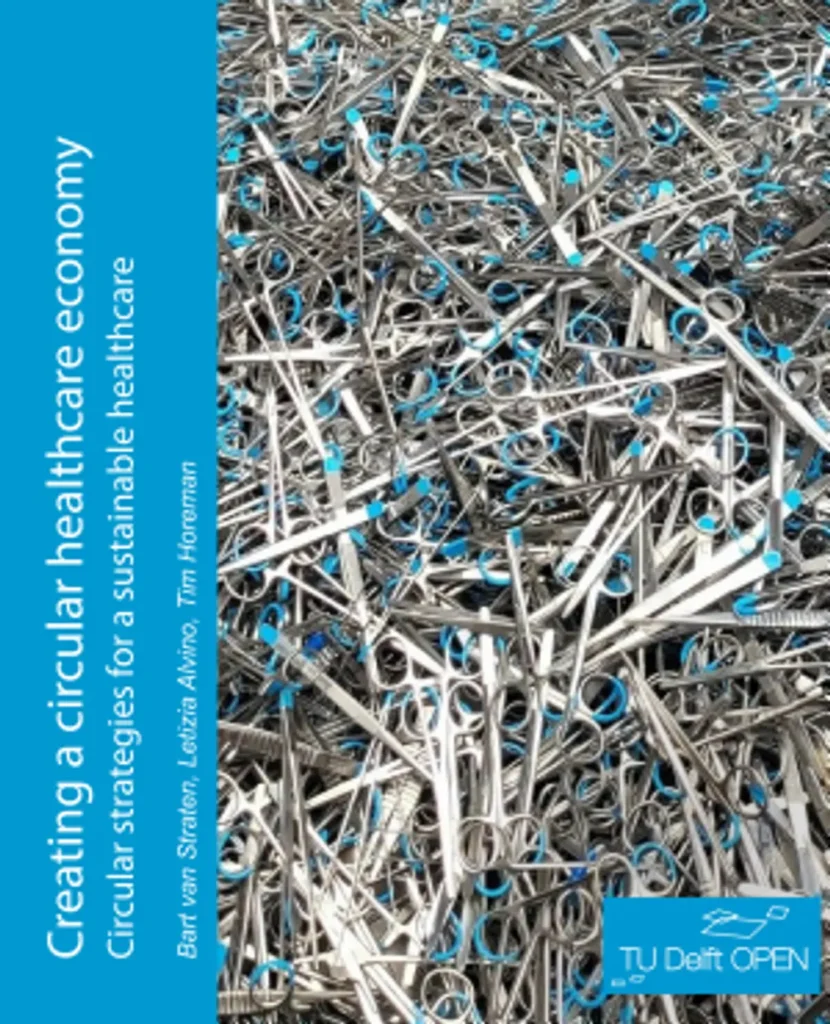
Creating a circular healthcare economy: Circular strategies for a sustainable healthcare
Not rated yetRate this bookCreating a Circular Healthcare Economy by Bart van Straten, Letizia Alvino, and Tim Horeman examines how design, collaboration, material recovery, and business models can reduce waste in healthcare. Ten chapters across three parts connect circular engineering principles with research cases involving surgical materials and products. This guide explains those cases as evidence to evaluate, keeping environmental ambitions connected to material performance, operational feasibility, and the requirements of healthcare use.
Free reading is available at the official source. Opens in a new tab.
 Free
About this book
Creating a Circular Healthcare Economy by Bart van Straten, Letizia Alvino, and Tim Horeman examines how design, collaboration, material recovery, and business models can reduce waste in healthcare. Ten chapters across three parts connect circular engineering principles with research cases involving surgical materials and products. This guide explains those cases as evidence to evaluate, keeping environmental ambitions connected to material performance, operational feasibility, and the requirements of healthcare use.
Chapter-wise summaries and study tasks
Chapter 1 The curse of global growth: Mass-consumption driven product design
The opening chapter connects resource pressure and waste with growth in consumption and increasingly complex products. Healthcare is part of this wider system: useful devices require materials and energy before they reach a hospital, and disposal creates consequences beyond the point of care. The authors challenge the assumption that a product’s environmental story begins only when it becomes waste. Readers should distinguish demand for effective care from the material arrangements used to deliver it. A linear purchasing pattern can make disposal appear inevitable even when design or service changes could reduce it. The chapter establishes the problem as a system of production, use, and end-of-life decisions rather than a failure that recycling alone can solve.
Study task. Map the lifecycle of a fictional healthcare product from raw material to disposal. Identify where material value is lost and which decisions occur before the hospital receives the product.
Chapter 2 Circular design engineering and the Butterfly Diagram
Circular engineering asks how products and materials can remain useful through maintenance, reuse, repair, refurbishment, remanufacturing, and recycling. The Butterfly Diagram helps organize biological and technical cycles and shows why recycling is only one strategy. Preserving a functioning product can retain more of its invested value than reducing it to raw material, although practical choices require context. The chapter connects these loops to design decisions: access to parts, disassembly, durability, and the ability to restore function influence which routes remain possible. Readers should separate an appealing loop on a diagram from the infrastructure needed to make it work. In healthcare, a return pathway also depends on validated handling and suitability for the intended use.
Study task. Compare repair, refurbishment, and recycling for a fictional nonclinical device. State the information required to choose among them and the design feature that would make each route easier.
Chapter 3 Designing a green (dream) team
A circular initiative depends on people and organizations as well as engineering. This chapter explains the role of a green team in coordinating expertise, influence, communication, and shared success criteria. Designers may understand materials, while clinicians, procurement staff, logistics specialists, and other participants understand different constraints. A technically workable product can fail if no one owns its collection or if the proposal conflicts with purchasing routines. Readers should define what success means before assembling a team and identify who can remove implementation barriers. Sharing results supports learning and commitment, but a positive story should remain grounded in measured outcomes. The chapter treats collaboration as a designed process with responsibilities rather than a general appeal for enthusiasm.
Study task. Plan a team for a hypothetical waste-reduction project. Assign expertise and decision responsibilities, identify an influential sponsor, and define a success measure and a communication milestone.
Chapter 4 Urban mining: The operating room as goldmine for raw materials
Hospital mining reframes discarded products as potential stocks of valuable materials. The chapter identifies opportunities in plastics, metals, and complex devices rather than treating all waste as one uniform stream. Material recovery depends on knowing composition and separating suitable streams, with logistics and safe handling integral to the proposal. A valuable constituent may be difficult to recover if it is combined with other materials or inaccessible within a device. Readers should connect economic potential to collection quality, transport, disassembly, and processing needs. The source’s account is a framework for investigation, not permission to improvise handling of clinical waste. Design for future recovery can reduce the difficulty encountered at end of life.
Study task. Create a desk-based inventory for a hypothetical hospital material stream. Record likely composition, contamination questions, separation needs, and the responsible specialists who would have to assess a recovery pathway.
Chapter 5 Turning surgical waste into new products
The surgical-waste case shows how a waste stream can become input for a new product through research and controlled development. The chapter follows recycled polypropylene toward an instrument-opening product, linking material characterization, processing, design, documentation, packaging, and later collection. Mechanical testing helps establish what a recovered material can support rather than assuming it retains every original property. The case also demonstrates that producing a prototype and establishing a product’s suitability are different achievements. Readers should trace how each decision affects the next stage, including whether the new item has another recovery route. Its significance lies in the connected circular system, not merely the novelty of making something from waste.
Study task. Draw the case’s chain from collected material to a new product and another recovery cycle. At each transition, identify the evidence needed about material quality, product function, or process control.
Chapter 6 Reprocessing metal waste from hospitals
Metal reprocessing requires attention to composition, coatings, oxidation, mechanical properties, and the demands of the new application. The chapter distinguishes ferrous and nonferrous materials and develops an experimental case using Zamak from discarded medical components. The alloy’s behavior during processing affects whether a new part can meet its requirements. A successful demonstration for one material and component cannot automatically be generalized to every metal device. Readers should compare retaining a product’s function through reuse with recovering material through recycling, since these preserve different forms of value. The broader lesson is that a circular claim needs a documented technical pathway and evidence about the output, not just a statement that metal is recyclable.
Study task. Compare two hypothetical metal recovery proposals by material identity, processing losses, output properties, and intended use. Explain which test result would most affect confidence in each proposal.
Chapter 7 Climate change as a business case
A circular business case connects environmental aims with costs, revenues, responsibilities, and risks. The chapter examines how repair and recycling strategies can create value for both hospitals and businesses, using a study of collected instruments and related opportunities. A persuasive proposal compares the current situation with an explicit alternative and explains who pays, who benefits, and what must change operationally. Avoided purchasing or disposal can matter, but collection and processing costs must also be visible. Readers should not equate a potential revenue stream with demonstrated net benefit. The Butterfly Diagram supports prioritization by asking whether a product can remain useful before a more resource-intensive recovery route is chosen.
Study task. Prepare a one-page hypothetical business case with a baseline, proposed loop, costs, savings, uncertainties, and responsibilities. Identify a condition under which the proposal would cease to be attractive.
Chapter 8 Eliminating waste by design: A Design by Dissection - Component Interaction analysis (DD-CIA)
Design by Dissection combined with Component Interaction Analysis examines how functions and interactions can be reorganized to reduce complexity. The chapter treats components as contributors to physical actions and flows, allowing a redesign to question whether separate parts or mechanisms are necessary. Examples show how one element can perform multiple functions and how a simpler concept may affect workflow, manufacturing, and eventual waste. Reducing part count is not sufficient if the result becomes difficult to clean, repair, or validate. Readers should trace functional requirements and interaction effects before claiming an improvement. The method encourages creative simplification while retaining an explicit account of how the whole system must perform.
Study task. Analyze a safe household object rather than medical equipment: list components, functions, and interactions, then propose one simplification. Explain a trade-off and a test needed before accepting the redesign.
Chapter 9 The myth revisited, behind the neurophysiological aspects of sustainability: Neuromarketing and sustainable buying behaviors
The marketing chapter examines sustainable purchasing through psychology, neuroscience, and consumer behavior. It distinguishes interest in environmental responsibility from the choices people make in a real buying situation. Attention, message framing, product features, price, and credibility can all influence interpretation. The source introduces physiological and neurophysiological research tools as ways to investigate aspects of response. Such measurements provide specific forms of evidence, not direct proof of every motive or a guarantee of purchasing behavior. Readers should also distinguish substantiated environmental information from greenwashing. Ethical communication makes the product’s actual environmental attributes understandable rather than using scientific language or green imagery to imply benefits that have not been established.
Study task. Evaluate a fictional green product claim by separating the environmental evidence from the persuasive presentation. Propose a research question and explain what a behavioral or physiological measure could and could not show.
Chapter 10 Reflection
The final reflection reconnects circular design, material recovery, collaboration, and market acceptance. It presents circularity as a transition involving products, processes, organizations, and future professional practice. Potential benefits include reduced resource dependence, lower waste, innovation, and resilience, but each should be assessed through an explicit comparison rather than assumed from the label circular. A loop that moves material may still consume substantial energy or shift burdens elsewhere. Readers should bring the earlier chapters together by identifying a realistic opportunity, the evidence needed, and the people responsible for progress. Education and industry collaboration can support experimentation when learning remains connected to transparent evaluation and the intended public benefit.
Study task. Create a proposal outline combining a circular design choice, stakeholder plan, material pathway, and evaluation approach. Include one possible burden shift and a criterion for revising or abandoning the idea.
How to study this book
- Follow the three-part progression: engineering principles, recovery cases, and a sustainable market. Keep a diagram linking each case’s material, process, product, and organizational requirements.
- Separate research feasibility, environmental comparison, business viability, and authorization for healthcare use. Evidence supporting one does not automatically establish the others.
- Use desk research and harmless nonclinical examples for these study tasks. Real clinical waste or device projects require the responsible institution’s validated processes, specialist assessment, and applicable current requirements.
Questions for reflection
- Which circular loop preserves the most useful value in your chosen context, and what evidence supports that judgment?
- Could an apparent waste reduction move environmental burdens to another stage?
- How would you distinguish a credible circular business case from an attractive prototype story?
Source edition and coverage
This guide covers the ten numbered chapters of the 2023 TU Delft OPEN book. Headings follow the contents list; some chapter-opening wording differs slightly. It summarizes the research and design reasoning rather than supplying procedures for processing clinical materials or approving medical products. This guide provides original explanations and learning tasks. Read the complete book at the publisher’s official source.
About access & copyright
This page provides book information and study material. Full-text access is provided by the original publisher or authorised source; a listing does not grant permission to republish the book.
Read our Library Access & Copyright policyExplore the contents
Check the chapters covered in this edition.
Visit the official source
See reading, preview or purchase options.
Save for later
Keep this textbook in your saved collection.
Reader ratings & reviews
Share your thoughts
Your review helps other students choose the right resources.
KEEP LEARNING
Your next great read
Math Econometrics and economic statistics
Introduction to Business Statistics Problem Ancillary Materials: Yukon Edition
View Introduction to Business Statistics Problem Ancillary Materials: Yukon Edition — book Nursing
Population Health for Nurses
View Population Health for Nurses — book Music Theory
Fundmentals of Music Theory
View Fundmentals of Music Theory — book Science
Physics
View Physics — book Mathematical Modeling
From theORy to application: learning to optimize with Operations Research in an interactive way
View From theORy to application: learning to optimize with Operations Research in an interactive way — book Business
Organizational Behavior
View Organizational Behavior — book Nursing
Nutrition for Nurses
View Nutrition for Nurses — book evidence-based HRM
Evidence Based HRM: What we know about people in workplaces
View Evidence Based HRM: What we know about people in workplaces — book Science



