
 Math
Music TheoryTextbook
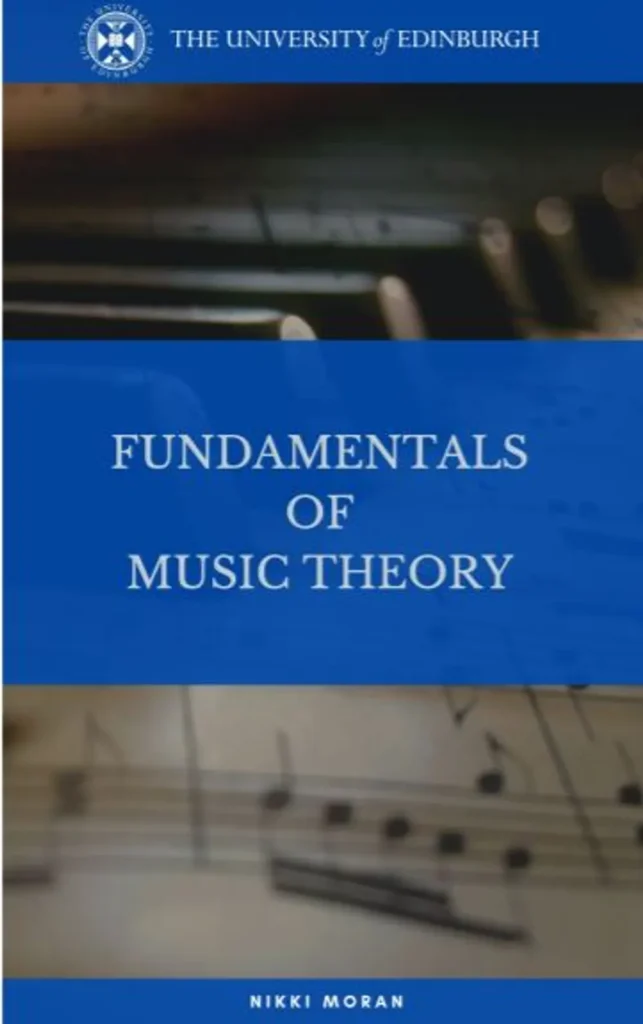
Fundmentals of Music Theory
Not rated yetRate this bookThis introductory music-theory resource by Nikki Moran, Michael Edwards, John Kitchen, Zack Moir, and Richard Worth links notation with listening and practical musicianship. Seven topics, numbered 0–6, move from the cultural setting of Western tonal theory to notes, scales, rhythm, chords, notation systems, harmonic function, and modulation. Video links, transcripts, written examples, and keyboard demonstrations support different ways of learning. The guide follows that topic sequence and encourages readers to hear, sing, play, and write each new idea rather than treating theory as a vocabulary exercise.
Free reading is available at the official source. Opens in a new tab.
 Free
About this book
This introductory music-theory resource by Nikki Moran, Michael Edwards, John Kitchen, Zack Moir, and Richard Worth links notation with listening and practical musicianship. Seven topics, numbered 0–6, move from the cultural setting of Western tonal theory to notes, scales, rhythm, chords, notation systems, harmonic function, and modulation. Video links, transcripts, written examples, and keyboard demonstrations support different ways of learning. The guide follows that topic sequence and encourages readers to hear, sing, play, and write each new idea rather than treating theory as a vocabulary exercise.
Chapter-wise summaries and reading tasks
Topic 0: Music theory in critical and global context
The opening topic establishes the scope and cultural position of the theory that follows. The book chiefly explains concepts developed within Western musical traditions; it does not present that system as a universal description of how all music must work. Its short lectures ask how a particular set of ideas became established and which musical experiences it makes easier or harder to describe. This framing gives readers permission to connect the material with their own listening and performance backgrounds while recognizing the limits of a notation system. Learning the rules therefore includes understanding what they are rules for. The topic can be revisited after some practical study, when questions about musical categories become more concrete.
Study task. Choose two pieces from different musical traditions. Describe something the coming notation system might capture well and something it might leave unexplained, without ranking either tradition.
Topic 1: Musical notes, scales, and the rudiments of notation
The first practical topic builds the relationship between pitch, written notation, and musical duration. Alphabetical note names are placed on a stave using clefs and ledger lines, and the octave explains the recurrence of note names at different pitch heights. Tones and semitones then provide the spacing needed to construct scales. Major, natural-minor, and modal patterns are introduced alongside basic note durations, so pitch reading and time reading begin together. The topic also forms simple triads and primary chords, connecting individual notes with combinations that support tonal music. A key learning move is to alternate between the symbol, its name, its physical location on an instrument, and its sound; knowing one representation does not automatically ensure fluency in the others.
Study task. Write a short ascending and descending scale in an appropriate clef, mark its semitone steps, and play or sing it. Build a major and a minor triad and compare their internal spacing.
Topic 2: Tonal music language - concepts and theory
Tonal language extends the initial scales through accidentals, key signatures, minor-key forms, and intervals. Sharps and flats alter pitch relationships so a scale can preserve its pattern when starting from a different tonic. A key signature supplies recurring alterations, while a local accidental operates within a more specific notation context. Minor scales have different forms because melodic and harmonic uses can demand different scale degrees. Intervals describe both a counted distance between letter names and a quality determined by semitone spacing; these are complementary parts of the label. Practising construction as well as recognition prevents key signatures from becoming a disconnected memory list. The aim is to understand how the written pattern organizes what is heard.
Study task. Construct the same major-scale pattern from two different starting notes. Label the required accidentals, compare the resulting key signatures, and identify several intervals by both number and quality.
Topic 3: Musical Time and Rhythm
Rhythm concerns the organization of durations relative to a beat, while metre groups beats into recurring patterns of emphasis. The topic develops note and rest values, tuplets, ties, dotted durations, and metrical groupings before connecting them with pickups, phrases, and larger forms. A tie joins durations of the same pitch; a dot changes the duration of the marked symbol. Reading rhythm therefore requires more than naming note shapes: the reader must maintain a pulse and hear how subdivisions fit within it. Formal labels describe relationships among musical sections, such as repetition and contrast, rather than prescribing one fixed emotional effect. Clapping, counting, and listening reveal distinctions that are easy to miss when looking only at the page.
Study task. Clap one rhythm against a steady pulse, then rewrite an equivalent duration using ties instead of a dotted value. Identify repeated and contrasting sections in a short recording and explain your labels.
Topic 4: More on Chords
The chord topic combines listening with the construction and use of triads and seventh chords. Chord quality depends on the arrangement of intervals above a root, so major, minor, diminished, and augmented structures should be heard as well as spelled. Diatonic chords connect these structures to a key, and harmonising a melody requires considering how melody notes relate to possible supporting chords. A chord choice is influenced by its musical context and motion, not merely by whether it contains a particular note. Adding a seventh expands the range of sonorities and their tendencies within tonal practice. Working across several keys helps distinguish a reusable interval pattern from a chord shape memorized in only one position.
Study task. Build contrasting triads on the same root and compare their sound. Harmonise a brief melody in two plausible ways, explaining how the melody notes and chord movement support each choice.
Topic 5: Music theory code-breaking reference guide
The reference topic helps readers navigate several symbolic languages used to describe related musical structures. Letter-based lead-sheet symbols, Roman-numeral analysis, and figured bass answer different questions: one may specify a chord’s named root and quality, another its relationship to a key, and another the intervals understood above a bass. These systems can refer to the same passage without being interchangeable. Distinguishing root from bass is essential, particularly when chords are inverted. Rather than treating every symbol as a separate definition to memorize, readers can translate a written chord into notes and then describe the same notes in another system. The reference is designed for repeated consultation as vocabulary and analytical fluency develop.
Study task. Select a simple chord in root position and inversion. Write its notes, bass, lead-sheet symbol, and a suitable Roman-numeral or figured-bass description, explaining the information each notation emphasizes.
Topic 6: Chord functions in practice
The final topic puts harmonic descriptions into musical motion. Inversions change which chord member appears in the bass without necessarily changing the root or basic chord identity. Their usefulness emerges through voice movement, stability, and the connections between successive harmonies. The demonstrations examine cadential effects, common progressions, and the way chords can support a phrase’s direction and ending. Modulation extends this reasoning by establishing a different tonal centre; it involves more than the appearance of one unexpected accidental. The listener must consider how the surrounding progression supports the new key. By comparing written examples with keyboard demonstrations, the reader learns to connect chord labels with the audible effect of a passage and the movement of individual parts.
Study task. Play or notate a short progression first with root-position chords and then with inversions. Compare the bass line, identify the cadence, and explain what further evidence would support a genuine modulation.
How to study this book
- Alternate reading with listening, singing, clapping, or playing. Check a theoretical label against an audible example whenever possible.
- Practise a pattern in several keys rather than memorizing one keyboard position or one written example.
- Keep a notebook linking each new term to a short notated example and your own explanation.
- Return to the reference topic when symbols become confusing, and distinguish the chord root, the sounding bass, and the tonal centre.
- Use the publisher’s video demonstrations alongside the PDF where listening or keyboard examples carry information that a transcript cannot fully convey.
Questions for reflection
- Why does the book explain its cultural scope before introducing notation?
- How can the same chord have different bass notes while retaining its identity?
- What evidence distinguishes a temporary chromatic note from a change of key?
Source edition and coverage
This guide follows all seven topic units, numbered 0–6, in the linked Edinburgh edition. It describes the source structure as topics rather than inventing a conventional chapter sequence. This original study guide explains the source in new wording and adds learning activities. Read the publisher’s book and complete exercises.
About access & copyright
This page provides book information and study material. Full-text access is provided by the original publisher or authorised source; a listing does not grant permission to republish the book.
Read our Library Access & Copyright policyExplore the contents
Check the chapters covered in this edition.
Visit the official source
See reading, preview or purchase options.
Save for later
Keep this textbook in your saved collection.
Reader ratings & reviews
Share your thoughts
Your review helps other students choose the right resources.
KEEP LEARNING
Your next great read
Math Econometrics and economic statistics
Introduction to Business Statistics Problem Ancillary Materials: Yukon Edition
View Introduction to Business Statistics Problem Ancillary Materials: Yukon Edition — book Nursing
Population Health for Nurses
View Population Health for Nurses — book Science
Physics
View Physics — book Mathematical Modeling
From theORy to application: learning to optimize with Operations Research in an interactive way
View From theORy to application: learning to optimize with Operations Research in an interactive way — book Business
Organizational Behavior
View Organizational Behavior — book Nursing
Nutrition for Nurses
View Nutrition for Nurses — book evidence-based HRM
Evidence Based HRM: What we know about people in workplaces
View Evidence Based HRM: What we know about people in workplaces — book Science
Microbiology
View Microbiology — book Social Sciences



