
 Math
Mathematical ModelingTextbook
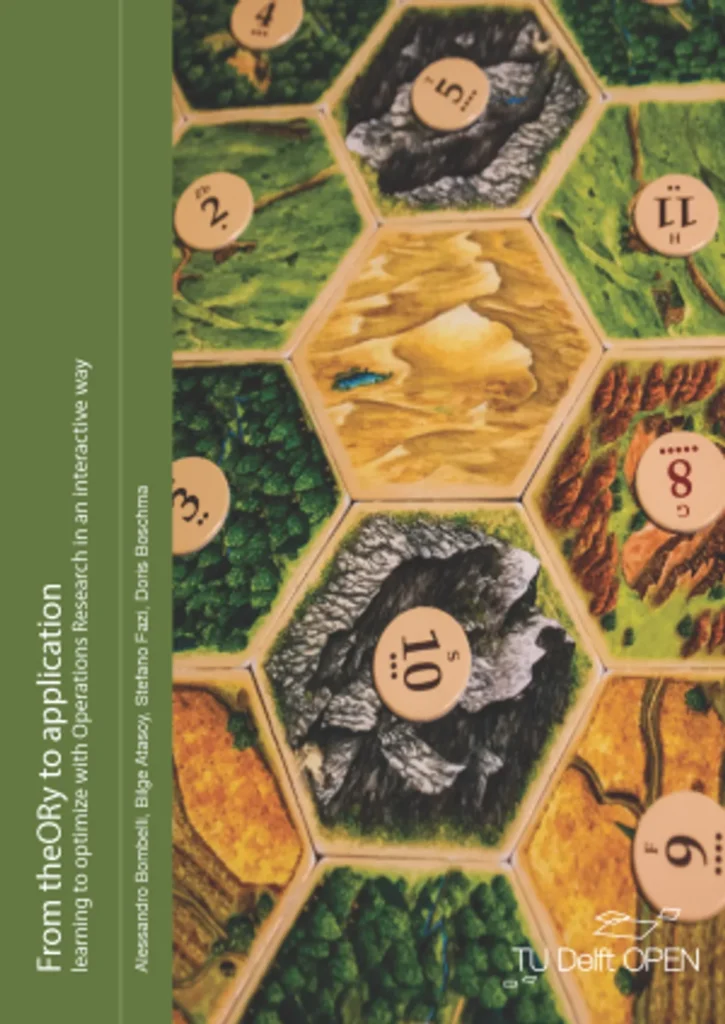
From theORy to application: learning to optimize with Operations Research in an interactive way
Not rated yetRate this bookFrom theORy to Application connects operations-research models and algorithms with interactive learning. Fourteen chapters across six parts move from mathematical modelling and linear algebra to simplex, integer optimization, assignment, packing, networks, routing, and two-stage stochastic programming. Serious games help readers experience trade-offs before formalizing them. This guide follows the numbered chapters and emphasizes the distinction between a model of a decision, a method for solving it, and the real situation against which the result must be checked.
Free reading is available at the official source. Opens in a new tab.
 Free
About this book
From theORy to Application connects operations-research models and algorithms with interactive learning. Fourteen chapters across six parts move from mathematical modelling and linear algebra to simplex, integer optimization, assignment, packing, networks, routing, and two-stage stochastic programming. Serious games help readers experience trade-offs before formalizing them. This guide follows the numbered chapters and emphasizes the distinction between a model of a decision, a method for solving it, and the real situation against which the result must be checked.
Chapter-wise summaries and reading tasks
Chapter 1 Introduction to Operations Research (OR)
Operations research frames decisions as choices among alternatives subject to objectives and restrictions. Its historical development explains why mathematical models became useful in coordinating complex systems. The opening chapter introduces modelling as selective abstraction: some features are retained because they affect the decision, while others are omitted. A model’s optimal answer is conditional on those choices and on the data supplied. Understanding who decides, which actions are controllable, and what counts as a good outcome is therefore prior to computation. This perspective prevents an elegant algorithm from being mistaken for a complete solution to an ill-defined practical problem.
Study task. Describe a resource-allocation problem in plain language. Identify the decision-maker, controllable choices, objective, constraints, and an omitted feature that could affect implementation.
Chapter 2 Introduction to serious games and gamification
Serious games and gamification introduce interactive ways to learn about decisions and optimization. The chapter distinguishes a game built around an educational purpose from the use of game elements within a broader learning activity. Feedback and repeated attempts can reveal trade-offs that are difficult to appreciate from notation alone. However, a high score is not the same as understanding why a strategy works. Debriefing should connect observed outcomes with modelling assumptions, constraints, and solution quality. The source explains how its learning activities are organized so the reader can move from experience to a formal description and then back to testing.
Study task. After a small decision game, record the strategy used, the feedback received, and one model assumption revealed by the result. Explain what the score alone fails to demonstrate.
Chapter 3 A primer on linear algebra
Linear algebra supplies compact representations for optimization models. Vectors organize quantities, matrices represent relationships, and linear systems connect multiple equations. The chapter reviews the operations and structures needed to read later formulations, with attention to dimensions and consistency. A matrix product is meaningful only when its sizes and interpretation agree; changing the order can change the result or make the operation undefined. The purpose is not isolated manipulation but an ability to recognize how many decisions and restrictions a model contains. Understanding a simple system geometrically also prepares readers to interpret feasible regions in linear programming.
Study task. Represent a two-resource allocation problem as a matrix inequality. Label the dimensions and units of each matrix and vector, then interpret one row in words.
Chapter 4 Introduction to mathematical modeling
Mathematical modelling separates sets, parameters, decision variables, an objective, and constraints. The chapter develops those components before combining them into a complete formulation. Special logical conditions require particular care: either-or choices, fixed charges, and a specified number of active conditions cannot simply be written as ordinary continuous arithmetic. Binary variables and big-M constructions provide modelling tools, but their bounds and interpretation must be justified. A good formulation defines exactly what is allowed and what is optimized. Checking a few small examples by hand can expose missing restrictions or unintended feasible decisions before a solver hides the error behind a plausible objective value.
Study task. Formulate a small selection problem with a fixed activation cost. Define each variable and bound, then test a feasible, infeasible, and boundary-case decision against the model.
Chapter 5 Linearization techniques
Linearization transforms certain expressions into formulations that linear optimization methods can handle. The chapter considers products involving binary variables, absolute values, piecewise-linear relationships, and conditional statements. The replacement is useful only if it preserves the intended feasible choices and objective interpretation under its stated bounds. A formulation that works for two binary variables may not remain valid for unrestricted continuous variables. Likewise, approximating a nonlinear curve with segments introduces a modelling choice rather than an exact identity in every case. Readers should examine both directions of equivalence and distinguish an exact reformulation from a controlled approximation.
Study task. Choose a binary-variable product or absolute-value expression and construct its linear formulation. Verify it on all binary cases or on representative boundary values.
Chapter 6 The simplex method
The simplex method connects the geometry of a linear program with a systematic movement between basic solutions. The chapter introduces feasible regions and corner points before augmented formulations, slack or artificial constructions where needed, and tableau operations. Each pivot changes the basis while preserving the underlying relationships. Stopping requires a justified optimality condition, and special cases such as infeasibility or unboundedness need different interpretations. The objective is to understand why an iteration is permitted and what it says about the solution. A short hand-worked example is more instructive than treating the tableau as an unexplained sequence of arithmetic rules.
Study task. Solve a two-variable linear program graphically and compare the result with a simplex solution. Explain the meaning of the selected entering and leaving variables.
Chapter 7 Branch & Bound (BB)
Branch and bound addresses discrete decisions by dividing the search space and using bounds to avoid exploring every possibility. A relaxed problem can provide a limit on the best objective attainable within a branch, while an incumbent records the best feasible discrete solution found. These have different roles and should not be confused. Nodes can be discarded when they are infeasible, already resolved, or unable to improve the incumbent under the appropriate objective convention. Branching rules affect efficiency without changing the underlying optimization task. The optimality gap communicates remaining uncertainty about solution quality, not the distance between arbitrary trial solutions.
Study task. Draw a small branch-and-bound tree and label one incumbent and several bounds. Justify why a selected node can be pruned and interpret the remaining optimality gap.
Chapter 8 Branch & Cut (BC)
Branch and cut strengthens a branch-and-bound approach by adding valid inequalities that exclude unwanted relaxed solutions while retaining the relevant integer-feasible solutions. The chapter introduces several cut families, including Gomory, cover, and zero-half ideas. A useful cut must be valid for the intended discrete problem; eliminating an inconvenient fractional point is insufficient if it also removes a legitimate optimum. Stronger relaxations can improve bounds and reduce search, although generating and managing cuts also has a computational cost. The chapter links formulation strength with algorithmic performance rather than presenting branching and cutting as unrelated techniques.
Study task. Use a small integer model to identify a fractional relaxation solution. Propose or interpret a valid inequality and explain why it preserves all legitimate integer choices.
Chapter 9 Assignment and scheduling problems
Assignment and scheduling allocate tasks, resources, or facilities under different operational restrictions. The chapter develops assignment structure and the Hungarian algorithm, then considers single- and parallel-machine scheduling, p-median, and facility-location problems. Similar-looking allocation questions can have very different objectives: minimizing completion time, assignment cost, travel distance, or the expense of opening facilities. Variable definitions and constraints must reflect whether tasks can be split, machines can work simultaneously, or locations have capacity. Recognizing these distinctions helps readers select a suitable model rather than force every allocation problem into one familiar template.
Study task. Compare assigning workers to jobs with scheduling jobs on machines. Specify the objective and a key constraint for each, then explain why a valid assignment alone may not define a feasible schedule.
Chapter 10 Packing problems
Packing problems combine limited capacity with decisions about which items to include and how to arrange them. Knapsack variants typically optimize value within capacity, while bin-packing variants focus on fitting items into containers and often minimizing the number used. The chapter extends these ideas to multiple capacities and geometric restrictions. A solution based only on total volume or weight can fail when spatial arrangement matters. Variable bounds distinguish one-time selection from bounded repetition, and an apparently attractive local choice may prevent a better overall combination. Small examples make those trade-offs visible before the formulation becomes more complex.
Study task. Construct a small example where choosing the highest-value item first is not optimal. Compare its knapsack objective with a bin-packing version of the same item set.
Chapter 11 An introduction to graph theory
Graph theory describes relationships through vertices and edges or arcs. The chapter develops basic properties and then connects abstract graphs with concrete networks. Direction, weights, connectivity, paths, and cycles determine which questions a representation can answer. A graph is a modelling choice: an edge might mean a permitted trip, a cost, or an interaction, and those meanings cannot be assumed to be identical. Translating the physical situation carefully helps prevent errors such as treating a one-way connection as reversible. The vocabulary introduced here supports the network and routing algorithms that follow.
Study task. Represent a small transport or communication system as a graph. Explain what vertices, arcs, and weights mean and identify a practical feature the graph does not capture.
Chapter 12 Network problems
Network optimization includes transportation, maximum flow, minimum-cost flow, colouring, shortest paths, and spanning trees. Each imposes a different objective and set of restrictions on graph structure. Flow models require conservation at appropriate nodes and respect capacities, while a shortest path and a minimum spanning tree solve different coverage questions. The chapter also introduces column generation as a way to work with a restricted set of variables and add useful ones systematically. Recognizing the structure of a problem can reveal a more efficient solution approach than treating it as an arbitrary general model. Interpretation remains essential: a mathematically feasible flow must correspond to a sensible physical movement.
Study task. Compare the shortest path between two locations with a tree connecting every location. For a flow problem, write the balance equation at an intermediate node and explain its meaning.
Chapter 13 Routing problems
Routing decides sequences of visits as well as allocation. The travelling-salesman problem asks for a tour, while vehicle-routing variants add multiple vehicles and practical restrictions. Capacity, time windows, split deliveries, depots, and pickup–delivery relationships can fundamentally change feasibility. A locally short journey may create an impossible later arrival or an overloaded vehicle. The chapter surveys models and methods while highlighting the difference between proving optimality and finding a useful feasible route. Explicitly recording assumptions makes it possible to judge whether a simplified solution remains relevant when operational details are restored.
Study task. Design a tiny delivery case and identify a tour that becomes infeasible after adding time windows or capacity. Explain which formulation components must change to represent the new restriction.
Chapter 14 Two-stage stochastic programming
Two-stage stochastic programming separates decisions made before uncertainty is resolved from later recourse actions. Scenarios describe possible outcomes, and the model balances the initial commitment with the expected consequences of adapting afterwards. A decision cannot use information that was unavailable when it had to be made, so the timing of knowledge is central. The framework differs from substituting average input values into a deterministic model because later adjustments can have asymmetric costs and constraints. Readers should examine how scenarios, probabilities, and recourse options affect the recommended plan and how sensitive that plan is to the uncertainty description.
Study task. Define a first-stage capacity decision and a second-stage response to uncertain demand. Explain why a plan based only on average demand could differ from the stochastic solution.
How to study this book
- Translate each problem into decisions, data, objective, and restrictions before selecting a solution method.
- Use small hand-checkable instances to verify a formulation and understand an algorithm’s stopping rule.
- After an interactive activity, explain the trade-off in mathematical language and identify what the game simplifies.
- Report feasibility, objective value, assumptions, and any optimality gap together.
- Test sensitivity to important costs, capacities, and uncertainty assumptions before interpreting a model as a practical recommendation.
Questions for reflection
- How can an optimal solution to a correct mathematical formulation still be unsuitable in practice?
- What distinguishes a bound from an incumbent in discrete optimization?
- Why does uncertainty timing matter in a two-stage model?
Source edition and coverage
The guide covers all fourteen numbered chapters across the source’s six parts. Interactive games and exercises remain at the publisher’s linked source. This original study guide explains the source in new wording and adds learning activities. Read the publisher’s book and complete exercises.
About access & copyright
This page provides book information and study material. Full-text access is provided by the original publisher or authorised source; a listing does not grant permission to republish the book.
Read our Library Access & Copyright policyExplore the contents
Check the chapters covered in this edition.
Visit the official source
See reading, preview or purchase options.
Save for later
Keep this textbook in your saved collection.
Reader ratings & reviews
Share your thoughts
Your review helps other students choose the right resources.
KEEP LEARNING
Your next great read
Math Econometrics and economic statistics
Introduction to Business Statistics Problem Ancillary Materials: Yukon Edition
View Introduction to Business Statistics Problem Ancillary Materials: Yukon Edition — book Nursing
Population Health for Nurses
View Population Health for Nurses — book Music Theory
Fundmentals of Music Theory
View Fundmentals of Music Theory — book Science
Physics
View Physics — book Business
Organizational Behavior
View Organizational Behavior — book Nursing
Nutrition for Nurses
View Nutrition for Nurses — book evidence-based HRM
Evidence Based HRM: What we know about people in workplaces
View Evidence Based HRM: What we know about people in workplaces — book Science
Microbiology
View Microbiology — book Social Sciences



