
 English Literature
Plays
As You Like It
William Shakespeare; complete source text.
Not rated yetRate this bookAs You Like It moves from households and a court governed by exclusion into the Forest of Arden, where displaced people try out alternative identities and relationships. Rosalind's disguise lets her direct much of the courtship while testing the difference between romantic performance and practical understanding. This guide follows all five acts, the four marriages, the political restoration, and Rosalind's Epilogue.
 Free
About this book
As You Like It moves from households and a court governed by exclusion into the Forest of Arden, where displaced people try out alternative identities and relationships. Rosalind's disguise lets her direct much of the courtship while testing the difference between romantic performance and practical understanding. This guide follows all five acts, the four marriages, the political restoration, and Rosalind's Epilogue.
The hosted PDF is Academic Master’s 2026 formatting of Project Gutenberg eBook #1523, first released in 1998. It contains the complete source text and Gutenberg notices. Its displayed 101-page count refers to PDF sheets, including front matter and notices, rather than the pagination of an early printed edition.
Academic relevance. The University of Oxford publishes Emma Smith’s Approaching Shakespeare lecture on As You Like It. This documents university teaching relevance without implying that this particular PDF is assigned. View the institutional source
Editorial suitability: undergraduate English literature and drama students practising close reading, with guidance where unfamiliar language requires it. This is Academic Master’s assessment, rather than a level stated by the author.
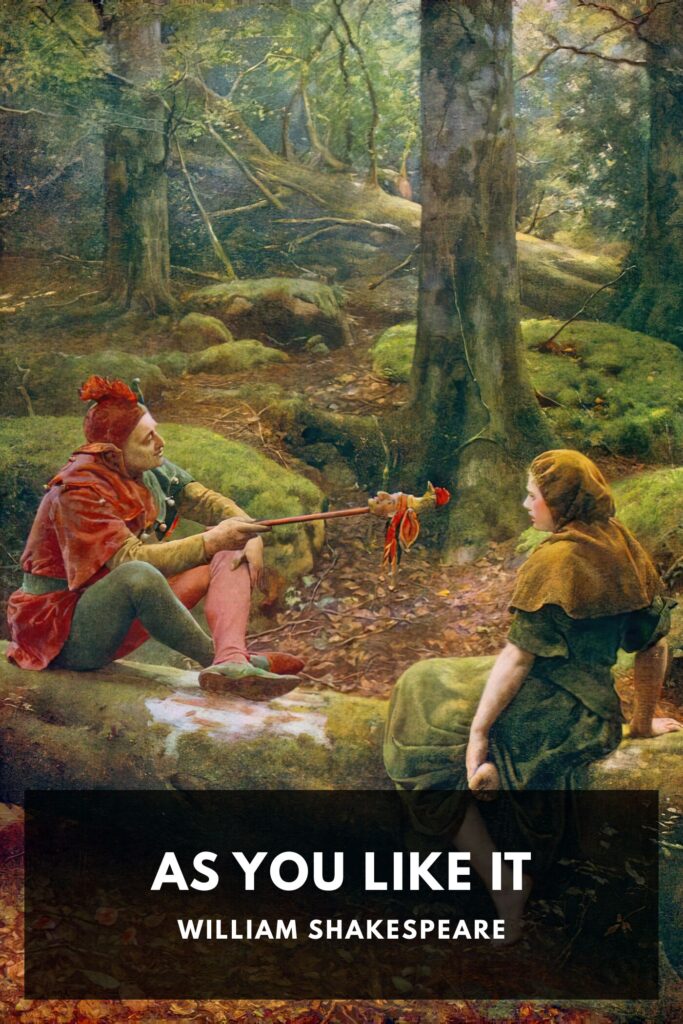
Cover image: Standard Ebooks edition. The hosted PDF uses the Project Gutenberg source described above.
Source licence: Full Project Gutenberg License. Required source notices and licence terms are retained in the downloadable files.
Book summary
About this work
As You Like It moves from households and a court governed by exclusion into the Forest of Arden, where displaced people try out alternative identities and relationships. Rosalind's disguise lets her direct much of the courtship while testing the difference between romantic performance and practical understanding. This guide follows all five acts, the four marriages, the political restoration, and Rosalind's Epilogue.
Act-by-act summaries
Act I — Dispossession and chosen companionship
Orlando protests that his brother Oliver has denied him the education and position appropriate to their family. Oliver's hostility turns a wrestling match into an opportunity to endanger him. Orlando nevertheless defeats Charles and attracts Rosalind, the daughter of the banished Duke Senior. Her cousin Celia remains loyal despite being the daughter of Duke Frederick, who has displaced Rosalind's father. Frederick then orders Rosalind into exile. Celia chooses to leave with her, demonstrating an allegiance that cuts across their fathers' political division. Rosalind adopts the male identity Ganymede, Celia becomes Aliena, and Touchstone accompanies them. The act connects material dependence with the power to define another person's place: affection alone cannot protect Orlando or Rosalind while hostile relatives control their households.
Act II — Entering a forest that still requires food
Duke Senior describes exile in Arden through the language of freedom from courtly flattery, but cold, hunting, and hunger complicate any easy picture of natural happiness. Jaques's response to an injured deer introduces criticism of the exiles' own conduct. Adam warns Orlando about Oliver's murderous intentions and offers savings and service to support their escape. Rosalind and Celia also arrive exhausted and arrange to purchase a cottage and pastoral resources through Corin. When Orlando interrupts the Duke's meal with a drawn sword, he discovers that hospitality can obtain what force seemed necessary to secure. Jaques's speech on the stages of life follows within this context of strangers being welcomed. The forest changes social possibilities without abolishing bodies, labor, ownership, or need.
Act III — The disguised teacher of love
Frederick orders Oliver to find Orlando, extending the court's coercion into the brothers' story. In Arden, Orlando hangs love verses on trees. Rosalind discovers them and, as Ganymede, offers to cure his infatuation by having him court the supposed boy as though he were Rosalind. This creates a performance within the plot: Orlando can rehearse love while Rosalind hears his language without revealing her position. Touchstone's pursuit of Audrey and Corin's practical perspective provide alternatives to elevated romantic convention. Meanwhile, Silvius loves Phoebe, who rejects him and becomes attracted to Ganymede after being rebuked. Rosalind's disguise therefore creates a new problem even while giving her control over her own courtship. The act asks who benefits from idealization and who must endure the demands it places on its object.
Act IV — Rehearsal, danger, and a reformed brother
Rosalind tests Orlando's punctuality, exaggerations, and expectations of married life. Celia participates in a mock marriage, allowing the play to stage commitment before its identities can be openly reconciled. Jaques offers another skeptical account of experience, which Rosalind challenges rather than simply accepting as wisdom. Oliver then arrives with news that Orlando saved him from a lioness despite their history of hostility. The rescue occurs offstage and reaches the audience through Oliver's account and a bloodied cloth. His transformation and sudden attraction to Celia introduce a rapid conversion alongside the slower education of the principal lovers. Rosalind faints at the news of Orlando's injury and attempts to explain it as acting, showing how the disguise can fail to contain bodily feeling.
Act V — Promises, marriages, and restoration
The competing courtships are brought together through promises Rosalind arranges while still appearing as Ganymede. She then returns in her own identity, resolving Orlando's uncertainty and Phoebe's attachment to the disguised figure. Hymen's appearance gives ceremonial form to four pairings: Rosalind and Orlando, Celia and Oliver, Phoebe and Silvius, and Audrey and Touchstone. News also arrives that Frederick has abandoned his political project after meeting a religious man and restored the dukedom. Jaques chooses to seek the converted ruler rather than join the festivities. Rosalind's Epilogue steps beyond the fiction and addresses the audience about receiving the play. The conclusion combines negotiated commitments with sudden reports of change, leaving readers to ask how differently each reconciliation has been prepared.
Arden as a place of testing
Do not equate the forest with a society outside all power. Characters still buy property, depend on service, hunt animals, negotiate status, and imagine returning to a restored court. Its distinctive freedom lies partly in the temporary loosening of familiar identities. Rosalind uses that freedom to investigate love from a position unavailable to her at the beginning, while the audience knows both roles she performs. Compare her pragmatic skepticism with Jaques's melancholy and Touchstone's mockery; none alone exhausts the play's account of human relationships. Also consider the uneven distribution of final choice: Phoebe's promise binds her to Silvius, while other matches emerge through mutual attraction or rapid conversion. Festive closure can contain different degrees of consent and knowledge.
Study instructions
- Map the two pairs of hostile brothers alongside the loyal cousins, identifying what changes each relationship.
- Keep a list of material needs in Arden: food, shelter, wages, property, and protection. Test the claim that nature removes social inequality.
- Annotate a Ganymede-Orlando conversation for what Orlando thinks is happening and what Rosalind is actually learning.
- Compare Oliver's reported conversion with the more extended courtship rehearsals before the ending.
- Read Rosalind's Epilogue separately from the marriages and explain how it changes the speaker's relationship with the audience.
Questions for reflection
- What can Rosalind say as Ganymede that she could not safely say at court?
- Does the play offer a cure for romantic idealization or a more skillful way of living with it?
- How far does the restoration of the dukedom preserve the discoveries made in exile?
Sources and coverage
This original study guide follows the complete work in the linked Project Gutenberg edition and includes the ending. Poem numbers and act divisions follow that source; thematic reading groups are editorial aids, not additional chapters of the original. Plot summary and interpretation are distinguished through the reading questions. Historical title-page attributions do not by themselves settle authorship. Read the source text; Edition details.
About access & copyright
Check this edition’s source and licence before reusing its files or content. A library listing does not grant additional rights.
Read our Library Access & Copyright policyInheritance
Explain Orlando’s claim to education and a material portion.
Character reports
Compare Oliver’s allegations with his private admission.
Performance
Study the contest as sport, danger and public judgement.
Affection
Contrast the brothers’ hostility with the cousins’ support.
Reader ratings & reviews
Share your thoughts
Your review helps other students choose the right resources.
KEEP LEARNING
Your next great read
English Literature English Literature
Thomas Lord Cromwell
View Thomas Lord Cromwell — book English Literature
Sir John Oldcastle
View Sir John Oldcastle — book English Literature
The Merry Devil of Edmonton
View The Merry Devil of Edmonton — book English Literature
The Puritan Widow
View The Puritan Widow — book English Literature
The London Prodigal
View The London Prodigal — book English Literature
King Edward III
View King Edward III — book English Literature
Fair Em
View Fair Em — book English Literature
Arden of Feversham
View Arden of Feversham — book English Literature



