
 History
Textbook
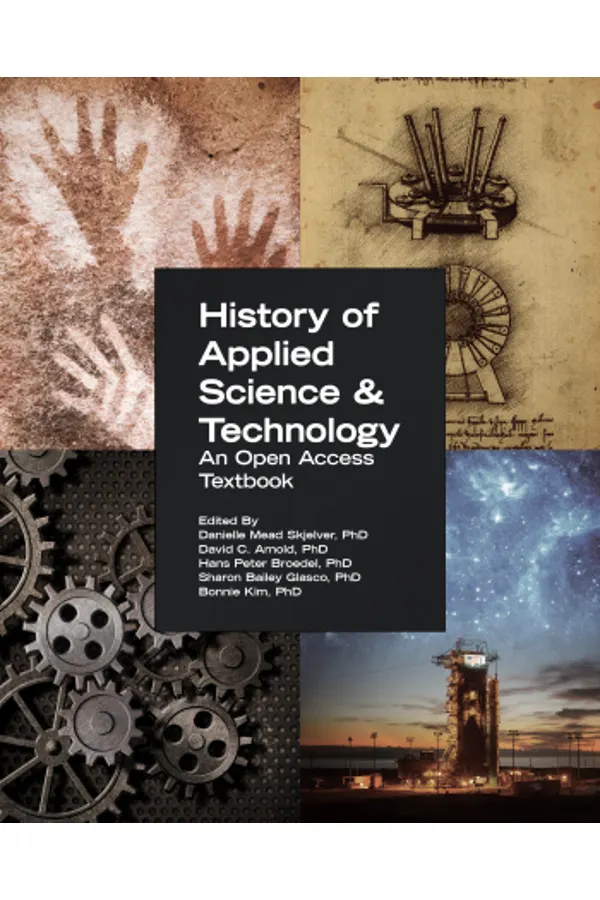
History of Applied Science & Technology : An Open Access Textbook
Not rated yetRate this bookHistory of Applied Science & Technology examines how tools, knowledge, institutions, and societies have shaped one another. This guide follows the fuller publisher edition’s available chapters and source exercises, preserving its nonconsecutive numbering rather than implying a complete chronological sequence.
Free reading is available at the official source. Opens in a new tab.
 Free
About this book
History of Applied Science & Technology examines how tools, knowledge, institutions, and societies have shaped one another. This guide follows the fuller publisher edition’s available chapters and source exercises, preserving its nonconsecutive numbering rather than implying a complete chronological sequence.
How to study this book
For each case, identify the technology or knowledge claim, the people and institutions involved, available evidence, and the social conditions shaping its use. Distinguish invention from adoption and historical explanation from a story of inevitable progress. Compare sources and note whose experience is missing.
Chapter-wise explanations and study tasks
Introduction: Historical Questions and Scope
The introduction frames the book as a collaborative, evolving account with global ambitions and gaps. Treat its selected contributions as cases for historical reasoning. A sequence of inventions alone does not explain who could use them or why they mattered.
Study task: Write a historical question about a technology that requires evidence about users or institutions as well as the device itself.
Prehistory
Prehistory requires reasoning from material and environmental evidence where written records are unavailable. Tools, subsistence, and changing practices can be interpreted through several explanations. Separate what an object demonstrates from a broader inference about its makers.
Study task: Choose a prehistoric technology discussed in the source and distinguish observation, plausible inference, and an unresolved question.
Chapter 1. Mesopotamia and the Fertile Crescent
Agriculture, irrigation, writing, labour specialization, and political organization interact in the chapter’s cases. Technical change can create new dependencies as well as opportunities. Compare city-state and empire examples without reducing social change to a single invention.
Study task: Create a causal diagram connecting water management, labour, record keeping, and authority, marking relationships that need additional evidence.
Chapter 2. Indus Valley and Vedic India
Agriculture, manufacture, trade, and writing provide different lines of evidence for understanding these societies. The discovery and interpretation of the Indus civilization also show how historical accounts change. Avoid treating uncertain evidence as a settled narrative.
Study task: Compare two technologies or practices across the source’s periods and explain what the evidence can and cannot establish.
Chapter 3. Ancient Egypt and African Technologies
Metallurgy, medicine, ironworking, and textiles demonstrate the variety of technical knowledge and evidence. Material culture can reveal processes and social relationships that textual histories miss. Compare specific contributions without merging distinct African regions and periods.
Study task: Analyse one material object or technical practice through production, expertise, use, and the limits of the surviving evidence.
Chapter 5. Medieval Europe
Agriculture, warfare, towns, trade, universities, and science connect technical practices with institutions. The chapter challenges simple assumptions of technological stagnation. Its primary-source work asks readers to interpret texts within their purposes and contexts.
Study task: Compare a technical change with an institutional development and explain how each influenced the other.
Chapter 8. Cannon and Fortresses
The available early-modern contribution examines interactions between artillery and fortification. Technology changes both practical possibilities and the resources required to respond. Avoid describing military developments as a purely mechanical competition detached from social organization.
Study task: Draw a feedback diagram connecting artillery, defensive design, resources, and strategic choices.
Chapter 9. Classification, Anthropology, and Encyclopedias
The contributions examine changing approaches to human difference and the organization of knowledge. Scientific classification can interact with social assumptions and power. Distinguish description of a historical theory from endorsement of its categories or conclusions.
Study task: Compare two historical classification projects and identify their evidence, assumptions, and social implications.
Chapter 12. Computing, Invention, and Electrification
Lovelace, Edison, Tesla, and electrification illustrate connections among theory, devices, collaboration, and systems. An inventor-centred narrative can conceal infrastructure and other contributors. Compare a technical concept with the conditions needed for widespread use.
Study task: Trace one innovation from idea to wider application, identifying at least three contributors or enabling conditions.
Chapter 14. Deep Time, Evolution, and Women Doctors
The chapter connects geological and biological changes in understanding with a separate historical study of women’s medical networks. Evidence, debate, and professional access shape these accounts. Do not assume the different contributions make one continuous argument.
Study task: Compare how evidence changed an explanation of nature with how professional networks affected access to medical work.
Primary Sources and Doing History
The supporting material includes guidance on sources and correspondence involving Elizabeth Blackwell and Florence Nightingale. A letter is evidence produced for a particular audience and purpose. Read its silences and context alongside its explicit statements.
Study task: Analyse one letter for author, recipient, purpose, context, claims, and limitations, then explain what another source would need to corroborate.
Applied assignment
Write a comparative historical essay using two available chapters and one primary source. Explain a relationship between technology or knowledge and social organization, test an alternative interpretation, and identify limits in the evidence. Include a timeline and a note on the edition’s coverage gaps.
Suggested reading plan
Begin with the introduction, prehistory, and source guidance. Study chapters 1–3 comparatively, then 5 and 8 for institutional and military change. Read 9, 12, and 14 as distinct thematic contributions, returning to source analysis throughout. Do not fill missing chapter numbers with assumed content.
Questions for reflection
- What distinguishes invention, adoption, and widespread use?
- Whose work disappears in an inventor-only explanation?
- How does a primary source’s purpose limit the conclusions drawn from it?
Edition and source notes
The original linked repository PDF contained only a short women-doctors excerpt. The Download PDF link has been corrected to the verified fuller publisher export, whose introduction discusses the 2021 print publication. That edition includes prehistory and chapters 1, 2, 3, 5, 8, 9, 12, and 14, plus supporting material; it remains an evolving collection with nonconsecutive coverage. These are original study explanations.
About access & copyright
This page provides book information and study material. Full-text access is provided by the original publisher or authorised source; a listing does not grant permission to republish the book.
Read our Library Access & Copyright policyExplore the contents
Check the chapters covered in this edition.
Visit the official source
See reading, preview or purchase options.
Save for later
Keep this textbook in your saved collection.
Reader ratings & reviews
Share your thoughts
Your review helps other students choose the right resources.
KEEP LEARNING
Your next great read
History citizenship
The European Experience: A Multi-Perspective History of Modern Europe, 1500–2000
View The European Experience: A Multi-Perspective History of Modern Europe, 1500–2000 — book Africa
History of International Relations: A Non-European Perspective
View History of International Relations: A Non-European Perspective — book Canada
Canadian History: Post-Confederation - 2nd Edition
View Canadian History: Post-Confederation - 2nd Edition — book Canada
Canadian History: Post-Confederation
View Canadian History: Post-Confederation — book History
 in the Making: A History of the People of the United States of America to 1877
View History in the Making: A History of the People of the United States of America to 1877 — bookMathematical Methods for Physics
Mathematical Methods for Physics
View Mathematical Methods for Physics — bookPrinciples of Development : An Inquisitive Journey into Embryology
Principles of Development : An Inquisitive Journey into Embryology
View Principles of Development : An Inquisitive Journey into Embryology — bookLe Littéraire dans le quotidien : Resources for a transdisciplinary approach to reading/writing at the first and second year levels of college French
Le Littéraire dans le quotidien : Resources for a transdisciplinary approach to reading/writing at the first and second year levels of college French
View Le Littéraire dans le quotidien : Resources for a transdisciplinary approach to reading/writing at the first and second year levels of college French — bookOperations Management



