
Introduction to Space Syntax in Urban Studies
Business enterprises—FinanceTextbook
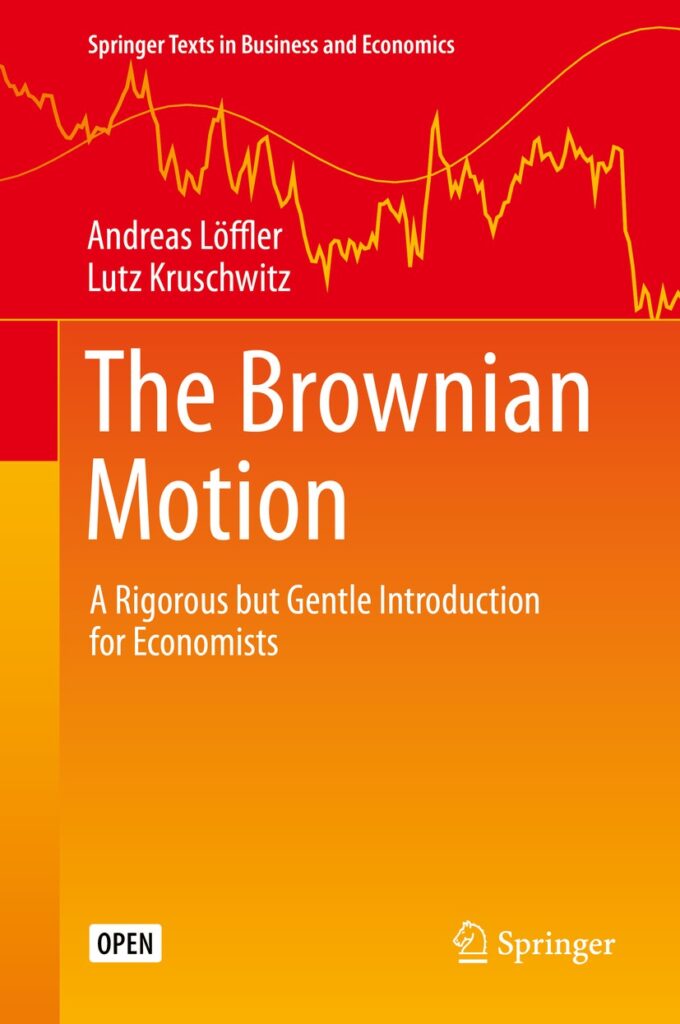
The Brownian Motion
Not rated yetRate this bookThe Brownian Motion explains the mathematical structure behind a central model of continuous-time economics and finance. Andreas Löffler and Lutz Kruschwitz develop sets, measurable events, random variables and integration before constructing Brownian motion on a space of paths. This guide follows all seven chapters of the 2019 edition, including its optional supplements.
Free reading is available at the official source. Opens in a new tab.
 Free
About this book
The Brownian Motion explains the mathematical structure behind a central model of continuous-time economics and finance. Andreas Löffler and Lutz Kruschwitz develop sets, measurable events, random variables and integration before constructing Brownian motion on a space of paths. This guide follows all seven chapters of the 2019 edition, including its optional supplements.
How to study this book
Begin with elementary probability and calculus, but expect to rebuild familiar terms more precisely. Keep the spaces and functions in each definition explicit. For every abstract concept, work a finite example first and then identify what changes in an infinite or continuous setting. The book develops mathematical foundations; resemblance between a simulated path and observed prices is not a validation of a financial model.
Chapter-wise explanations and study tasks
Chapter 1: Introduction
The authors introduce the mathematical vocabulary behind continuous-time financial theory and explain why intuition needs precise definitions. Brownian motion should not be understood simply as a jagged line resembling a stock-price chart. Its meaning depends on a probability structure and properties of a stochastic process. The introductory discussion motivates the sequence from sets through measures and integration to a construction on path space. Keep mathematical claims distinct from claims that a model accurately describes an economic market. The book supplies conceptual foundations rather than a guarantee about real asset prices, and its examples are intended to clarify definitions before more advanced applications.
Study task: Write two questions separately: what makes a process Brownian motion, and whether a particular observed series is well represented by that model. Explain why evidence for one does not settle the other.
Chapter 2: Set Theory
Set theory provides the language for describing possible outcomes, events and functions. Membership, subsets, unions, intersections and complements become tools for expressing uncertain statements precisely. Distinguish an elementary outcome from an event containing one or more outcomes, and distinguish a set from a numerical measure assigned to it. Translating a verbal event into set notation exposes ambiguity before probabilities are calculated. Infinite settings require additional care because familiar counting intuitions may fail. The chapter builds the foundation needed to understand collections of measurable events and later random variables as functions defined on an outcome space.
Study task: Define a small outcome space and express two overlapping events using set notation. Identify their intersection, union and complements without yet assigning probabilities.
Chapter 3: Measures and Probabilities
A measure assigns sizes to suitable sets according to specified rules; probability is a normalized instance of that idea. The chapter introduces sigma-algebras as collections of events on which the probability assignment is defined and connects them with information that can distinguish outcomes. Examples involving Stieltjes and Dirac measures broaden the picture beyond finite equally likely events. Null sets and almost-everywhere statements separate impossibility in a pointwise sense from probability-zero behavior. Keep the outcome space, event collection and measure visible as distinct parts of the model. This prevents informal probability language from obscuring what is actually being measured.
Study task: Construct two different information partitions on a finite outcome space. Explain why an event distinguishable under one may not be measurable under the other.
Chapter 4: Random Variables
A random variable is a measurable function on an outcome space, not merely a number whose value is unknown. The chapter makes this distinction explicit and connects it with distributions. Several outcomes can produce the same observed value, so the distribution describes probabilities of values without preserving every detail of the original space. Measurability ensures that statements about the function's values correspond to events whose probabilities are defined. Track domains and codomains when translating examples into notation. The same formula can interact differently with different probability measures, making the underlying model part of the definition of any probabilistic claim.
Study task: Define a numerical function on a finite outcome space, calculate its distribution and identify two distinct outcomes that it maps to the same value.
Chapter 5: Expectation and Lebesgue Integral
Expectation is developed as integration with respect to a probability measure. The chapter contrasts integration viewpoints, introduces the Lebesgue approach and relates it to expectation and variance before considering conditional expectation. A weighted average in a finite example supplies intuition, but the formal framework also covers more general random variables. State the measure being used and check the conditions under which an expectation is defined. Conditioning changes the information on which an expectation is based; it does not reveal the eventual outcome. Work through a small example before moving to continuous settings so that the integral remains connected with its probabilistic meaning.
Study task: Calculate an expectation directly in a finite example, then regroup outcomes according to available information. Explain how the conditional expectations reflect the grouping.
Chapter 6: Wiener's Construction of the Brownian Motion
The core chapter shifts attention from one displayed trajectory to the space of possible continuous paths and a probability measure on that space. It presents definitions of Brownian motion and discusses properties that graphical illustrations often hide. A path and a process are different objects: fixing time yields a random quantity, while fixing an outcome yields a trajectory. Continuity should not be confused with ordinary differentiability, and individual sample-path probabilities require care. Read the construction as an explanation of the model's mathematical structure, then relate the definitions to the distributions and dependence properties they require.
Study task: Explain the difference between fixing a time and fixing an outcome in a stochastic process. Describe why one simulated trajectory cannot verify all the defining properties of Brownian motion.
Chapter 7: Supplements
The supplement collects optional material on cardinality, continuous functions with extreme nondifferentiability, convergence concepts and conditional expectations as random variables. The authors indicate that these sections can be read independently and are not all required to follow the main construction. Use them to repair a specific conceptual gap rather than assume every notion must be mastered at once. Different modes of convergence make different claims, while cardinality provides a disciplined approach to comparing infinite sets. The conditional-expectation discussion reinforces the distinction between an information-dependent random variable and a single unconditional numerical average.
Study task: Choose one supplementary section and explain the misconception it corrects. For convergence, formulate what changes when a statement concerns each input separately versus a probabilistic criterion.
Conceptual demonstration
Build a small finite probability model, define a random variable and calculate its distribution, expectation and conditional expectations under two levels of information. Then explain which parts of that construction generalize to a process indexed by time and which additional issues arise on a continuous path space. Keep the mathematical demonstration separate from any claim about observed economic behavior.
Suggested study plan
- Read Chapters 1–2 and translate elementary uncertain statements into outcome spaces and events.
- Study Chapter 3 slowly, distinguishing the outcome space, sigma-algebra and probability measure.
- Use Chapters 4–5 to connect measurable functions, distributions and expectations. Recompute finite examples by direct sums.
- Read Chapter 6 by alternating the process viewpoint and path-space viewpoint.
- Return selectively to Chapter 7 for cardinality, convergence, nondifferentiability or conditional expectation when a conceptual gap arises.
Questions for deeper understanding
- What is lost when only a distribution is retained from a random variable on an underlying space?
- How does an event of probability zero differ from an empty set?
- Why is conditional expectation an information-dependent random variable?
- How do a trajectory and a stochastic process differ?
- Why does continuity not imply the ordinary derivative needed for elementary calculus?
Edition and source coverage
Source edition: Andreas Löffler and Lutz Kruschwitz, The Brownian Motion: A Rigorous but Gentle Introduction for Economists, Springer, 2019, DOI 10.1007/978-3-030-20103-6. These original explanations follow the verified chapter sequence and published chapter descriptions, using the official book record and linked chapter material. They provide a conceptual study companion rather than reproducing the book's proofs, worked solutions, code or illustrations. Consult the original chapters for complete assumptions, derivations, examples and references.
About access & copyright
This page provides book information and study material. Full-text access is provided by the original publisher or authorised source; a listing does not grant permission to republish the book.
Read our Library Access & Copyright policyExplore the contents
Check the chapters covered in this edition.
Visit the official source
See reading, preview or purchase options.
Save for later
Keep this textbook in your saved collection.
Reader ratings & reviews
Share your thoughts
Your review helps other students choose the right resources.
KEEP LEARNING
Your next great read
Built Environment
 college
Prose Fiction: An Introduction to the Semiotics of Narrative
View Prose Fiction: An Introduction to the Semiotics of Narrative — book Agents
No Prices No Games! Four Economic Models
View No Prices No Games! Four Economic Models — book data analysis
Learning Statistics with jamovi: A Tutorial for Beginners in Statistical Analysis
View Learning Statistics with jamovi: A Tutorial for Beginners in Statistical Analysis — book Cultural Rights
Non-Territorial Autonomy
View Non-Territorial Autonomy — book Analysing multimedia data
Doing Qualitative Data Analysis with NVivo
View Doing Qualitative Data Analysis with NVivo — book Education
al Data Analytics for Teachers and School Leaders
View Educational Data Analytics for Teachers and School Leaders — book charged particle motion in Earth’s magnetosphere
Physics of Earth’s Radiation Belts
View Physics of Earth’s Radiation Belts — book global change
Marine Mammals
View Marine Mammals — book Classical mechanics