
 critical statistical reasoning
philosophersTextbook
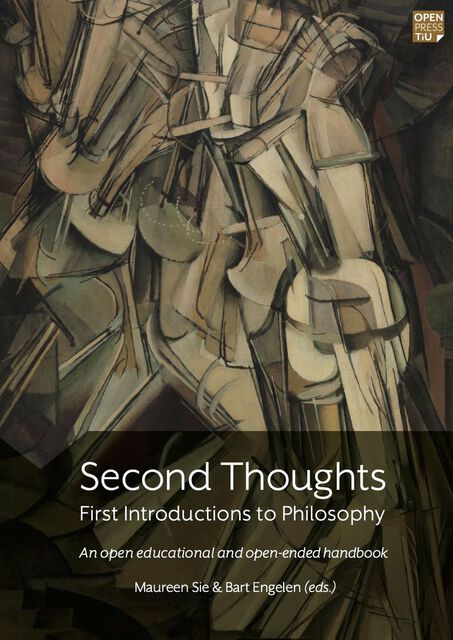
Second Thoughts: First Introductions to Philosophy
Not rated yetRate this bookSecond Thoughts: First Introductions to Philosophy presents fifteen introductions across society, human life, thinking, and reality. Edited by Sander Verhaegh, Tim Christiaens, Bart Engelen, and Maureen Sie, the collection pairs accessible discussions with classic philosophical readings. This guide follows every numbered chapter and uses reconstruction, comparison, and counterexample tasks to support active reading.
Free reading is available at the official source. Opens in a new tab.
 Free
About this book
Second Thoughts: First Introductions to Philosophy presents fifteen introductions across society, human life, thinking, and reality. Edited by Sander Verhaegh, Tim Christiaens, Bart Engelen, and Maureen Sie, the collection pairs accessible discussions with classic philosophical readings. This guide follows every numbered chapter and uses reconstruction, comparison, and counterexample tasks to support active reading.
Chapter-wise summaries and study tasks
1 Power, Justice and Identity
Political philosophy asks how power, justice, and identity shape collective life and what could justify political arrangements. Describing who has power differs from evaluating how that power ought to be exercised. Historical theories supply concepts that can illuminate present questions while also containing assumptions and exclusions requiring criticism. The chapter introduces philosophical inquiry through this movement between inherited ideas and a problem under discussion. Its accompanying Arendt reading adds a concrete encounter with an influential analysis rather than a final authority. Reconstruct the argument and its context before deciding whether its concepts transfer to another situation.
Study task. Analyze a fictional public decision by separating power, legitimacy, justice, and identity. Reconstruct one argument from the chapter and state an objection that addresses its reasoning rather than the author's reputation.
2 Why Ethical Reflection Matters
Ethics examines reasons concerning how to live and how to treat others. Familiar moral judgments can conflict, so reflection asks whether they are coherent and how they can be justified. Consequences, duties, character, care, and relationships can make different features of a situation important. A philosophical approach does not end with reporting personal preference or majority opinion. The companion reading from Virginia Held brings care and dependency into the discussion. Compare what a framework reveals and overlooks, and distinguish a disagreement about facts from one about values or the weight of competing reasons.
Study task. Use a fictional care dilemma to compare two moral approaches. State their relevant reasons, test an objection, and explain whether disagreement concerns facts, principles, or priorities.
3 Imagined and Contested Communities
Philosophy of culture examines how communities, practices, meanings, and identities are formed and contested. Treating a whole society as if it had one stable culture can conceal internal differences and relations of power. The chapter connects changing philosophical questions with neighboring disciplines while asking how cultural categories themselves shape interpretation. Horkheimer and Adorno's companion selection provides one critical perspective on modern cultural life. Avoid turning criticism of a concept into the claim that social practices have no reality. Ask who uses a category, for what purpose, and what it permits or prevents people from seeing.
Study task. Compare two descriptions of a fictional community, identifying assumptions about unity, difference, and authority. Explain how a critical cultural perspective would change the questions asked.
4 Religious Beliefs: Can they Be Legitimate?
Philosophy of religion asks about the content and justification of religious beliefs while distinguishing those questions from the rights and attitudes of believers. Respect for a person does not settle whether a proposition is true, and criticizing a proposition need not deny the person's liberty. The chapter examines what it could mean for belief to be legitimate and how arguments should be assessed. Its accompanying classic materials support comparison among approaches. Reconstruct the actual conclusion and assumptions of an argument rather than treat religious or nonreligious identity as a substitute for reasons.
Study task. Distinguish a truth claim, a justification claim, and a claim about religious freedom in a fictional exchange. Evaluate one argument without conflating criticism of belief with treatment of the believer.
5 Cartesian Conundrums
Philosophy of mind investigates the relationship between mental life and the physical world. Descartes' distinction between thinking and extended substance frames questions about knowledge of oneself and interaction between mind and body. The interaction problem asks how radically different kinds of substance could affect one another. Alternative approaches need to explain experience and mental causation rather than simply reject an unfamiliar vocabulary. Reading the Second Meditation alongside the introduction allows the learner to examine the steps of the reasoning. Distinguish what is directly claimed about certainty from later conclusions about the nature of reality.
Study task. Reconstruct a Cartesian argument about self-knowledge, then identify the additional steps needed to reach a claim about mind and body. Explain one difficulty an alternative position must also address.
6 Plastic Mortals and 21st Centrury Healthcare
Philosophical anthropology asks what human beings are and how embodiment, technology, vulnerability, and mortality shape existence. Medical technologies challenge a simple opposition between natural humans and artificial additions: practices of repair and enhancement can change how a body is experienced and understood. The chapter's healthcare context connects these questions with lived life rather than reducing a person to a biological mechanism. The Merleau-Ponty companion reading develops an embodied perspective. Separate a description of what technology makes possible from a judgment about what should be done or what counts as a good human life.
Study task. Analyze a fictional bodily technology through function, lived experience, identity, and dependency. Distinguish an anthropological question from a technical-performance or clinical-effectiveness question.
7 Appreciating Beauty and Art
Aesthetics considers art, beauty, appreciation, and the reasons offered for judgments. Enjoying an object and claiming that others ought to recognize its quality are different moves. Art can also challenge the assumption that beauty is its defining purpose. The chapter explores how practices and philosophical accounts influence one another, while the Hegel selection provides a historical position to examine. A reasoned aesthetic judgment should attend to the work and the criteria being used rather than simply insist that taste is either purely arbitrary or universally settled. Identify what disagreement reveals about interpretation and value.
Study task. Compare two fictional evaluations of the same artwork. Separate description, interpretation, and appraisal, then explain which reasons another viewer could reasonably assess.
8 Examining Life
Phenomenology examines experience and the ways things appear rather than assuming that ordinary access to the world needs no analysis. Attention shifts from simply cataloging objects to investigating the structures and conditions of encountering them. This is not equivalent to inventing a private world or denying every external object. The chapter invites readers to examine assumptions that are normally taken for granted. Husserl's companion selection supplies a more demanding example of this inquiry. Describe an experience carefully before imposing an explanation, and distinguish the act of experiencing from what is experienced.
Study task. Write a short description of a fictional ordinary perception, separating the object, perspective, expectation, and act of attention. Explain how a phenomenological question differs from a causal account of the sensory organ.
9 The Quest for Truth
Epistemology asks what knowledge involves, how it differs from belief, and what makes a claim justified. Truth, evidence, reliability, and certainty should not be treated as synonyms. A person can hold a true belief for a poor reason, raising questions about what more knowledge requires. The chapter introduces these problems and the challenges of skepticism. The Theaetetus companion reading connects contemporary introductory questions with a classic dialogue. Evaluate proposed definitions through cases and counterexamples, checking whether a revision solves one problem by creating another. Disagreement alone does not prove that knowledge is impossible.
Study task. Construct a fictional true belief reached by a poor method and compare it with a well-supported belief. Use the contrast to test a proposed account of knowledge.
10 The Bounds of Reason
Philosophy of science examines what distinguishes scientific inquiry and how theories gain, lose, or change support. The boundary between science and other claims cannot be settled merely by attaching a prestigious label. Evidence, methods, explanation, historical practice, and standards of criticism all matter. The chapter's disputes over scientific status introduce the difficulty of defining a single criterion. Kuhn's companion selection adds questions about normal research, conceptual frameworks, and major change. Distinguish a descriptive account of how scientists work from an argument about how inquiry should proceed, and avoid inferring that theory change makes evidence irrelevant.
Study task. Evaluate a fictional claim to scientific status using several criteria. Explain which features concern testing and which concern research practice, then consider how a change of framework would affect interpretation.
11 The Study of Informational Processes
Logic studies patterns of inference and the conditions under which conclusions follow from premises. Validity concerns the relationship between statements, not whether each premise happens to be true. Conditional reasoning illustrates why apparently similar moves can differ: drawing a contrapositive is not the same as affirming a consequent. The chapter broadens attention toward information, interaction, and change rather than presenting reasoning only as isolated static formulas. The companion selection on logical dynamics supports that expansion. Translate an argument carefully and test its structure before judging the persuasiveness of its subject matter.
Study task. Formalize several fictional conditional arguments, test validity with counterexamples, and distinguish valid inference from a sound argument with justified premises.
12 ‘You Can't Argue With That!’
Argumentation concerns giving and assessing reasons in an interaction where a claim is questioned or contested. It serves functions in cooperation, disagreement, and the filtering of information learned from others. A formally valid sequence can still fail as responsible argument if premises are unsupported, relevant objections are ignored, or a speaker exploits the discussion. The chapter connects reasoning with social practices rather than treating winning as the objective. The Gorgias companion reading offers a classic encounter with persuasion. Identify the claim, reasons, audience, and standards of exchange before applying a label such as fallacy.
Study task. Reconstruct a fictional disagreement with both sides represented fairly. Identify an unsupported premise or evasive move and propose a question that improves inquiry rather than merely scores a point.
13 This is the Question: To Be or Not To Be?
Ontology asks what exists and how categories of things should be understood. Questions about numbers, material objects, properties, and other entities require more than an inventory of familiar examples. Meta-ontological questions ask what it means to make an existence claim and how such disputes can be assessed. The chapter introduces arguments and competing ways to frame the inquiry. Quine's companion selection connects ontology with the commitments of an account or theory. Distinguish an everyday use of a word from an explicit argument that a kind of entity must be admitted.
Study task. Compare two fictional theories that explain similar observations while appearing to assume different entities. Identify their ontological commitments and what would make the disagreement substantive rather than verbal.
14 The Highest Principles?
Metaphysics investigates fundamental questions about reality and the relationship among philosophical inquiries. Its history includes ambitions to provide first principles and criticisms of whether such ambitions can be justified. The chapter asks whether philosophy is unified by foundational questions or better understood through diverse approaches. Heidegger's companion selection provides one demanding route into these issues. Do not equate metaphysics simply with anything untestable or supernatural. Examine what a proposed principle explains, how it is defended, and what limits critics identify. A question's depth does not exempt its proposed answer from argument.
Study task. State a fictional foundational claim and reconstruct its support. Explain whether the claim organizes other inquiries, assumes what it seeks to establish, or leaves a clear question unresolved.
15 Language and Reality
Philosophy of language examines meaning and relationships among language, thought, and world. The linguistic turn treated analysis of language as a route into philosophical problems, but different theories disagreed about what meaning requires. Reference alone may not explain every meaningful expression or every use of speech. The chapter connects those debates with questions about how language structures understanding. Wittgenstein's companion material invites attention to use and practice. Distinguish the meaning of an expression, its reference where relevant, and what a speaker does by using it in context.
Study task. Analyze a fictional expression used in two settings, separating reference, meaning, and communicative action. Explain what a theory focused only on naming objects would miss.
How to study this book
- Identify each chapter's question, main distinctions, argument, and unresolved difficulty before taking a position.
- Read the paired classic in its immediate context and distinguish the introduction's explanation from the selected author's own claim.
- Represent a view fairly, then test a premise, inference, definition, or consequence with a clear objection.
- Keep examples separate from general arguments and revise a claim when a counterexample exposes a limitation.
- Use the four thematic parts to trace connections without assuming all contributors share one position.
Questions for reflection
- What question is being answered, and has it changed during the argument?
- Does the objection challenge the view itself or a simplified version?
- Is a disagreement factual, conceptual, evaluative, or methodological?
- What would count as progress even if the question remains unsettled?
Source edition and coverage
The guide follows the fifteen numbered chapters of the Open Press Tilburg University collection and situates their accompanying classic readings. It is an original study companion rather than a reproduction of the extracts or an assertion that the contributors endorse a single philosophical doctrine. These are original study explanations and learning tasks. Read the complete book at the official source.
About access & copyright
This page provides book information and study material. Full-text access is provided by the original publisher or authorised source; a listing does not grant permission to republish the book.
Read our Library Access & Copyright policyExplore the contents
Check the chapters covered in this edition.
Visit the official source
See reading, preview or purchase options.
Save for later
Keep this textbook in your saved collection.
Reader ratings & reviews
Share your thoughts
Your review helps other students choose the right resources.
KEEP LEARNING
Your next great read
critical statistical reasoning Humanities
Modern Philosophy
View Modern Philosophy — book Philosophy
An Introduction to Ontology Engineering
View An Introduction to Ontology Engineering — book Philosophy
Responsible Innovation: Ethics, Safety and Technology
View Responsible Innovation: Ethics, Safety and Technology — book Humanities
Philosophical Ethics
View Philosophical Ethics — book Engineering & Technology
The Primacy of the Public
View The Primacy of the Public — book Humanities
Theological Questions
View Theological Questions — book Philosophy
Learning from Arguments: An Introduction to Philosophy
View Learning from Arguments: An Introduction to Philosophy — book Philosophy
Introduction to Philosophy: Ethics
View Introduction to Philosophy: Ethics — book Humanities



