
 Humanities
Textbook
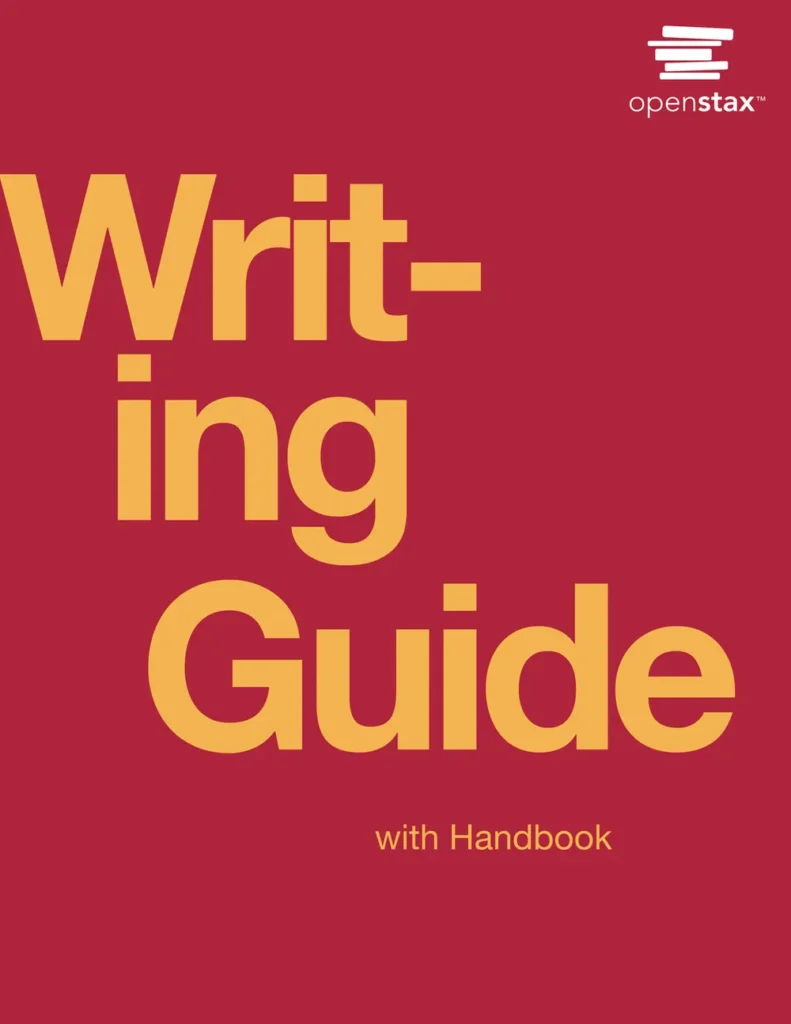
Writing Guide with Handbook
Not rated yetRate this bookWriting Guide with Handbook treats writing as a rhetorical, social, and revisable practice. OpenStax’s twenty chapters move from critical response, language, and personal experience through research and argument to textual, visual, multimodal, and spoken communication. Michelle Bachelor Robinson and Maria Jerskey, featuring Toby Fulwiler, connect genre study with models, drafting, evaluation, editing, and portfolio reflection. This guide follows that sequence and the accompanying handbook, turning each chapter into a focused writing or revision task.
Free reading is available at the official source. Opens in a new tab.
 Free
About this book
Writing Guide with Handbook treats writing as a rhetorical, social, and revisable practice. OpenStax’s twenty chapters move from critical response, language, and personal experience through research and argument to textual, visual, multimodal, and spoken communication. Michelle Bachelor Robinson and Maria Jerskey, featuring Toby Fulwiler, connect genre study with models, drafting, evaluation, editing, and portfolio reflection. This guide follows that sequence and the accompanying handbook, turning each chapter into a focused writing or revision task.
Chapter-wise summaries and study tasks
Chapter 1 The Digital World: Building on What You Already Know to Respond Critically
Critical response begins by reading a text broadly understood, including digital messages and public exchanges. Purpose, audience, context, and evidence shape how a reader interprets and answers a message. The chapter connects existing communication experience with rhetorical and academic practice rather than assuming new writers begin without useful knowledge.
Separate a source’s claim from your reaction and from the evidence supporting either position. Evaluate the relationship between intention and execution: a message can aim to inform while its form or assumptions undermine that goal. Drafting a response requires selecting a specific issue and explaining it to a defined audience.
Study task. Choose a public message and record its audience, claim, evidence, and context. Draft a focused response that accurately represents it before evaluating one rhetorical choice.
Chapter 2 Language, Identity, and Culture: Exploring, Employing, Embracing
Language, identity, and culture interact with power, belonging, and the expectations attached to different settings. The chapter examines oppression and reclamation while encouraging writers to consider the linguistic resources they already possess. Variations of English are not simply defects to erase; rhetorical decisions can draw on multiple languages and forms according to purpose and context.
Analyze a convention by asking who expects it and what consequences it carries. Respect for linguistic difference does not remove the need for clear communication, but clarity should not be confused with treating one identity as the universal norm. Reflect on voice through actual choices in a draft.
Study task. Revise a paragraph for two audiences while retaining its meaning and an intentional sense of voice. Explain which language choices change, which remain, and how power or expectation affects the decision.
Chapter 3 Literacy Narrative: Building Bridges, Bridging Gaps
A literacy narrative examines experiences of learning, reading, writing, speaking, or interpreting meaning. The genre connects a specific event or artifact with a larger understanding rather than merely listing educational milestones. Narrative choices such as scene, sequence, detail, and reflection help readers see why the experience matters. The source models interpretation through examples and revision.
Choose a manageable focus and distinguish what happened from what you now understand about it. A clear point does not require exaggerating the event into a universal lesson. Sentence structure and self-evaluation help refine the account, while a literacy artifact can anchor reflection in evidence.
Study task. Select one literacy event and an associated artifact. Draft a scene and a reflective paragraph, then check whether the reflection arises from the specific details instead of a generic claim about learning.
Chapter 4 Memoir or Personal Narrative: Learning Lessons from the Personal
Memoir and personal narrative make selected experiences meaningful for readers beyond the writer. Conflict, detail, point of view, characterization, and revelation organize an account without requiring a complete autobiography. Memory is filtered, so thoughtful writing distinguishes recollection from an unsupported claim to know another person’s inner experience.
Ask why this moment deserves attention and how its structure leads the reader toward that significance. A chronological draft may need rearrangement to clarify the central tension. Multilingual experience and audience expectations can inform the voice rather than remain outside the writing process.
Study task. Draft a personal scene with a clear tension and point of view. Revise the opening and ending so the significance emerges through detail and reflection, checking claims about others’ motives.
Chapter 5 Profile: Telling a Rich and Compelling Story
A profile presents a subject through a purposeful angle, background, observation, and selected detail. The subject may be a person or cultural artifact, but the piece needs more than a sequence of facts. Research and description work together to create a credible account that is vivid without inventing information.
Define the angle early enough to guide interviews or observation, while remaining willing to revise it when evidence challenges the initial idea. Keep direct observation, quotation, background, and interpretation distinguishable. Tense consistency and organization help a reader understand both the subject and the writer’s perspective.
Study task. Plan a profile with a provisional angle, observation questions, and background sources. Draft one evidence-rich section and explain which material would cause you to revise the initial angle.
Chapter 6 Proposal: Writing About Problems and Solutions
A proposal defines a problem for a particular audience and argues for a feasible response. The reader needs evidence that the problem matters, an explanation of the proposed action, and criteria for judging its suitability. Alternatives, resources, constraints, and likely objections strengthen the reasoning when addressed honestly.
A proposal is not simply an opinion that something should improve. Connect each action with the mechanism it is intended to change. Clarity and coherence matter because a decision-maker must understand what is requested and why. Avoid promising outcomes beyond the available evidence or resources.
Study task. Write a problem statement and compare two responses against explicit criteria. Outline the preferred proposal with steps, resources, expected outcomes, and a limitation the audience should consider.
Chapter 7 Evaluation or Review: Would You Recommend It?
Evaluation and review make a judgment through stated criteria and supporting evidence. The criteria should fit the subject and intended audience rather than appear only after the writer has chosen a verdict. Personal response can motivate the inquiry but does not replace explanation. The source’s entertainment-focused work illustrates how representation, context, and audience affect evaluation.
Distinguish description from assessment and explain how particular features meet or fail a criterion. A fair review acknowledges relevant strengths and weaknesses without manufacturing balance. Quotations or examples should support a specific judgment rather than fill space.
Study task. Review a work or experience using three justified criteria. Support each judgment with evidence and revise one sentence that reports preference without explaining its basis.
Chapter 8 Analytical Report: Writing from Facts
An analytical report investigates a question through organized evidence and interpretation. Formal and informal versions differ in presentation, but both need scope, reliable information, and a reasoned structure. Facts do not arrange themselves into an answer: the writer must identify meaningful relationships while making the method and limitations visible.
Separate findings from unsupported advocacy, and use tables or other material when they clarify a comparison. Technical or disciplinary language should fit the audience and be explained where needed. Review the final report for whether the evidence actually answers its stated question.
Study task. Define a focused report question and evidence plan. Draft a findings section that distinguishes observation, interpretation, and uncertainty, then remove a claim that the collected material cannot support.
Chapter 9 Rhetorical Analysis: Interpreting the Art of Rhetoric
Rhetorical analysis explains how a text attempts to influence an audience in a particular situation. It examines choices, appeals, organization, and evidence rather than merely agreeing or disagreeing with the message. A useful thesis identifies a meaningful strategy and its effect or limitation in context.
Show the connection between a textual detail and the proposed audience response. Do not assume every reader reacts identically or treat a named appeal as proof of effectiveness. Distinguish the creator’s intention, the strategy used, and what the available evidence permits you to say about its execution.
Study task. Select a short persuasive text and develop an analytical thesis about one strategy. Use two details to explain its operation, acknowledging a limit on claims about actual audience response.
Chapter 10 Position Argument: Practicing the Art of Rhetoric
A position argument makes a contestable claim supported by reasons and evidence suited to its audience. It needs a clear thesis, a defensible chain of reasoning, and engagement with a relevant counterposition. Appeals work together, but emotional force or authority should not substitute for evidence where the claim requires it.
Organize paragraphs around reasons rather than source summaries, and make transitions express actual logical relationships. Citation gives readers a route to check support. Revision should test the inference from evidence to claim, not merely strengthen the wording of the conclusion.
Study task. Draft a position with two reasons, evidence, and a fair counterargument. Identify the assumption connecting one reason to the claim and revise it if the assumption cannot be defended.
Chapter 11 Reasoning Strategies: Improving Critical Thinking
Reasoning strategies help organize and test thought through relationships such as example, comparison, definition, cause, and inference. The appropriate strategy depends on the question. A signal word can announce a relationship without establishing that the relationship is sound. The chapter connects logical development with evidence and critical reading.
Examine what must be true for the conclusion to follow. A striking example may illustrate a possibility without establishing prevalence; two associated events may not demonstrate causation. Strong reasoning also recognizes exceptions and defines categories consistently rather than changing their meaning to protect a conclusion.
Study task. Analyze a paragraph’s reasoning by stating its claim, evidence, and implied assumption. Rebuild it with a more appropriate strategy and explain why the revised inference is stronger.
Chapter 12 Argumentative Research: Enhancing the Art of Rhetoric with Evidence
Argumentative research connects a developing position with relevant evidence from others’ work. Research can revise the question and thesis rather than merely supply quotations for a decision already made. Source integration includes accurate representation, attribution, explanation, and a clear connection with the writer’s own reasoning. Bias in language and selection can affect the argument even when citations are formatted correctly.
Synthesis compares sources around a question instead of placing isolated summaries in sequence. Evaluate disagreements through methods, evidence, scope, and assumptions. A persuasive paper communicates what remains uncertain rather than hiding limits behind an absolute claim.
Study task. Create a synthesis paragraph using two sources that differ on a focused issue. Explain the basis of disagreement and revise the thesis to reflect the strongest available evidence.
Chapter 13 Research Process: Accessing and Recording Information
The research process includes locating existing sources, creating evidence where appropriate, evaluating material, taking notes, and maintaining a research log. A search should be guided by a question and revised as terminology or scope becomes clearer. Interviews or other original inquiry require ethical planning, not just a convenient person to quote.
Separate exact quotations from paraphrases and your own ideas in notes. Record enough context and bibliographic information to verify a claim later. A transparent log makes it easier to explain why sources were included, what changed, and where gaps remain.
Study task. Develop search concepts, source-selection criteria, and a research log for one question. Record a quotation, original paraphrase, and evaluation separately, then identify an ethical issue in a proposed original-data activity.
Chapter 14 Annotated Bibliography: Gathering, Evaluating, and Documenting Sources
An annotated bibliography combines source documentation with a concise account and evaluation of each item. Its purpose can include mapping a field, preparing an argument, or explaining how a source contributes to a project. Annotation should do more than repeat an abstract or praise a publication generally.
Identify the source’s question, approach, central contribution, limits, and relevance according to the assignment. Citation style and format support traceability but do not replace intellectual evaluation. Comparing annotations can reveal repetition or missing perspectives before the longer paper is drafted.
Study task. Write two annotations with accurate citations, original summaries, and specific evaluations. Explain their different roles in the project and identify one evidence gap neither source fills.
Chapter 15 Case Study Profile: What One Person Says About All
A case-study profile uses a closely examined individual or situation to investigate a broader question. Observation, description, context, and analysis must remain connected. The source’s language-related examples show how a focused case can illuminate a process while requiring caution about generalization.
A vivid account does not establish how common a pattern is, and a theoretical claim should not erase the subject’s particular circumstances. Distinguish the evidence collected from the interpretation offered. Respectful representation includes avoiding invented motives or unnecessary identifying information when a fictional or appropriately protected example can serve the task.
Study task. Plan a case-study question with observation and contextual evidence. Draft an analytical passage and state precisely what the case can illuminate and what would require additional cases or methods.
Chapter 16 Print or Textual Analysis: What You Read
Textual analysis examines what a work says and how its choices create meaning. Form, diction, organization, pattern, and context can support an interpretive thesis. Analysis differs from retelling the whole work or attaching a personal reaction without close evidence. The chapter connects academic interpretation with the writer’s own experience while retaining a reasoned basis.
Select details because they develop the interpretation, and consider a plausible alternative reading. A strong essay can explain ambiguity without forcing every feature into one rigid conclusion. Editing conventions, including appropriate tense for discussing a work, support clarity after the argument is established.
Study task. Develop a thesis from a recurring textual feature and analyze two passages in detail. Test it against a passage that complicates the interpretation and revise rather than ignore the difficulty.
Chapter 17 Image Analysis: What You See
Image analysis treats visuals as constructed communication. Composition, framing, color, perspective, symbols, and context can influence interpretation, while audience and circulation affect meaning. Description establishes what is visible; analysis explains relationships and possible effects without assuming certainty about every viewer’s response.
Connect a claim with observable detail and relevant context. An image’s persuasive force does not prove its factual completeness. Comparing related images can reveal choices that appear natural in isolation. Accurate descriptive diction helps readers evaluate the argument even if they do not immediately share the interpretation.
Study task. Describe a visual without evaluation, then develop an analytical claim supported by three features. Compare an alternative framing or caption and explain how it could change the message.
Chapter 18 Multimodal and Online Writing: Creative Interaction between Text and Image
Multimodal and online writing combines language, visuals, sound, movement, or spatial arrangement around a purpose. Genre and medium influence organization and audience interaction. The chapter’s advocacy project asks writers to coordinate modes rather than add decoration to a conventional essay.
Each element should contribute something specific, with transitions or relationships guiding attention. Accessibility, attribution, platform constraints, and maintenance affect whether the message reaches its audience. Evaluate the whole experience, including how someone encounters the material and what action or understanding it supports.
Study task. Storyboard a small multimodal project with a defined audience and goal. Assign a purpose to each mode and plan attribution and accessible alternatives, then test whether the message survives without a purely decorative element.
Chapter 19 Scripting for the Public Forum: Writing to Speak
Writing to speak adapts language for listeners who encounter it in time rather than reread at their own pace. Public purpose, audience, structure, delivery, and visual support influence the script. Spoken transitions, signposting, pacing, and sentence length may need revision from a written draft. A public argument still requires accurate evidence and fair treatment of alternatives.
Rehearsal tests whether listeners can follow the claim and remember its structure. Do not equate a polished script with effective delivery or use dramatic language to hide a weak inference. Plan an ending that completes the message rather than introducing the main idea too late.
Study task. Adapt a paragraph into a short spoken script and rehearse it aloud. Ask a listener to restate the argument, then revise pacing, transitions, and evidence placement based on what was actually understood.
Chapter 20 Portfolio Reflection: Your Growth as a Writer
Portfolio reflection evaluates growth through selected work, revision evidence, and future goals. It should explain decisions and changes rather than announce improvement without examples. A draft, feedback note, and revision can show how a writer learned to define an audience, strengthen reasoning, integrate evidence, or manage a process.
Connect the selected artifacts with a specific claim about development and acknowledge an unresolved challenge. Reflection is analytical when it examines what caused a change and how the lesson transfers to a new task. The portfolio therefore becomes a reasoned account of practice, not simply a container of finished pieces.
Study task. Select an early draft, feedback, and a revised passage. Explain one meaningful change, its cause, and its effect, then set a future goal with an observable way to assess progress.
Handbook
The handbook supports revision at the levels of paragraphs, sentences, words, point of view, verbs, pronouns, punctuation, mechanics, and quotation. It also provides a documentation guide and MLA and APA material. These resources are most useful when a writer identifies the problem a rule addresses rather than edits every sentence through an undirected checklist.
Separate structural revision from correction. A clear sentence cannot supply missing evidence, and a perfectly formatted citation cannot explain a source’s relevance. Conversely, sentence errors or unclear references can obstruct an otherwise strong argument. Use examples to diagnose the pattern, revise it in context, and check whether meaning has been preserved.
Documentation requirements depend on the relevant assignment or publication and current guidance. The source’s examples provide a learning framework, but real submissions should follow the required edition and local instructions. Record enough source information during research to support either style without reconstructing it later.
Study task. Review a draft in separate passes for paragraph logic, sentence clarity, and documentation. Diagnose one recurring pattern, revise it in several contexts, and verify two source references against the required style guidance.
How to study this book
- Use one project to practice planning, drafting, feedback, revision, and editing rather than treating genres as fixed templates.
- Read each annotated example for a specific rhetorical decision, then test that decision in original work.
- Keep a research log separating quotations, paraphrases, evaluation, and your own developing ideas.
- Revise purpose, evidence, and organization before polishing sentence-level features with the handbook.
- Build portfolio reflections from concrete before-and-after evidence and state how a lesson transfers to a new audience or medium.
Questions for reflection
- What should the audience understand, decide, or do after reading?
- Which evidence actually supports the thesis, and which is only interesting background?
- How did a revision change the reader’s experience rather than merely the surface wording?
Source edition and coverage
This guide covers all twenty numbered chapters and the complete handbook’s major learning areas in the linked OpenStax text. Unit dividers, example readings, exercises, and reference lists remain in the source. The guide adds original practice tasks rather than reproducing the source’s assignments or sample papers. These are original study explanations and learning tasks. Read the complete book at the official source.
About access & copyright
This page provides book information and study material. Full-text access is provided by the original publisher or authorised source; a listing does not grant permission to republish the book.
Read our Library Access & Copyright policyExplore the contents
Check the chapters covered in this edition.
Visit the official source
See reading, preview or purchase options.
Save for later
Keep this textbook in your saved collection.
Reader ratings & reviews
Share your thoughts
Your review helps other students choose the right resources.
KEEP LEARNING
Your next great read
Humanities Humanities
World History, Volume 1: to 1500
View World History, Volume 1: to 1500 — book Humanities
U.S. History
View U.S. History — book Humanities
Introduction to Philosophy
View Introduction to Philosophy — book Humanities
Writing for Success
View Writing for Success — book Humanities
Stand up, Speak out - The Practice and Ethics of Public Speaking
View Stand up, Speak out - The Practice and Ethics of Public Speaking — book Humanities
Yorùbá Yé Mi
View Yorùbá Yé Mi — book Humanities
The Process of Research Writing
View The Process of Research Writing — book Humanities
Modern Philosophy
View Modern Philosophy — book Humanities



