
Precalculus
AppliedTextbook
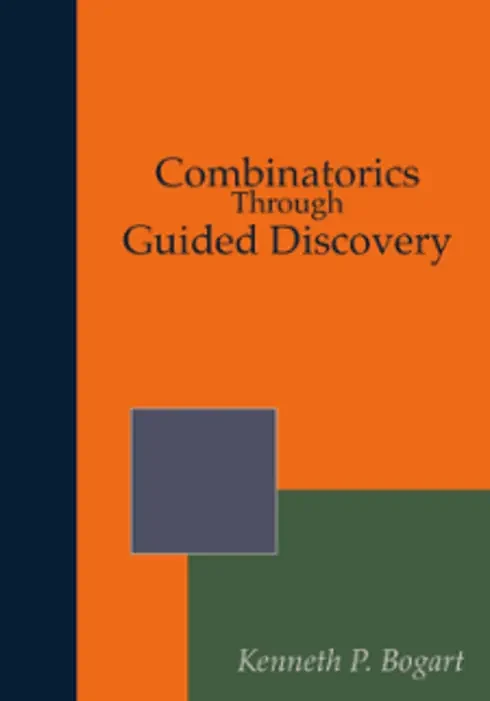
Combinatorics Through Guided Discovery
Not rated yetRate this bookKenneth P. Bogart’s Combinatorics Through Guided Discovery develops ideas through carefully sequenced problems. Students are expected to form conjectures, construct arguments, and learn from examples rather than read every result as a finished lecture. The linked PreTeXt edition contains six main chapters, three mathematical appendices, and selected hints. This guide explains the purpose of each part while preserving the book’s emphasis on doing the mathematical work.
Free reading is available at the official source. Opens in a new tab.
 Free
About this book
Kenneth P. Bogart’s Combinatorics Through Guided Discovery develops ideas through carefully sequenced problems. Students are expected to form conjectures, construct arguments, and learn from examples rather than read every result as a finished lecture. The linked PreTeXt edition contains six main chapters, three mathematical appendices, and selected hints. This guide explains the purpose of each part while preserving the book’s emphasis on doing the mathematical work.
Book summary
About this book
Kenneth P. Bogart’s Combinatorics Through Guided Discovery develops ideas through carefully sequenced problems. Students are expected to form conjectures, construct arguments, and learn from examples rather than read every result as a finished lecture. The linked PreTeXt edition contains six main chapters, three mathematical appendices, and selected hints. This guide explains the purpose of each part while preserving the book’s emphasis on doing the mathematical work.
Chapter and section guide
1. What Is Combinatorics?
The first chapter develops counting through explicit constructions and comparisons. Sum and product principles, permutations, combinations, and related ideas become tools for explaining why a number counts the intended objects. Guided problems encourage students to discover relationships rather than merely identify a formula. A counting argument should establish completeness and avoid duplication. Small examples are useful because they expose hidden assumptions about order, repetition, and distinguishability.
Study application: Solve a small counting problem by listing and by a general construction. Explain how the construction includes every valid object exactly once.
2. Induction, Recursion, and Graph Theory
Recursive structure makes a larger object depend on smaller ones, while induction provides a way to justify a general claim through that dependency. Graph-theoretic examples give the ideas a concrete setting. The chapter connects a recurrence, its initial cases, and the construction that produces it. Students should explain why the smaller cases actually cover the larger case rather than assert that the pattern continues. A base case is part of the proof, not a decorative opening.
Study application: Derive a recurrence from a decomposition of a small family of objects. State the initial values and explain why the cases are disjoint and exhaustive.
3. Distribution Problems
Distributing objects among recipients changes substantially when objects or recipients are distinguishable and when restrictions apply. The chapter develops these distinctions through related problem families. A familiar formula can answer the wrong question if the model is not specified. Students should define what makes two distributions the same or different and check boundary cases such as empty recipients. This is a central combinatorial skill: translate a verbal problem into a precise class of objects before counting.
Study application: Compare distributing identical objects with distributing distinct objects under the same recipient conditions. Use a small example to explain why the counts differ.
4. Generating Functions
Generating functions encode a sequence in coefficients and turn combinations of objects into algebraic operations. Multiplication can represent combining independent choices, while extracting a coefficient answers a counting question. The interpretation of the coefficients is essential: manipulating a formal expression without knowing what it counts loses the combinatorial argument. Students should distinguish formal power-series reasoning from questions about numerical convergence unless a particular argument requires the latter.
Study application: Build a generating function for a restricted choice problem and interpret one coefficient. Verify that coefficient by direct counting in a small case.
5. Inclusion and Exclusion
Counting a union requires correcting overlaps rather than adding category sizes indiscriminately. Inclusion–exclusion organizes those corrections through intersections. The chapter develops why signs alternate and how the principle applies to constrained counting. Students should define the unwanted or target events precisely and ensure that intersection counts correspond to the same underlying universe. A memorized formula is less reliable than understanding how many times each object is counted.
Study application: Count objects satisfying at least one of three properties and track an object belonging to all three through every term. Explain why its final contribution is one.
6. Groups Acting on Sets
Symmetry creates counting questions in which several labeled arrangements may represent the same object. Group actions organize those equivalences and the fixed configurations associated with transformations. The chapter connects algebraic structure with orbit counting. Students should identify the action explicitly: rotating an arrangement and relabeling its parts are not automatically the same equivalence. Dividing by a group’s size without checking stabilizers can give a wrong result.
Study application: Compare labeled colorings with colorings considered equivalent under rotation. Identify a coloring with extra symmetry and explain why naive division can fail.
Appendix A. Relations
The relations appendix supplies language for organizing comparisons and equivalence. An equivalence relation partitions a set into classes, connecting directly with the symmetry questions in the main text. Properties such as reflexivity, symmetry, and transitivity require distinct checks. Students should state the underlying set and the rule defining relatedness before attempting a proof. This keeps the abstraction connected with the objects being counted.
Study application: Define an equivalence relation on a small collection of arrangements and list its classes. Explain how each property supports the classification.
Appendix B. Mathematical Induction
The induction appendix reinforces the logical structure underlying recursive counting arguments. A base case establishes a starting point, and an inductive step must show that the assumed earlier result actually supports the next case. Strong and ordinary induction organize information differently but share a dependence on a justified step. Students should identify the exact statement being proved and avoid assuming a stronger conclusion than the hypothesis provides.
Study application: Write a short induction proof with the hypothesis explicitly labeled. Explain where that hypothesis is used and why checking several examples would not replace the step.
Appendix C. Exponential Generating Functions
Exponential generating functions are suited to labeled combinatorial constructions and use factorial-weighted coefficients. They should not be substituted for ordinary generating functions without changing the interpretation. The appendix connects algebraic operations with the way labels are assigned among component objects. Students should derive the relevant coefficient rule from the combinatorial construction so that the factorials have an explanation rather than appear as a mnemonic.
Study application: Compare an ordinary and an exponential generating function for a simple sequence. Explain what the coefficient represents in each and why the associated product rules differ.
Hints and Independent Work
Selected hints are intended to support discovery after a meaningful attempt. Reading a hint changes the problem-solving situation, so students should record what they had already established and which obstruction remained. The value of an exercise lies in reconstructing the reasoning, not only obtaining its final number. Comparing alternative proofs can reveal a bijection, recurrence, or algebraic representation that was hidden in the first approach.
Study application: Keep a problem log containing conjecture, failed approach, small test, hint used, and revised proof. Re-solve the problem later without the hint.
Study instructions
- Attempt each problem before reading hints and write a precise description of the objects being counted.
- Check small cases for omitted objects and duplication before generalizing.
- Whenever possible, compare two counting methods and explain the correspondence between them.
- State the action or equivalence relation before counting objects up to symmetry.
- Reconstruct a completed proof in your own words and identify the idea that made it work.
Practice and review task
Choose one counting family and solve it through two methods, such as a recurrence and generating function or direct counting and inclusion–exclusion. Explain why the methods agree and which assumptions each makes most visible.
Questions for reflection
When is a generating function an explanation rather than only a compact calculation? Why must a symmetry-counting problem define which transformations make objects equivalent?
Sources and coverage
This original study guide follows Linked PreTeXt PDF, six main chapters and three mathematical appendices. It draws on the source contents, chapter introductions, selected explanations and examples, and review material. It condenses the resource rather than replacing the full text; study applications are original exercises.
About access & copyright
This page provides book information and study material. Full-text access is provided by the original publisher or authorised source; a listing does not grant permission to republish the book.
Read our Library Access & Copyright policyExplore the contents
Check the chapters covered in this edition.
Visit the official source
See reading, preview or purchase options.
Save for later
Keep this textbook in your saved collection.
Reader ratings & reviews
Share your thoughts
Your review helps other students choose the right resources.
KEEP LEARNING
Your next great read
Calculus
College Trigonometry
College Trigonometry
View College Trigonometry — bookWhitman Calculus
Whitman Calculus
View Whitman Calculus — bookVector Calculus
Vector Calculus
View Vector Calculus — bookBasic Analysis: Introduction to Real Analysis
Basic Analysis: Introduction to Real Analysis
View Basic Analysis: Introduction to Real Analysis — bookCalculus for the Life Sciences: A Modeling Approach
Calculus for the Life Sciences: A Modeling Approach
View Calculus for the Life Sciences: A Modeling Approach — book Applied
Introductory Statistics
View Introductory Statistics — book Applied
 Discrete Structures
View Applied Discrete Structures — book Algebra
Linear Algebra
View Linear Algebra — book Mathematics



