
 Curriculum & Instruction
Library Science and Museum StudiesTextbook
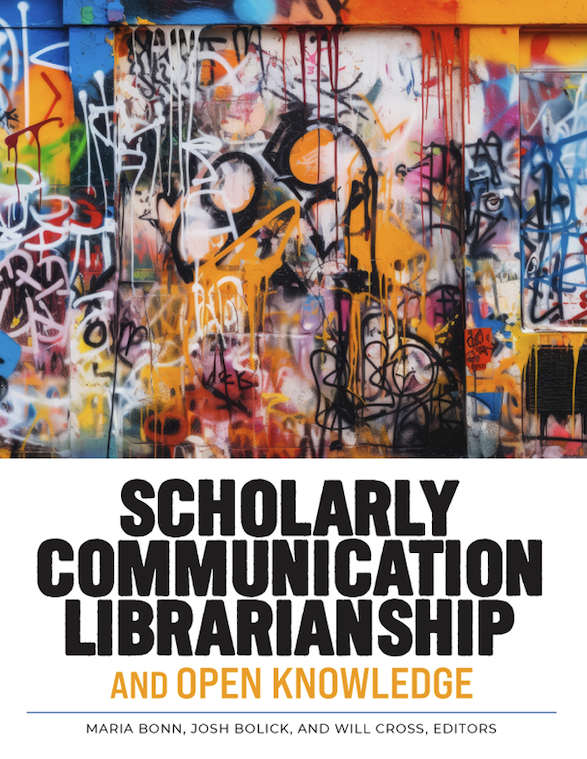
Scholarly Communication Librarianship and Open Knowledge
Not rated yetRate this bookThis edited collection introduces scholarly communication as a field shaped by institutions, economics, technology, law, and professional choices. Its opening asks readers to connect the value of access with the practices through which knowledge is published and shared.
Free reading is available at the official source. Opens in a new tab.
 Free
About this book
About this book
Maria Bonn, Josh Bolick, and Will Cross are the editors of this 2023 Association of College and Research Libraries publication, with chapters and shorter contributions by numerous writers. The contents move from definitions and contextual foundations to open access, open data, open education, infrastructure, and practitioners’ experiences. Its preface describes the collaborative development of an open resource for library and information science education. The guide here considers that preface and the collection’s organization. It does not substitute for the individual chapters or imply that every contributor takes the same position.
Sources and reading coverage
Title, copyright, contents, and selected passages from the preface on PDF sheets 10–11 were reviewed. This is an opening-focused guide, not a summary of all chapters.
See the official publication record for edition details. The external PDF provides the available source text.
The consulted PDF contains 529 sheets, including preliminary material; this count can differ from printed pagination.
Book summary
Guide to the reviewed opening
The preface presents access as something that must be demonstrated through professional practice. Its writers question a gap between libraries’ stated commitment to public access and the paywalled environment in which much scholarly work circulates. They argue for a stronger connection between professional values and decisions about publishing, services, and infrastructure. This is the preface authors’ critical perspective, rather than a neutral description of every library.
The book’s collaborative origins are part of its teaching approach. Educators and practitioners helped shape a resource intended for future librarians as well as the people teaching them. The opening links the format of an openly available textbook to the subject it studies: the production and circulation of knowledge.
The contents then offer several routes into the field. Foundational contexts come before specific forms of openness, and the final part brings in perspectives, intersections, and case studies. Readers can use that structure to distinguish a general principle from an institutional example. Detailed accounts of the later chapters remain outside this guide’s coverage.
How to study this book
Start a two-column reading journal. In the first column, record the professional value or goal under discussion; in the second, identify a practice that could support or undermine it. Mark whose argument you are recording, especially when moving between the editors’ framing and individual contributors.
Choose one later chapter relevant to your interests, such as open data or library publishing. Read it in full and connect its practical choices to one of the foundational contexts in Part I. Before making a recommendation for a real institution, check the chapter’s date, local circumstances, and the current policy documents that govern that setting.
Questions for reflection
- What would it mean to put access into practice in a library service?
- Why might an institution’s values and purchasing decisions come into tension?
- How should a case study be distinguished from a general claim?
The study suggestions and questions are independent Academic Master editorial material.
About access & copyright
This page provides book information and study material. Full-text access is provided by the original publisher or authorised source; a listing does not grant permission to republish the book.
Read our Library Access & Copyright policyAccess and practice
Relate professional values to institutional choices.
Contributors
Keep the editors’ framing distinct from individual chapters.
Context
Identify economic, legal, social, and technical dimensions.
Reading strategy
Connect a case study with a foundational concept.
Reader ratings & reviews
Share your thoughts
Your review helps other students choose the right resources.
KEEP LEARNING
Your next great read
Curriculum & Instruction Curriculum & Instruction
Intersections of Open Educational Resources and Information Literacy
View Intersections of Open Educational Resources and Information Literacy — book Library Science and Museum Studies
Dublin Core Quick Start
View Dublin Core Quick Start — bookIntroduction to Drafting and AutoCAD 3D
Introduction to Drafting and AutoCAD 3D
View Introduction to Drafting and AutoCAD 3D — bookIntroduction to Sustainability
Introduction to Sustainability
View Introduction to Sustainability — bookProgramming for Computations – Python: A Gentle Introduction to Numerical Simulations with Python 3.6
Programming for Computations - Python: A Gentle Introduction to Numerical Simulations with Python 3.6
View Programming for Computations - Python: A Gentle Introduction to Numerical Simulations with Python 3.6 — bookCISC 187: Data Structures in C++
CISC 187: Data Structures in C++
View CISC 187: Data Structures in C++ — bookAccounting Analytics: An Integrated Approach
Accounting Analytics: An Integrated Approach
View Accounting Analytics: An Integrated Approach — bookBeginning Spanish ¡Empecemos por aquí!
Beginning Spanish ¡Empecemos por aquí!
View Beginning Spanish ¡Empecemos por aquí! — bookApplying the International Classification of Functioning, Disability & Health: A Team-Based/Project Based Course for Undergraduate Students



