
 Social Sciences
Library Science and Museum StudiesTextbook
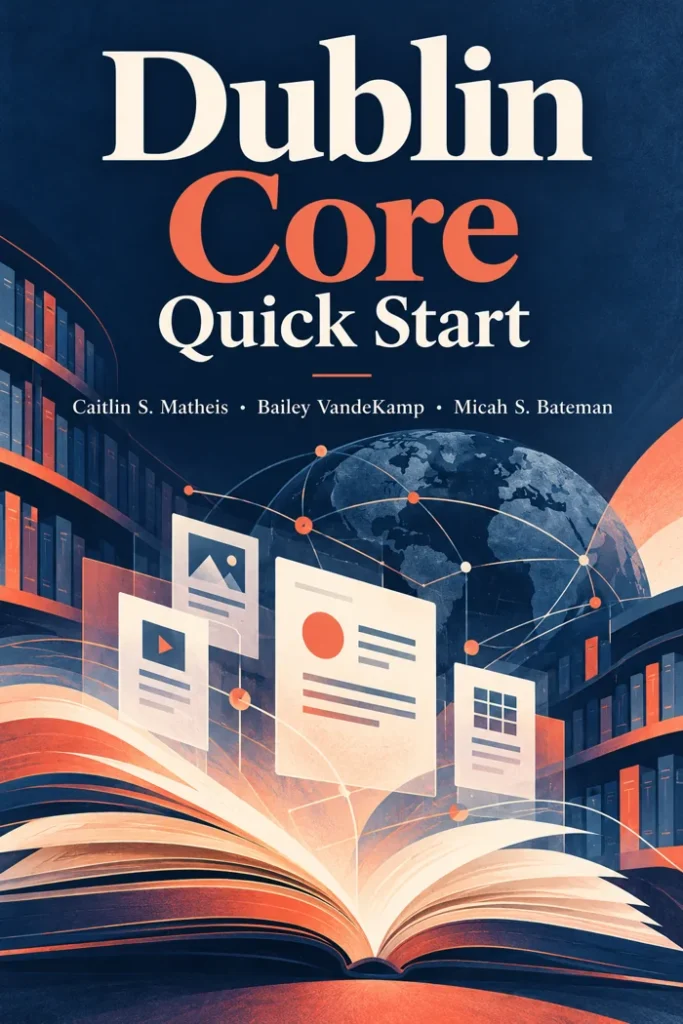
Dublin Core Quick Start
Not rated yetRate this bookDublin Core Quick Start introduces basic metadata records for digital documents. Caitlin S. Matheis, Bailey VandeKamp and Micah S. Bateman connect metadata concepts with Dublin Core elements and examples suited to community archives and historical collections.
 Free
About this book
The resource is a concise tutorial rather than an exhaustive cataloguing manual. Its introduction names historical society workers, community archivists, library and information science students, and information workers outside technical services as intended readers. It moves from a basic account of metadata to guidance on Dublin Core elements and sample records. The text was created with support from University of Iowa programmes and partner resources. The hosted version includes some unfinished template text, so this page describes the substantive material without inventing missing learning objectives.
The attached edition contains 48 PDF pages, including front matter. Cover: source edition title page rendered from the PDF. The textbook and its original notices are retained; Academic Master’s study material is separate from the source text.
Book summary
Dublin Core Quick Start, by Caitlin S. Matheis, Bailey VandeKamp, and Micah S. Bateman, introduces descriptive metadata through a concise vocabulary and sample records. This guide follows the 2024 draft resource. Its three main sections explain metadata, the fifteen Dublin Core elements, and examples drawn from several collection types. The aim is a record another person can interpret consistently, with distinctions preserved among the resource, its content, its creators, and its digital representation.
Chapter-by-chapter summaries
Metadata: Definition, Purpose, and Standardization
Metadata describes a resource so it can be identified, discovered, understood, and managed. A description depends on purpose and audience, so not every observation belongs in the same field. Standardization makes records comparable, but a shared field name is insufficient without shared practice for values. Examine what a future user needs to distinguish this resource from similar ones. Document decisions so consistency does not rely on one cataloger’s memory.
Dublin Core: Overview
Dublin Core supplies a general descriptive vocabulary rather than a complete local workflow. The fifteen elements offer a starting structure for records, while local guidance clarifies how they are applied. Keep the resource being described explicit: an original letter and a digital image of that letter are related but not identical objects. Ambiguity about that distinction can spread across date, format, creator, and rights information.
Contributor
Contributor identifies responsibility beyond the primary creator role. State the person or organization consistently and preserve a useful distinction between kinds of participation when your local practice requires it. Do not assign a role simply because a name appears somewhere in the item.
Coverage
Coverage describes spatial or temporal scope associated with the content. A place discussed in a document differs from the place where the document is stored. Interpret the field through the resource’s subject matter and document any convention used for geographic or time values.
Creator
Creator identifies the principal responsibility for making the resource. A person represented in a photograph is not automatically its photographer. When authorship is uncertain or collective, preserve what is known without inventing an individual attribution to complete the field.
Date
Date records a relevant time associated with the resource. Creation, publication, and digitization can be different events. Make the intended meaning explicit and use a consistent representation. An uncertain date should not acquire false precision through formatting.
Description
Description supplies an account that helps users understand the resource. It should complement the other elements rather than repeat every field without purpose. Distinguish a factual summary from interpretation, and avoid claiming information not supported by the item or reliable accompanying documentation.
Format
Format concerns the resource’s physical or digital manifestation. A file’s format differs from its intellectual genre. Describe the relevant representation consistently and avoid assuming that a filename alone reliably establishes what a digital object contains.
Identifier
An identifier distinguishes a resource within an appropriate system. A title can change or be shared by many objects, while an identifier should support reliable reference. Record the intended identifier rather than substitute a convenient but unstable location without explanation.
Language
Language describes the linguistic content. A resource may contain more than one language, and interface language need not match content language. Use the collection’s chosen representation consistently so discovery does not depend on guessing among equivalent labels.
Publisher
Publisher names the entity responsible for making a resource available in the relevant sense. It need not be the creator or present repository. Identify the publication context before filling the element, especially when an original item and its digital edition have different histories.
Relation
Relation connects the described resource with another resource. Specify what is related rather than let a link stand without context. A component, a version, and a companion item represent different relationships that can matter for interpretation and discovery.
Rights
Rights describes relevant information about use and ownership. Public visibility does not establish unrestricted reuse. Record supported rights information and the appropriate statement or reference. A metadata record should preserve uncertainty rather than invent permission because the item is easy to download.
Source
Source identifies a resource from which the described item derives. Keep it distinct from a general related resource or the institution holding the object. This element can clarify the connection between a digital representation and the item used to create it.
Subject
Subject describes what the resource is about. Consistent terms support discovery across records, while arbitrary variations can fragment a collection. Separate topic from genre and creator identity. Choose terms that help a user locate relevant content without overstating its scope.
Title
Title names the resource. Distinguish a transcribed title from one supplied to describe an untitled item. Use consistent practice while retaining information needed to identify the object. A helpful supplied title is accurate and specific without becoming an unsupported miniature narrative.
Type
Type classifies the nature or genre of the resource. It is different from the file format: a photograph can exist in several digital formats. Apply the vocabulary consistently and check that the chosen category describes the resource at the intended level.
Sample Records
Examples for a newspaper, letter, genealogy, yearbook, and photograph show how the same elements apply to different materials. Compare their decisions rather than copy values mechanically. Ask which information belongs to the original object and which to its representation. A final record should work both independently and beside similar records. Reviewers should be able to explain inconsistent treatment or correct it through an explicit local rule.
Study instructions
- Describe one physical or digital item before looking at a sample record.
- For each field, state what question it answers and what nearby field it must not be confused with.
- Create a short local practice sheet for names, dates, subjects, and uncertain information.
- Compare records for two different material types and justify the differing choices.
- Have another reader use the record to identify and understand the resource, then revise ambiguities.
Questions for reflection
- Are you describing an original object, a digital representation, or both?
- What is the difference between type and format, or source and relation?
- Where should uncertainty remain visible rather than be replaced with a guess?
Sources and coverage
This original study guide follows the complete linked source edition and all of its substantive chapters or named teaching sections. It condenses their main ideas and relationships; the study tasks are guidance for reading alongside the complete resource. It does not reproduce the source exercises or answer key. Book source; Complete source PDF.
About access & copyright
Check this edition’s source and licence before reusing its files or content. A library listing does not grant additional rights.
Read our Library Access & Copyright policyResource description
Connect metadata with identification and discovery.
Metadata purposes
Distinguish descriptive, structural and administrative roles.
Standardisation
Recognise the value of consistent fields.
Draft awareness
Identify substantive material separately from placeholders.
Reader ratings & reviews
Share your thoughts
Your review helps other students choose the right resources.
KEEP LEARNING
Your next great read
Social Sciences Business
Principles of Microeconomics 3e
View Principles of Microeconomics 3e — book Business
Principles of Macroeconomics 3e
View Principles of Macroeconomics 3e — book Social Sciences
Lifespan Development
View Lifespan Development — book Social Sciences
Introduction to Sociology 3e
View Introduction to Sociology 3e — book Social Sciences
Introduction to Political Science
View Introduction to Political Science — book Social Sciences
Introduction to Anthropology
View Introduction to Anthropology — book Psychology
Introduction to Psychology (University of Minnesota, 2015 Edition)
View Introduction to Psychology (University of Minnesota, 2015 Edition) — book Political Science
American Government and Politics in the Information Age
View American Government and Politics in the Information Age — book Political Science



