
 Engineering & Technology
Electrical EngineeringTextbook
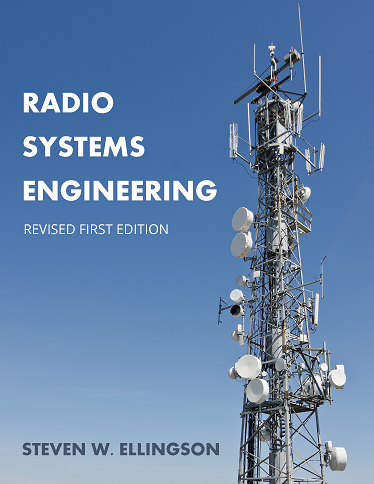
Radio Systems Engineering
Not rated yetRate this bookSteven W. Ellingson’s radio engineering text connects physical principles, link analysis, and hardware design. Its systems framework helps readers relate a component’s behaviour to the performance of an entire communication link.
Free reading is available at the official source. Opens in a new tab.
 Free
About this book
About this book
The consulted text is the 2023 revised first edition, openly released after the earlier Cambridge University Press edition. Its preface describes foundations in antennas, propagation, noise, and modulation, followed by radio hardware and digital signal-processing topics. Radio Link Analysis forms a bridge between those parts. The intended readership includes senior undergraduate and beginning graduate electrical-engineering students and practising engineers with relevant preparation. The book assumes prior circuits, signals and systems, probability, electronics, and electromagnetics. This page considers the preface and selected introductory material rather than verifying every derivation or design example.
Sources and reading coverage
The edition and rights information, preface on PDF sheets 12–13, and selected Chapter 1 opening passages on sheet 15 were reviewed. Later derivations and hardware examples were not independently checked.
See the official publication record for edition details. The external PDF provides the available source text.
The consulted PDF contains 531 sheets, including preliminary material; this count can differ from printed pagination.
Book summary
Guide to the reviewed opening
The preface explains that radio devices are studied within a system-level context. Performance requirements affect hardware choices, while hardware limitations affect the performance a link can achieve. Radio Link Analysis provides an organizing connection between the foundational material and later design chapters.
The reviewed introduction describes a communication chain in which information is converted into a propagating electromagnetic signal and recovered at a receiver. Frequency and wavelength are connected, but the practical behaviour of a wave also depends on its relationship to structures and materials in the environment. This gives a reason for treating propagation as part of engineering design.
The author also defines the book’s limits: its main emphasis is the physical layer and below, rather than the entire communication-protocol stack. Recognizing that scope prevents readers from expecting a complete account of networking. The later circuit, noise, modulation, and signal-processing analyses remain outside the detailed coverage of this page.
How to study this book
Begin with a block diagram of a radio link and annotate where information changes representation. As each component is introduced, record both its local function and the system requirement it helps satisfy. Keep a separate list of prerequisite concepts that need revision rather than trying to infer them from a complicated example.
When studying Radio Link Analysis, trace each quantity back to a physical assumption. Distinguish a theoretical model, a specification, and a measured result. Work from the original derivations and course exercises; this guide does not validate a hardware design or establish operating authorization.
Questions for reflection
- How can a system requirement constrain a component choice?
- Why is propagation part of the engineering problem?
- Which communication questions fall outside the book’s stated scope?
The study suggestions and questions are independent Academic Master editorial material.
About access & copyright
This page provides book information and study material. Full-text access is provided by the original publisher or authorised source; a listing does not grant permission to republish the book.
Read our Library Access & Copyright policySystems thinking
Relate component behaviour to link performance.
Physical representation
Connect frequency, wavelength, and environment.
Prerequisites
Identify the engineering knowledge assumed.
Model limits
Keep assumptions and measured results distinct.
Reader ratings & reviews
Share your thoughts
Your review helps other students choose the right resources.
KEEP LEARNING
Your next great read
Engineering & Technology Engineering & Technology
Ethics in Technology
View Ethics in Technology — book Civil Engineering
The Design of the Built Environment: The University of Illinois Urbana-Champaign Campus and Its Context
View The Design of the Built Environment: The University of Illinois Urbana-Champaign Campus and Its Context — book Contract Law
Construction Contracting: Business and Legal Principles, Second Edition
View Construction Contracting: Business and Legal Principles, Second Edition — book Engineering & Technology
Introduction to Engineering Thermodynamics
View Introduction to Engineering Thermodynamics — book Engineering & Technology
Engineering Mechanics: Statics
View Engineering Mechanics: Statics — book Analysis
Basic Engineering Data Collection and Analysis
View Basic Engineering Data Collection and Analysis — book Engineering & Technology
Biomedical Engineering Lab Manual
View Biomedical Engineering Lab Manual — book Engineering & Technology
Interior Materiality
View Interior Materiality — book Engineering & Technology



