
Introduction to Consumer Behaviour
BusinessTextbook
Fashion and Apparel Consumer Behavior
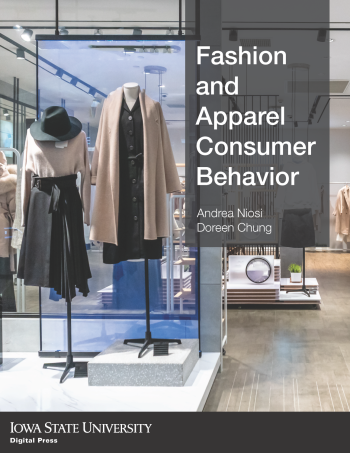
Not rated yetRate this bookAndrea Niosi and Doreen Chung examine consumption through the particular context of fashion and apparel. Their textbook connects purchasing and product use with identity, culture, social influence, and the experiences that extend before and after a sale.
Read on the publisher’s website. Opens in a new tab.
 Free
About this book
Fashion and Apparel Consumer Behavior is a 2025 Iowa State University Digital Press textbook by Andrea Niosi and Doreen Chung. It adapts and supplements earlier consumer-behaviour resources for the study of clothing and appearance-related decisions.
The verified contents comprise ten broad topics, covering decision making, the sociology of fashion, perception, learning, motivation, personality and identity, attitudes, social influences, and culture. Key terms and chapter reflections support those topics. The official PDF contains 377 pages, including front matter.
The introduction explains why a subject-specific approach matters: appearance-related decisions are influenced by identity and social settings as well as by the properties of an item. The book therefore brings ideas from several disciplines into a fashion and merchandising context.
The source edition is CC BY-NC-SA 4.0 with exceptions and credited adaptations. The guide below reviews the introduction and one early section. It does not claim to cover all ten topics or reproduce their activities.
Book summary
Study overview of the reviewed opening
The reviewed introduction explains that general consumer-behaviour material has been reorganised and supplemented for fashion and apparel. The aim is not merely to change examples. The subject calls for particular attention to how people use appearance, relate to others, and understand themselves within cultural settings.
The early section “What is Consumer Behavior?” presents consumption as a continuing process. Searching for information, evaluating possibilities, purchasing, using, and eventually disposing of an item raise different questions. This widens the focus beyond the moment of payment and makes post-purchase experience relevant to the subject.
Another useful distinction concerns roles. The person who chooses an item, the person who pays, the person who uses it, and someone who influences the choice need not be the same individual. Recognising these roles helps a reader specify whose behaviour is being discussed instead of treating a purchase as the action of one undifferentiated customer.
The section also connects apparel consumption with identity, culture, social relationships, and lifestyle. It introduces the value of looking beyond basic demographic categories when trying to understand a pattern of choices. Those categories may help organise a question, but they do not replace an explanation of the motives and circumstances involved.
Together, the reviewed material establishes a process-oriented approach to studying consumers. Later theories of perception, learning, motivation, and attitudes require their own reading and have not been summarised here.
Independent study suggestions
Academic Master editorial guidance:
Choose a familiar apparel item and map questions that could arise before purchase, during use, and at the end of its use. Identify whose perspective each question concerns. Avoid presenting your own habits as evidence about all consumers; instead, note what observations or research would be needed to investigate the question.
Questions for discussion
These are Academic Master’s original discussion prompts.
- What does a focus on the whole consumption process reveal that a focus on sales alone may miss?
- How could different participants influence one purchasing decision?
- What evidence would help distinguish a lifestyle-based explanation from an unsupported stereotype?
Book contents and further reading
Consult the complete official contents. The contents are linked rather than reproduced here.
Sources and coverage
Reviewed: title, copyright, contents, introduction (PDF page 9), and “What is Consumer Behavior?” in full (printed pages 5–7, PDF pages 15–17). The remaining topics and chapter-reflection activities have not been summarised.
Sources: official source and official PDF.
About access & copyright
This page provides book information and study material. Full-text access is provided by the original publisher or authorised source; a listing does not grant permission to republish the book.
Read our Library Access & Copyright policyConsumption process
Distinguish questions arising before and after purchase.
Consumer roles
Recognise that buyer, user, and influencer may be different people.
Fashion context
Relate appearance-related decisions to identity and social settings.
Evidence
Separate a proposed explanation from an assumption about consumers.
Reader ratings & reviews
Share your thoughts
Your review helps other students choose the right resources.
KEEP LEARNING
Your next great read
Business
Accounting Analytics: An Integrated Approach
Accounting Analytics: An Integrated Approach
View Accounting Analytics: An Integrated Approach — book Business
Mastering Strategic Management
View Mastering Strategic Management — book Business
Project Management: Navigating the Complexity with a Systematic Approach
View Project Management: Navigating the Complexity with a Systematic Approach — bookBusiness Law, Ethics, and Sustainability
Business Law, Ethics, and Sustainability
View Business Law, Ethics, and Sustainability — book Business
Sustainable Property Management
View Sustainable Property Management — book Business
 Calculus with Excel
View Business Calculus with Excel — book Business
 Startup and Entrepreneurship: Canada
View Business Startup and Entrepreneurship: Canada — book Business
The Marketing Map: Navigating the Principles of Marketing for Tourism, Hospitality, and Services
View The Marketing Map: Navigating the Principles of Marketing for Tourism, Hospitality, and Services — book Arts



