
Introduction to Consumer Behaviour
BusinessTextbook
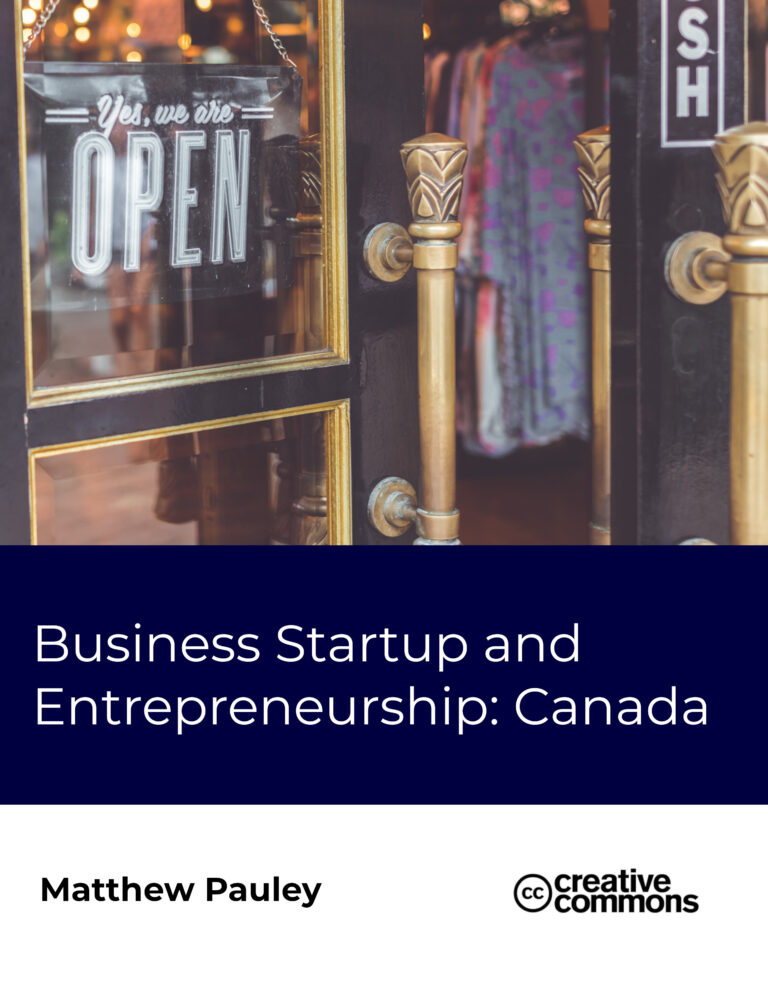
Business Startup and Entrepreneurship: Canada
Not rated yetRate this bookMatthew Pauley introduces the foundations of starting a business in a Canadian context. This textbook connects business concepts with a developing startup plan, supported by an accompanying workbook and financial worksheet.
Read on the publisher’s website. Opens in a new tab.
 Free
About this book
Business Startup and Entrepreneurship: Canada is Matthew Pauley’s 2021 open textbook, produced through Robertson Library and the University of Prince Edward Island. It presents introductory business and entrepreneurship material with an applied emphasis on developing a proposed venture.
The official contents address business fundamentals, entrepreneurship, industries and markets, strategy, value propositions, marketing, launching and operating a business, risk, teams, human resources, social resources, and finance. The book draws on credited educational material from several sources; its Canadian framing should not be mistaken for a claim that every example concerns Canada.
The available PDF contains 602 pages, including front matter. The introductory explanation recommends developing a business plan alongside the readings rather than postponing it until the course ends. A separate workbook and spreadsheet support that approach.
The study guide below covers the preface, introduction, and selected opening material only. It describes the identified edition rather than supplying current registration, tax, or financial instructions. The complete text remains available through official external links.
Book summary
Study overview of the reviewed opening
The preface explains the author’s practical purpose: to make introductory startup material accessible and useful to students. The focus is on building an understanding of essential business questions, with a resource that instructors can incorporate into introductory entrepreneurship teaching.
The introduction places a business plan at the centre of the learning process. Students are encouraged to develop the plan as they progress through the material, using it to connect ideas rather than treating chapters as isolated information. Pauley associates that work with critical analysis, creativity, and engagement with other people. The accompanying spreadsheet is presented as support for financial reporting, not as a guarantee that a proposed venture will succeed.
The reviewed opening of the business-fundamentals chapter widens the frame beyond a single idea. It introduces organisations, the environment in which they operate, and the need to respond to change. Businesses are examined alongside other organisations and within economic and social settings. This helps establish why planning requires attention to conditions outside the founder’s immediate control.
Taken together, these opening sections connect understanding with application. A plan becomes a place to test explanations, identify missing information, and relate a proposed offering to customers and circumstances. The later operational and financial chapters are signposted by the contents but have not been summarised here.
Independent study suggestions
Academic Master editorial guidance:
Choose a hypothetical venture and keep two separate lists: assumptions and supporting evidence. As you read, identify which assumptions have become more defensible and which need investigation. Record the source and date of factual claims. This independent study exercise is intended to improve reasoning about a plan, not to replace current professional or regulatory information.
Questions for discussion
These are Academic Master’s original discussion prompts.
- How would you distinguish an attractive idea from an assumption supported by evidence?
- Why might developing a plan during a course reveal questions that a final assignment alone would miss?
- Which parts of your explanation concern the venture, and which concern its wider environment?
Book contents and further reading
Consult the complete official contents. The contents are linked rather than reproduced here.
Sources and coverage
Reviewed: copyright and author information, official contents, preface (PDF page 10), introduction (page 11), and the opening of Chapter 1 (pages 13–15, printed pages 3–5). The remainder of Chapter 1 and later chapters have not been summarised.
Sources: official source and official PDF.
About access & copyright
This page provides book information and study material. Full-text access is provided by the original publisher or authorised source; a listing does not grant permission to republish the book.
Read our Library Access & Copyright policyApplied planning
Relate introductory concepts to the development of a proposed venture.
Evidence and assumptions
Identify questions that require investigation before a plan can be justified.
Business environment
Recognise the importance of conditions beyond an individual organisation.
Learning progression
Use the introduction to understand the role of the separate workbook.
Reader ratings & reviews
Share your thoughts
Your review helps other students choose the right resources.
KEEP LEARNING
Your next great read
Business
Accounting Analytics: An Integrated Approach
Accounting Analytics: An Integrated Approach
View Accounting Analytics: An Integrated Approach — book Business
Mastering Strategic Management
View Mastering Strategic Management — book Business
Project Management: Navigating the Complexity with a Systematic Approach
View Project Management: Navigating the Complexity with a Systematic Approach — bookBusiness Law, Ethics, and Sustainability
Business Law, Ethics, and Sustainability
View Business Law, Ethics, and Sustainability — book Business
Sustainable Property Management
View Sustainable Property Management — book Business
 Calculus with Excel
View Business Calculus with Excel — book Business
Fashion and Apparel Consumer Behavior
View Fashion and Apparel Consumer Behavior — book Business
The Marketing Map: Navigating the Principles of Marketing for Tourism, Hospitality, and Services
View The Marketing Map: Navigating the Principles of Marketing for Tourism, Hospitality, and Services — book Arts



