
Introduction to Consumer Behaviour
BusinessTextbook
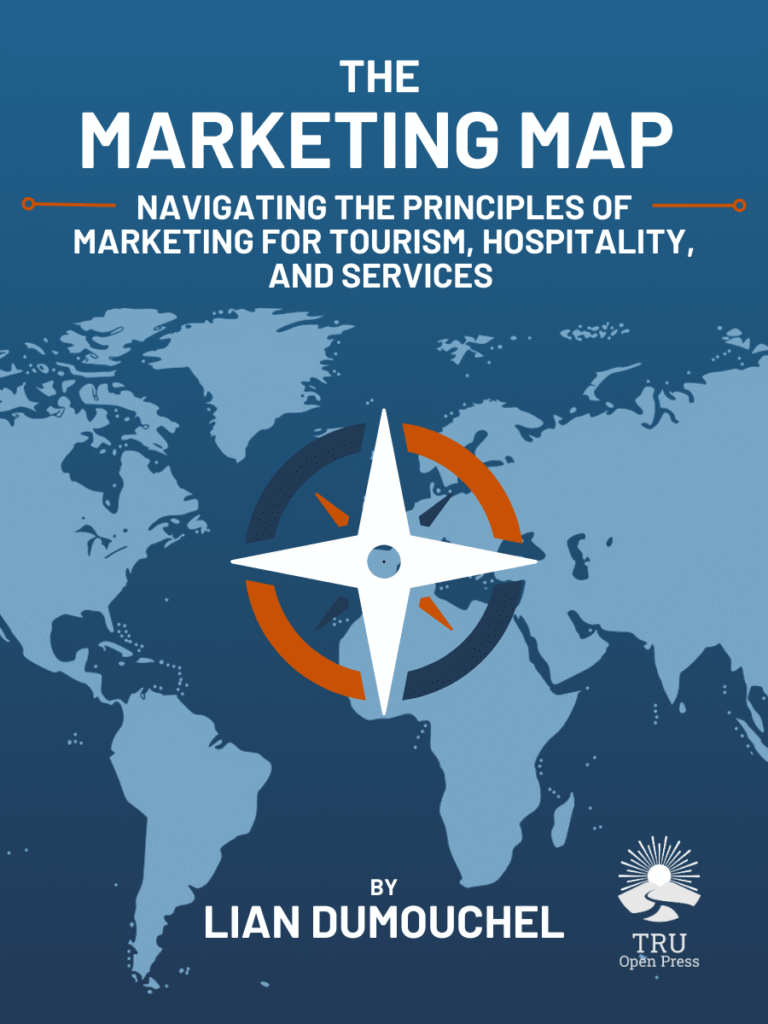
The Marketing Map: Navigating the Principles of Marketing for Tourism, Hospitality, and Services
Not rated yetRate this bookLian (Evangelia) Dumouchel introduces marketing through the distinctive demands of tourism, hospitality, and services. This Canadian post-secondary textbook connects marketing concepts with experiences, customer relationships, and the practical challenges of serving varied markets.
Read on the publisher’s website. Opens in a new tab.
 Free
About this book
The Marketing Map is a 2025 textbook from TRU Open Press. Its ten-chapter structure brings foundational marketing ideas into tourism, hospitality, and service settings. The emphasis is on understanding customers and organisations in context, then connecting that understanding with marketing decisions.
The verified contents progress through purchasing behaviour, segmentation and positioning, information systems, products, pricing, distribution, communication, global and responsible marketing, and strategic planning. These are the book’s documented areas of coverage; the study overview below concentrates on its introduction.
The downloaded PDF contains 589 pages, including front matter, and its version history identifies version 1.01, dated 15 April 2025. The acknowledgements document use in TMGT 1150 at Thompson Rivers University during Winter 2025. That is specific course-use evidence, rather than a claim of universal adoption.
The official online edition supplies chapter navigation and learning activities. Academic Master retains external access to the full text, which carries a CC BY-NC-SA 4.0 licence with separately credited material.
Book summary
Study overview of the reviewed introduction
The introduction positions marketing as a discipline that must respond to the nature of the offering. Tourism and hospitality involve experiences and interactions, so a useful strategy needs to account for more than the physical characteristics of an item. Dumouchel’s starting point is the relationship between general marketing principles and the particular circumstances in which services are delivered.
Several challenges give that relationship practical importance. An experience cannot always be inspected beforehand or stored for later sale. Demand may change with the season, and organisations may serve customers whose expectations differ across cultural settings. The introduction also places customer interactions and long-term relationships within the marketing problem. These features explain why a service-focused treatment needs its own examples and applications.
The learning outcomes connect conceptual understanding with analysis. Students are expected to distinguish needs, wants, demand, and value; understand the marketing mix; examine environmental influences; and relate marketing choices to organisational strategy. The introduction therefore presents a progression from vocabulary toward justified decisions, rather than treating knowledge of terminology as the final goal.
A further theme is adaptability. The announced competencies include contextual analysis, critical evaluation, and problem-solving. In this opening framework, a strategy should be assessed against its setting and purpose. The introduction establishes those expectations; it does not itself supply all the methods developed in the later chapters.
Suggested study approach
Academic Master editorial guidance: Select one service setting you know well. Write down a question about its customers, one about the experience offered, and one about the evidence needed to evaluate a marketing choice. Revisit these questions as you read the full book. Keep your own observations separate from claims supported by a source, and explain why each example fits the concept under discussion.
Questions for discussion
Academic Master editorial questions:
- How might the inability to store an experience affect the questions a marketer asks?
- What evidence would help distinguish a customer need from an assumption about customers?
- How could cultural context change the interpretation of an otherwise familiar marketing approach?
Book contents and further reading
Consult the complete official contents. The contents are linked rather than reproduced here.
Sources and coverage
Reviewed: title and copyright information, contents, the introduction on printed pages 1–2 (PDF pages 9–10), acknowledgements, and version history. The detailed study overview covers the introduction only. Chapters I–X have not been summarised.
Sources: official book details and the complete official PDF.
About access & copyright
This page provides book information and study material. Full-text access is provided by the original publisher or authorised source; a listing does not grant permission to republish the book.
Read our Library Access & Copyright policyService context
Explain why experiences create distinctive marketing questions.
Customer relationships
Connect customer interactions with satisfaction and longer-term relationships.
Contextual analysis
Identify the environmental factors a marketing decision should consider.
Strategic reasoning
Relate the introduction’s learning goals to justified marketing choices.
Reader ratings & reviews
Share your thoughts
Your review helps other students choose the right resources.
KEEP LEARNING
Your next great read
Business
Accounting Analytics: An Integrated Approach
Accounting Analytics: An Integrated Approach
View Accounting Analytics: An Integrated Approach — book Business
Mastering Strategic Management
View Mastering Strategic Management — book Business
Project Management: Navigating the Complexity with a Systematic Approach
View Project Management: Navigating the Complexity with a Systematic Approach — bookBusiness Law, Ethics, and Sustainability
Business Law, Ethics, and Sustainability
View Business Law, Ethics, and Sustainability — book Business
Sustainable Property Management
View Sustainable Property Management — book Business
 Calculus with Excel
View Business Calculus with Excel — book Business
Fashion and Apparel Consumer Behavior
View Fashion and Apparel Consumer Behavior — book Business
 Startup and Entrepreneurship: Canada
View Business Startup and Entrepreneurship: Canada — book Arts



