
Principles of Political Economy
LawTextbook
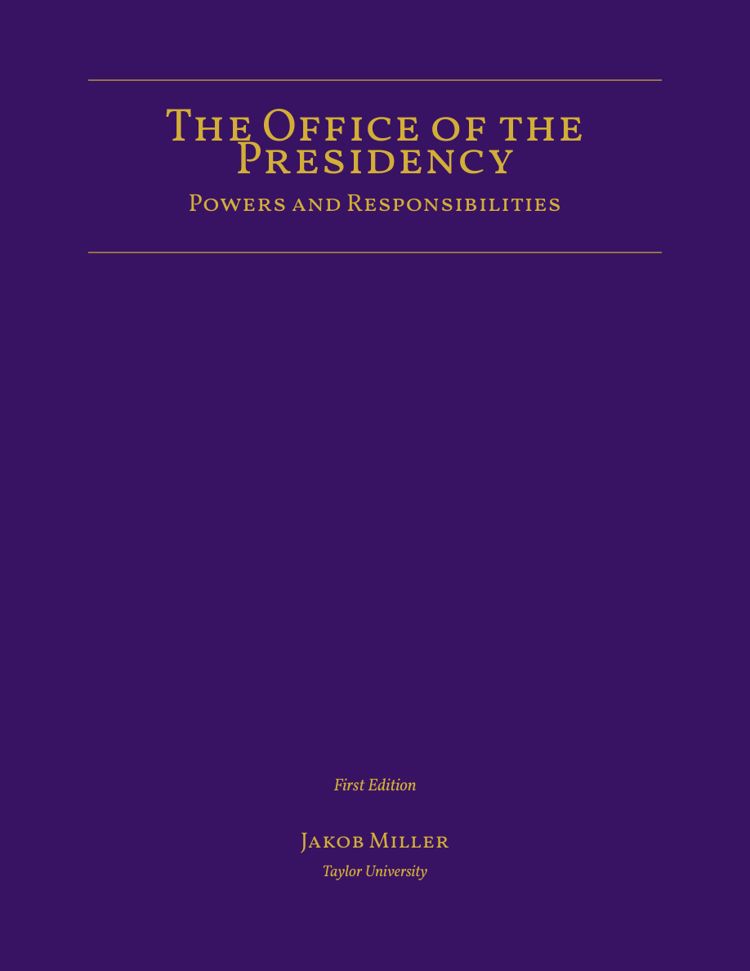
The Office of the Presidency: Powers and Responsibilities
Not rated yetRate this bookJakob Miller introduces the American presidency by examining the relationship between public expectations and the powers of the office. This concise undergraduate textbook focuses on institutions, constraints, and the ways presidents pursue their goals within them.
Free reading is available at the official source. Opens in a new tab.
 Free
About this book
The Office of the Presidency: Powers and Responsibilities is Jakob Miller’s 2025 first-edition introduction for undergraduate political science students. Its organising concern is the difference between the achievements people expect from a president and the authority available to that office. Miller uses an accessible, conversational approach to make institutional questions approachable.
The edition contains ten chapters. Its verified contents move from the formation of the presidency through elections, campaigns, taking office, relations with Congress and the courts, public opinion, media, and foreign affairs. An annotated Constitution, glossary, and further-reading recommendations provide routes into closer study.
Miller explains that the book is deliberately selective. It introduces important principles rather than offering a comprehensive history, a sequence of presidential biographies, or an exhaustive account of the research literature. It can therefore serve as a starting point for class discussion and additional reading.
The author’s official download contains 221 PDF pages. The source is freely available under CC BY-NC 4.0; Academic Master links to that edition externally. The study material below covers the introductory chapter and retains the edition’s 2025 context.
Book summary
Study overview of Chapter 1: Introduction
Miller opens by questioning an appealing picture of presidential leadership: a decisive individual identifies a problem and fixes it with a simple order. His concern is that this picture hides the institutions and processes through which public decisions are made. A president operates within a government containing other officeholders, agencies, legal requirements, and competing influences.
The chapter introduces the leadership dilemma, also described as an expectations gap. In Miller’s account, public demands can exceed the president’s actual control over events. This creates pressure to stretch existing tools or seek additional authority. Understanding that pressure provides a way to examine both the ambitions of presidents and the obstacles they encounter.
Limits are not presented as proof that the presidency is unimportant. Rather, Miller argues that the relationship between substantial power and significant constraints makes the institution interesting. The questions become more precise: what can an officeholder accomplish, what lies beyond the office’s reach, and how does the officeholder respond to that mismatch?
The introduction also sets the expectations for the textbook itself. Its subject is the presidency as an institution, rather than a catalogue of individual presidents. Historical examples support political science questions, but the book does not attempt to replace a detailed history or a reference collection. It aims to offer a manageable entry point, with further reading available when students want greater depth.
Guide to the reviewed chapter
Preface for Students
The student-facing opening asks readers to reconsider familiar assumptions about leadership. Miller uses comparisons with popular films to show how a dramatic story can make a powerful actor seem capable of doing almost anything. His institutional approach asks students to look beyond the visible individual and identify the processes that enable or restrict action. The key connection is between expectations, constraints, and attempts to achieve results.
How To Use This Book
This section explains the meaning of the book’s introductory scope. Chapters are intended to be readable in a sitting and to establish essential concepts rather than include every possible detail. Miller distinguishes political science inquiry from reference lookup, biography, historical narration, and personal political opinion. Students are encouraged to follow additional reading and ask instructors about questions that deserve more investigation.
Preface for Instructors
Miller presents the text as a concise and adaptable starting point for teaching. Its informal tone and selective treatment are deliberate choices intended to support student engagement. The chapter acknowledges that accessible explanations sometimes omit qualifications specialists would add. For teaching, this makes supplementary articles, discussion, and instructor guidance important companions to the introductory framework.
Questions for discussion
Academic Master editorial questions:
- What additional evidence would you need before attributing a public outcome to one president?
- How does studying an institution differ from studying the biography of an officeholder?
- Why might a concise introduction be useful, and what questions would require supplementary scholarship?
- How could you separate a claim about formal authority from a claim about practical influence?
Book contents and further reading
Consult the official first-edition contents, PDF pages 9–12 for the full chapter sequence and subsection titles. The contents are linked rather than reproduced here.
Sources and coverage
Edition checked: First Edition, copyright 2025, Jakob Miller, Taylor University. The title and copyright pages, preface, contents, and Chapter 1 were consulted. The chapter guide covers printed pages 1–5, PDF pages 14–18. Chapters 2–10 and the appendices have not been summarised. This is a guide to the identified edition, not an account of subsequent legal or political developments. Sources: the author’s book page and the complete official PDF.
About access & copyright
This page provides book information and study material. Full-text access is provided by the original publisher or authorised source; a listing does not grant permission to republish the book.
Read our Library Access & Copyright policyExpectations gap
Explain Miller’s distinction between public demands and presidential capacity.
Institutional focus
Distinguish the presidency from individual presidential biographies.
Limits and influence
Frame questions about what enables or constrains executive action.
Further inquiry
Recognise the limits of a concise introductory treatment.
Reader ratings & reviews
Share your thoughts
Your review helps other students choose the right resources.



