
 Intellectual property law
Administrative LawTextbook
Global Corruption: Its Regulation under International Conventions, US, UK, and Canadian Law and Practice
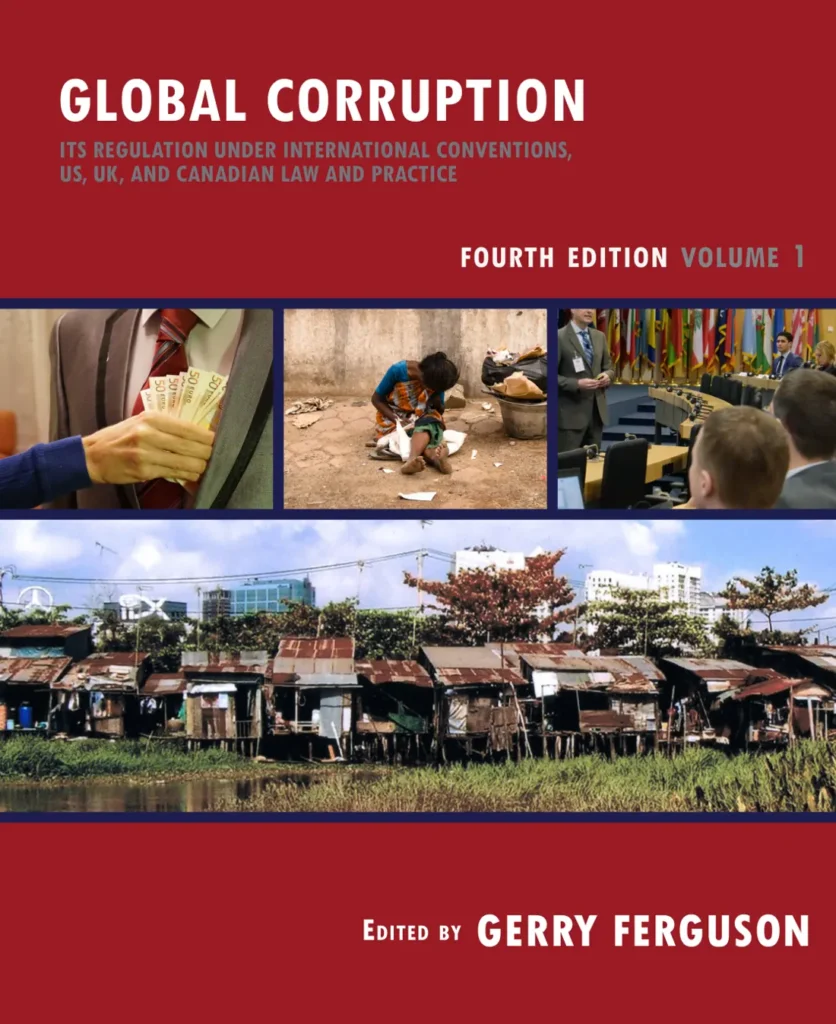
Not rated yetRate this bookGlobal Corruption: Its Regulation under International Conventions, US, UK, and Canadian Law and Practice, fourth edition, is edited by Gerry Ferguson and combines international standards with comparative legal analysis. The linked 2022 PDF contains both volumes and sixteen chapters. This guide follows that edition’s organization, including context, offences, enforcement, professional duties, preventive systems, political institutions, and collective responses. It distinguishes convention commitments from domestic legal rules and describes the source’s legal materials in their edition context. It is an academic reading guide, not a statement of the current law governing an individual case.
Free reading is available at the official source. Opens in a new tab.
 Free
About this book
Global Corruption: Its Regulation under International Conventions, US, UK, and Canadian Law and Practice, fourth edition, is edited by Gerry Ferguson and combines international standards with comparative legal analysis. The linked 2022 PDF contains both volumes and sixteen chapters. This guide follows that edition’s organization, including context, offences, enforcement, professional duties, preventive systems, political institutions, and collective responses. It distinguishes convention commitments from domestic legal rules and describes the source’s legal materials in their edition context. It is an academic reading guide, not a statement of the current law governing an individual case.
Book summary
Global Corruption: Its Regulation under International Conventions, US, UK, and Canadian Law and Practice, fourth edition, is edited by Gerry Ferguson and combines international standards with comparative legal analysis. The linked 2022 PDF contains both volumes and sixteen chapters. This guide follows that edition’s organization, including context, offences, enforcement, professional duties, preventive systems, political institutions, and collective responses. It distinguishes convention commitments from domestic legal rules and describes the source’s legal materials in their edition context. It is an academic reading guide, not a statement of the current law governing an individual case.
Chapter-by-chapter summaries
Chapter 1: Corruption in Context — Social, Economic, and Political Dimensions
The opening chapter examines why corruption matters, how it is defined, what drives it, and how it is measured. Historical development, international instruments, institutional perspectives, corporate governance, and examples connect legal regulation with social consequences. Perception indexes and estimates answer different questions and have methodological limits. A ranking should not be treated as a direct count of every corrupt act. Identify the definition, population, evidence, and unit of comparison before using a measurement in an argument. The chapter supplies context for legal analysis while showing why enforcement alone cannot explain the whole phenomenon.
Chapter 2: Bribery and Other Offences
Domestic bribery, foreign-public-official bribery, facilitation payments, and related misconduct are examined through international conventions and selected national laws. Similar policy concerns do not imply identical statutory elements, exceptions, or institutional arrangements. Separate the conduct, mental element, identity of participants, territorial connection, and possible defences in each system. Then identify whether a convention requires an offence or a domestic provision creates one. Comparative reading is strongest when it explains the difference precisely instead of describing every transfer of value as automatically the same legal wrong. Use the source’s cases and statutory extracts to support the analysis.
Chapter 3: Jurisdiction, Corporate Liability, Accomplices, and Inchoate Offences
A cross-border event raises questions about which state may act and which people or organizations may be responsible. Corporate attribution, participation, attempt, conspiracy, and other forms of liability require their own legal foundations. The place of a payment is not necessarily the only connection relevant to jurisdiction. Draw a map of actors, corporate relationships, conduct, and locations, then apply each jurisdiction’s source rules separately. Distinguish an organization’s liability from that of a particular officer or intermediary. An international business structure does not by itself answer the question of who can be prosecuted or on what basis.
Chapter 4: Money Laundering
The treatment connects proceeds of wrongdoing with transactions and legal rules directed at concealment, conversion, possession, and other forms of laundering under the systems discussed. An underlying corruption offence and a laundering offence are related but distinct inquiries. Identify the property, alleged source, transaction, required knowledge or other mental element, and applicable legal provision. Trace the movement of value without assuming that a complicated transaction is necessarily unlawful. The chapter also situates preventive institutions within the broader anti-corruption response. Its comparative material should be read against the legal and institutional framework of the 2022 edition.
Chapter 5: Asset Recovery and Mutual Legal Assistance
Recovering assets across borders involves identifying property, preserving it, obtaining evidence, and using the relevant legal process. Mutual assistance, confiscation-related mechanisms, and cooperation between jurisdictions raise questions different from proving the original offence. Distinguish temporary restraint from a final determination and separate criminal, civil, or other routes recognized by the system under discussion. Build a process diagram identifying the requesting authority, requested authority, evidential need, legal basis, and potential procedural obstacles. This makes clear why a suspicion that assets are abroad does not itself provide a complete route to their return.
Chapter 6: Investigation and Prosecution
Investigation and prosecutorial decisions depend on evidence, institutional capacity, legal powers, priorities, and cross-border cooperation. The chapter examines enforcement arrangements and issues that arise in taking allegations toward a legal proceeding. An accusation, an investigative finding, a negotiated resolution, and a judicial determination have different status. Follow an example by identifying who made each claim and what evidence or procedure supported it. Comparative analysis should also ask whether an agency’s formal powers can be exercised effectively in its institutional environment. The chapter connects legal rules with practical enforcement without implying that every jurisdiction follows one universal sequence.
Chapter 7: Criminal and Civil Sanctions and Remedies
Penalties and remedies can address punishment, deterrence, recovery, compensation, and organizational consequences. Their availability and calculation depend on the governing legal system and the established basis of liability. A finding of wrongdoing does not automatically justify every requested response. Distinguish consequences for an individual from those for an organization, and identify whether a measure is criminal, civil, administrative, or part of another process. For an assigned case, separate the conduct proved from the reasons given for the sanction. Then consider proportionality, incentives, and possible effects on parties not directly responsible for the offence.
Chapter 8: The Lawyer’s Ethical and Professional Duties
Lawyers may advise clients, manage transactions, encounter suspicious facts, or work within organizations affected by corruption risks. Professional obligations can involve confidentiality, privilege, independence, competence, and limits on assisting wrongdoing, with jurisdiction-specific rules. The chapter examines tensions rather than supplying one instruction that applies to every lawyer in every setting. Identify the professional role, client relationship, information, and relevant duty before evaluating an example. Distinguish legal privilege from a general desire for secrecy. The source is best used alongside the actual professional rules assigned for the jurisdiction and period being studied.
Chapter 9: Compliance Programs, Risk Assessments, and Due Diligence
Prevention requires more than a written prohibition. Risk assessment, governance, training, controls, monitoring, and attention to third parties connect organizational policy with actual behavior. Due diligence asks questions appropriate to the transaction, relationship, and context instead of mechanically collecting identical documents in every case. Map the specific risk and explain how each control is intended to address it. Then identify what evidence would show that the control works in practice. A program can look comprehensive while leaving incentives or reporting arrangements that discourage people from raising concerns. The chapter supports analysis of both design and implementation.
Chapter 10: Public Officials and Conflicts of Interest
Public duties can interact with private interests, relationships, benefits, and later employment in ways that threaten impartial decision-making or public trust. A conflict of interest is not identical to a proved bribe, and managing one requires attention to the applicable rule and circumstances. Identify the public function, relevant interest, decision, and disclosure or other response being discussed. Compare how the systems define and address the problem rather than assuming that one country’s categories apply everywhere. The chapter connects individual conduct with institutional safeguards and the appearance as well as reality of compromised public service.
Chapter 11: Regulation of Lobbying
Lobbying can be part of legitimate participation in public decision-making while also creating risks involving unequal access, hidden influence, and conflicts. Regulation may concern registration, disclosure, conduct, oversight, and enforcement, with differences across jurisdictions. Distinguish advocacy itself from the particular practice being regulated. Trace who is acting for whom, what decision is targeted, and what information the public or regulator receives. This clarifies why transparency is valuable but does not necessarily resolve every influence problem. Read the comparative arrangements as those covered in the source rather than assuming they remain unchanged today.
Chapter 12: Public Procurement
Public purchasing combines large financial decisions with discretion, specifications, competition, evaluation, performance, and oversight. Corruption risks can arise before a tender, during selection, or after award. A formally competitive procedure can still be compromised by the way requirements are written or information is distributed. Map the procurement stages and identify where a particular safeguard operates. Distinguish an irregularity, poor administration, a conflict, and a proved offence. The chapter connects prevention and enforcement with the design of the purchasing process rather than treating corruption as something that can occur only when money changes hands at the final award.
Chapter 13: Whistleblower Protections
People who report concerns may supply information otherwise unavailable to an organization or authority, but can face personal and professional risks. Protection regimes differ in covered persons, disclosures, channels, conditions, and remedies. An internal reporting policy and enforceable legal protection are not the same. Identify the reporter, information, recipient, and alleged retaliation in a case, then connect each with the relevant source provisions. The comparative approach also asks whether formal protection can be accessed effectively. A guide to a textbook chapter should not be treated as personal advice about which disclosure route is protected in a current matter.
Chapter 14: Campaign Finance — Controlling Corruption Risks and Public Cynicism
Campaign funding raises questions about political participation, resources, access, influence, transparency, and public confidence. Legal systems organize contribution, expenditure, disclosure, and oversight rules differently. A political donation is not automatically equivalent to a bribe, while formal legality alone does not settle every question of institutional influence. Specify the alleged risk and the mechanism by which a rule is intended to reduce it. Compare competing values and unintended consequences rather than judging a system only by whether it imposes more or fewer restrictions. The chapter links legal design with the broader legitimacy of political institutions.
Chapter 15: Collective Action
Corruption can be difficult to resist when participants believe that acting honestly alone places them at a disadvantage. Collective-action approaches seek coordinated commitments and changes in expectations among relevant actors. Their effectiveness depends on participation, credibility, incentives, monitoring, and consequences rather than the announcement of a shared principle alone. Identify the actors needed for a particular arrangement to work and what might encourage defection. Then explain how the initiative interacts with law and enforcement instead of assuming it replaces them. This broadens the analysis from individual compliance toward the conditions sustaining a practice across a sector or community.
Chapter 16: The Role of NGOs
Nongovernmental organizations can contribute research, monitoring, public education, advocacy, support, and pressure for reform. Their influence depends on methods, credibility, resources, access, independence, and relationships with communities and institutions. The chapter considers civil-society participation as part of the wider anti-corruption environment. Evaluate a proposed contribution by identifying the evidence it produces, audience it reaches, and change it can plausibly influence. Distinguish a public allegation from a legal finding and examine the method behind a report. Civil-society activity is an important analytical category without implying that every organization performs the same role or has equal capacity.
Study instructions
- Use the 2022 fourth-edition text consistently and identify the jurisdiction and legal source for each proposition.
- Create comparison tables that separate convention obligations, domestic offences, jurisdiction, procedure, and remedies.
- For a case, record actors, locations, transaction, evidence, procedural stage, holding, and consequence. Separate allegations from established findings.
- Trace an asset or decision through a process diagram to identify where legal powers and institutional safeguards operate.
- Evaluate a compliance or transparency proposal through the risk it addresses and evidence of implementation, not its title alone.
- When extending a discussion to a current issue, check the relevant current statutes, cases, conventions, and professional rules before relying on an edition example.
Questions for reflection
- Which part of the analysis is an international commitment and which is domestic law?
- What evidence distinguishes an allegation from an established violation?
- Why might an apparently strong compliance policy fail in practice?
- Which institutional incentive sustains the problem being examined?
Sources and coverage
This original reading guide follows the linked source edition’s chapter, module, unit, or lesson structure. Consult the source for full arguments, cases, worked examples, exercises, illustrations, and references. Coverage follows all sixteen chapters in both volumes of the linked 2022 fourth-edition PDF. The original Volume 1 cover represents the combined text. Rules and institutional descriptions are treated as edition material rather than certified current legal advice. Read the source edition.
About access & copyright
This page provides book information and study material. Full-text access is provided by the original publisher or authorised source; a listing does not grant permission to republish the book.
Read our Library Access & Copyright policyExplore the contents
Check the chapters covered in this edition.
Visit the official source
See reading, preview or purchase options.
Save for later
Keep this textbook in your saved collection.
Reader ratings & reviews
Share your thoughts
Your review helps other students choose the right resources.
KEEP LEARNING
Your next great read
Intellectual property law Contract Law
The Story of Contract Law: Formation
View The Story of Contract Law: Formation — book Law
Introduction to Criminal Law
View Introduction to Criminal Law — book Law
Evidence: Best Evidence Rule
View Evidence: Best Evidence Rule — book Law
Federal Rules of Appellate Procedure
View Federal Rules of Appellate Procedure — book Law
Land Use
View Land Use — book Business
Contract Doctrine, Theory & Practice, Volume 1
View Contract Doctrine, Theory & Practice, Volume 1 — book Law
The Ethics of Tax Lawyering
View The Ethics of Tax Lawyering — book Law
Federal Rules of Bankruptcy Procedure
View Federal Rules of Bankruptcy Procedure — book Civil Law



