
 English Literature
Plays
King Henry VIII
Modern scholarship widely treats Henry VIII as a collaboration between Shakespeare and John Fletcher. Folger’s authorship appendix records the history and limitations of attribution arguments. This page does not allocate particular lines or scenes to either writer.
Not rated yetRate this bookKing Henry VIII presents courtly power through accusation, ceremony, marriage, conscience, and sudden changes of fortune. This guide follows the five-act Project Gutenberg text, including the prologue and epilogue. The page retains the collaborative attribution to Shakespeare and John Fletcher. Its Tudor history is shaped for performance: speeches, reports, and pageants offer competing perspectives that should not be mistaken for a complete or neutral historical record.
 Free
About this book
King Henry VIII, also discussed under the title All Is True, is a historical play associated with Shakespeare and Fletcher. The hosted text follows Project Gutenberg #1541, with a Prologue, five acts and an Epilogue. Its opening contrasts a magnificent royal meeting with noblemen’s doubts about what that display cost and achieved. Dialogue, ceremonial entrances and the appearance of official papers make power visible in different forms. Because a character’s assertion of treason is not itself proof, the scene is useful for studying the relationship between dramatic evidence and political accusation. The guide below examines the opening rather than presenting a complete account of Henry’s reign. Historical context and the play’s chosen representation should be kept distinct, especially when using it alongside a history course.
This hosted edition is Academic Master’s 2026 PDF formatting of Project Gutenberg eBook #1541, originally released in 1998. The displayed 115-page count is the PDF sheet count, including source notices, rather than an early printed edition’s pagination. The Gutenberg catalogue’s ISBN (HTML) identifies its HTML format; no PDF-specific ISBN or DOI has been verified.
Authorship and edition context. Modern scholarship widely treats Henry VIII as a collaboration between Shakespeare and John Fletcher. Folger’s authorship appendix records the history and limitations of attribution arguments. This page does not allocate particular lines or scenes to either writer. Read the supporting source
Academic relevance. Cornell’s Spring 2024 ENGL 4270 course description explicitly includes this work among the late plays studied. View the archived course description. This documents study of the work, not assignment of this particular PDF.
Editorial suitability: undergraduate English literature and drama students, with attention to close reading and comparison of editions. This is Academic Master’s assessment, rather than a level stated by the original author.
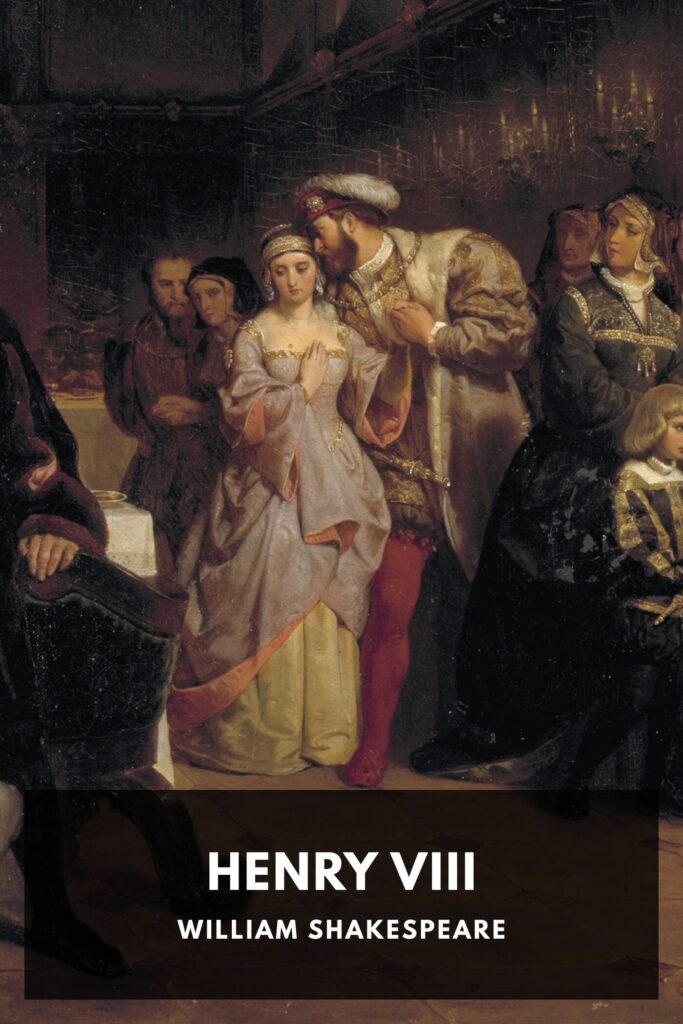
Cover image: Standard Ebooks edition. The hosted PDF remains the edition described above.
Source licence: Full Project Gutenberg License. Required source notices and licence terms are retained in the downloadable files.
Book summary
About this work
King Henry VIII presents courtly power through accusation, ceremony, marriage, conscience, and sudden changes of fortune. This guide follows the five-act Project Gutenberg text, including the prologue and epilogue. The page retains the collaborative attribution to Shakespeare and John Fletcher. Its Tudor history is shaped for performance: speeches, reports, and pageants offer competing perspectives that should not be mistaken for a complete or neutral historical record.
Act-by-act summaries
Prologue: An Invitation to Serious Attention
The prologue asks spectators to expect weighty matters rather than a familiar kind of comic entertainment. Grief, spectacle, rank, and unstable fortune are placed before the audience as connected subjects. This opening helps explain why apparently splendid events can coexist with suffering. Compare its appeal to truth with the play’s frequent reliance on partial reports and differing interpretations. The audience is invited to judge, but it is also reminded that the stage produces an experience requiring active participation.
Act I: Authority, Taxation, and Festivity
Buckingham’s anger at Wolsey establishes a conflict in which speech and accusation can become dangerous. His arrest turns private hostility into official action. Katherine then challenges a levy associated with the cardinal, making the effects on ordinary subjects visible within court discussion. The king’s response and Wolsey’s handling of credit show that an act of relief can itself become politically managed. Courtly conversation about fashion and status leads toward the entertainment at York Place, where Henry encounters Anne. Read the festive ending beside the preceding coercion: the same court can display generosity, pleasure, and vulnerability without those appearances being equally available to everyone.
Act II: Execution and the Question of Marriage
Buckingham’s final movement toward death is mediated through spectators and his own public speech. Reports about the king’s marriage introduce another field in which private feeling, institutional authority, and political consequences overlap. Anne’s conversation with the Old Lady complicates a simple account of ambition by setting disavowals beside speculation about advancement. At Blackfriars, Katherine appeals directly to Henry and contests Wolsey’s fitness to judge her. Her departure changes the court’s procedure, while Henry’s impatience with delay exposes the pressure behind the formal inquiry. Distinguish the court’s stated process from the outcome particular participants desire.
Act III: Persuasion and Wolsey’s Reversal
Katherine’s private setting becomes another place where the cardinals seek a response that will serve the wider proceedings. Her suspicion and eventual restraint must be read against their authority and the limits of her position. Wolsey’s own security then collapses when information reaches the king in a form he cannot control. His movement from grandeur to dispossession echoes earlier falls without making the causes identical. The farewell to Cromwell turns political defeat into reflection on ambition, service, and misplaced devotion. Compare Wolsey’s inward account with the charges and resentments voiced by others; neither perspective alone exhausts the dramatic judgment.
Act IV: A Coronation and a Dying Queen
Anne’s coronation is represented through the responses and descriptions of onlookers, placing public ceremony at a distance from the audience’s direct access to its full meaning. The act then turns to Katherine at Kimbolton. Her account of Wolsey is qualified by Griffith’s more charitable remembrance, allowing an opponent’s life to be reconsidered after death. A vision brings another kind of ceremony, followed by her requests concerning her daughter and her own burial. The juxtaposition makes succession and displacement simultaneous rather than separate stories. Katherine’s concern to be remembered as a chaste wife resists the reduction of her life to an obstacle already removed.
Act V: Cranmer, Birth, and Prophecy
The birth sequence creates anxiety before becoming a public occasion. Cranmer’s exposure to hostile council proceedings shows that official dignity does not guarantee secure treatment; the king’s intervention changes the balance. The crowd outside the christening adds unruly physical life to an event framed elsewhere through rank and religious significance. At Elizabeth’s baptism, prophecy projects the present infant into a future national narrative. Treat that future as a dramatic and political construction rather than a neutral forecast made outside history. The ending offers confidence after repeated uncertainty, while the earlier falls remain part of the experience through which that confidence is heard.
Epilogue and Comparative Reading
The epilogue returns judgment to spectators and gives women’s response a particular role in the hoped-for reception. That appeal can be compared with Katherine’s access to speech and Anne’s representation within the action. Across the play, pageantry is never merely decoration: it distributes attention, establishes rank, and frames transitions. Track the difference between someone’s public appearance and their security. A final interpretation should account for both the celebratory conclusion and the people whose losses make the succession story possible.
Study instructions
- Build a five-act timeline separating an accusation, a reported event, a public spectacle, and an event directly shown.
- Compare Buckingham’s and Wolsey’s falls without assuming one explanation fits both.
- Track Katherine’s opportunities to speak and the limits placed on her responses.
- Read the coronation and Katherine’s final scenes together as a deliberate juxtaposition.
- Analyze how the prophecy reframes the birth after the play’s earlier instability.
- Use the historical and collaborative-attribution notes to frame the work without treating title-page wording as proof.
Questions for reflection
- Who controls the interpretation of an event when it reaches the audience through report?
- How does a public ceremony conceal or expose vulnerability?
- Does the final prophecy resolve the earlier suffering or place it within a new narrative?
Sources and coverage
This original study guide follows the complete work in the linked Project Gutenberg edition and includes the ending. Poem numbers and act divisions follow that source; thematic reading groups are editorial aids, not additional chapters of the original. Plot summary and interpretation are distinguished through the reading questions. Historical title-page attributions do not by themselves settle authorship. Read the source text; Edition details.
About access & copyright
Check this edition’s source and licence before reusing its files or content. A library listing does not grant additional rights.
Read our Library Access & Copyright policyHistorical drama
Distinguish a theatrical truth claim from historical verification.
Political speech
Compare counsel, resentment and accusation.
Spectacle and cost
Analyse competing valuations of royal magnificence.
Stage evidence
Explain how entrances and documents represent power.
Reader ratings & reviews
Share your thoughts
Your review helps other students choose the right resources.
KEEP LEARNING
Your next great read
English Literature English Literature
Thomas Lord Cromwell
View Thomas Lord Cromwell — book English Literature
Sir John Oldcastle
View Sir John Oldcastle — book English Literature
The Merry Devil of Edmonton
View The Merry Devil of Edmonton — book English Literature
The Puritan Widow
View The Puritan Widow — book English Literature
The London Prodigal
View The London Prodigal — book English Literature
King Edward III
View King Edward III — book English Literature
Fair Em
View Fair Em — book English Literature
Arden of Feversham
View Arden of Feversham — book English Literature



