
 English Literature
Plays
A Midsummer Night's Dream
William Shakespeare; complete source text.
Not rated yetRate this bookA Midsummer Night's Dream brings four Athenian lovers, a company of amateur actors, and a quarrelling fairy court into the same wood. Magic intensifies desires that already meet opposition, while the final performance turns private confusion into communal entertainment. This guide covers all five acts and the concluding fairy blessing, with attention to the difference between restored order and freely chosen affection.
 Free
About this book
A Midsummer Night's Dream brings four Athenian lovers, a company of amateur actors, and a quarrelling fairy court into the same wood. Magic intensifies desires that already meet opposition, while the final performance turns private confusion into communal entertainment. This guide covers all five acts and the concluding fairy blessing, with attention to the difference between restored order and freely chosen affection.
The hosted PDF is Academic Master’s 2026 formatting of Project Gutenberg eBook #1514, first released in 1998. It contains the complete source text and Gutenberg notices. Its displayed 81-page count refers to PDF sheets, including front matter and notices, rather than the pagination of an early printed edition.
Academic relevance. Cornell’s Spring 2026 ENGL 2080 course description explicitly lists this play for study. This documents course use of the work rather than assignment of this particular PDF. View the institutional source
Editorial suitability: undergraduate English literature and drama students practising close reading, with guidance where unfamiliar language requires it. This is Academic Master’s assessment, rather than a level stated by the author.
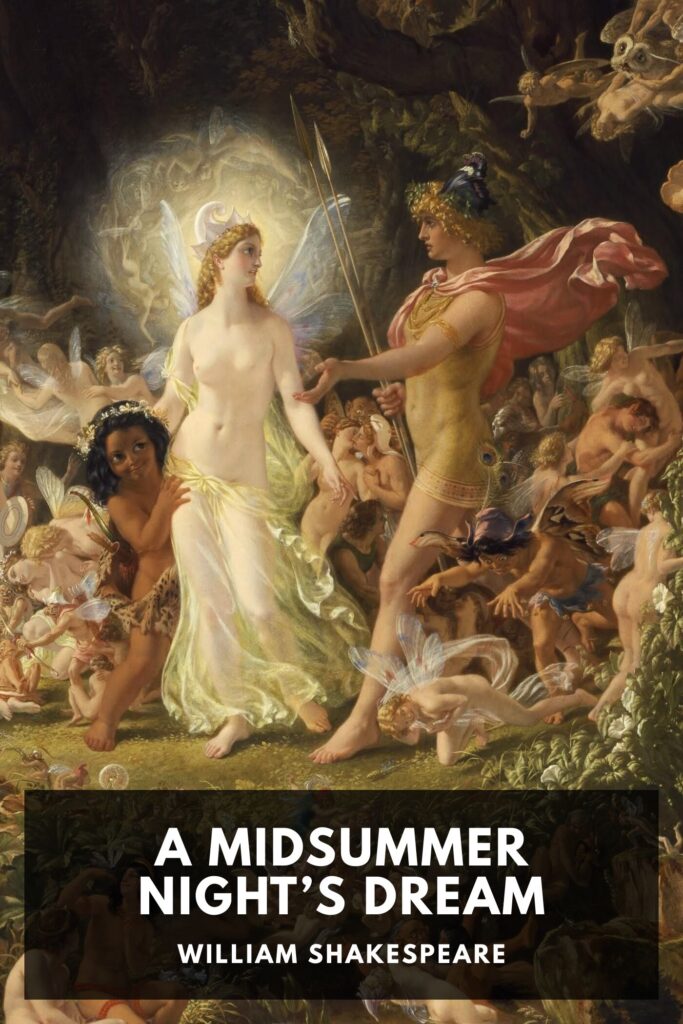
Cover image: Standard Ebooks edition. The hosted PDF uses the Project Gutenberg source described above.
Source licence: Full Project Gutenberg License. Required source notices and licence terms are retained in the downloadable files.
Book summary
About this work
A Midsummer Night's Dream brings four Athenian lovers, a company of amateur actors, and a quarrelling fairy court into the same wood. Magic intensifies desires that already meet opposition, while the final performance turns private confusion into communal entertainment. This guide covers all five acts and the concluding fairy blessing, with attention to the difference between restored order and freely chosen affection.
Act-by-act summaries
Act I — Marriage under public authority
Theseus and Hippolyta anticipate their wedding, but Egeus interrupts with a demand that Hermia marry Demetrius instead of Lysander. Theseus supports the father's legal authority and presents Hermia with severe alternatives. Hermia and Lysander plan to escape Athens. Helena, who loves Demetrius, tells him their plan in the hope of receiving attention, thereby bringing all four toward the wood. Separately, Quince organizes working men to perform Pyramus and Thisbe at the wedding. Bottom's enthusiasm repeatedly exceeds the limits of his assigned role. The act places lovers and actors within systems of permission and judgment: the young people seek control over their relationships, while the artisans negotiate how to represent another set of lovers before powerful spectators.
Act II — A fairy quarrel and a mistaken application
Oberon and Titania dispute custody of a child associated with Titania's deceased companion. Their quarrel is described as disturbing the seasons, linking intimate conflict to the surrounding environment. Oberon obtains a flower whose juice causes a sleeper to love the first creature seen on waking. He uses it against Titania and instructs Puck to help an Athenian woman rejected by a man in the wood. Puck mistakes Lysander for Demetrius and applies the juice to him. Helena wakes Lysander, who immediately abandons his attachment to Hermia. She interprets the sudden declaration as mockery, while Hermia wakes alone and frightened. The magic therefore does not produce transparent knowledge of anyone's true feelings; it reorganizes desire while leaving the affected people to invent explanations.
Act III — An ass's head and a crisis among the lovers
The artisans rehearse, worrying about how an audience might distinguish enacted violence and a theatrical lion from real danger. Puck gives Bottom an ass's head, frightening the others away. Titania wakes and becomes devoted to him, turning the transformation into an opportunity for Oberon's leverage over her. Meanwhile, Oberon discovers Puck's mistake and enchants Demetrius so that he too loves Helena. Helena believes the two men and Hermia have combined to humiliate her, while Hermia cannot understand Lysander's rejection. Their former friendship becomes another casualty of competing explanations. Puck imitates the men's voices to keep them from fighting, then restores Lysander's earlier attachment. He arranges sleep as a practical means of ending the immediate disorder, rather than persuading the lovers through a shared account of what happened.
Act IV — Waking into an uneven settlement
Oberon obtains the child, releases Titania from the enchantment, and reconciles with her. Bottom regains his ordinary appearance and struggles to describe his experience, imagining it as material for a ballad. Theseus's hunting party discovers the lovers. Demetrius now declares love for Helena, while Lysander again loves Hermia. Theseus overrides Egeus and announces that the couples will marry alongside him and Hippolyta. Notice the important asymmetry: Lysander's enchantment has been removed, but the play does not show a corresponding removal of Demetrius's love charm. The apparent solution is therefore partly sustained by magic rather than wholly established through deliberation. The artisans welcome Bottom back and prepare their performance, translating the night's extraordinary disruptions into renewed work and anticipation.
Act V — The play within the play and the final blessing
The newlyweds debate the lovers' account of the night, with Theseus questioning imagination's claims and Hippolyta finding significance in the consistency of their stories. They watch Pyramus and Thisbe, whose literal explanations, earnest acting, and technical awkwardness invite ridicule. Yet its lovers' mistaken deaths also echo dangers the main plot has avoided. Theseus's willingness to receive the performance contrasts with the sharper mockery of other spectators. After the court retires, the fairies bless the house and marriages. Puck finally asks the audience to regard any offense as a dream and to signal acceptance through applause. The play thus ends by returning judgment to the spectators while making theater's capacity to shape belief part of its appeal.
Dream, theatrical illusion, and the politics of desire
Track what the play treats as natural affection, magical intervention, legal command, and remembered dream. These categories overlap but should not be collapsed. Oberon's intervention helps resolve the Athenian conflict while also serving his own authority over Titania. Theseus grants the lovers a future after initially upholding paternal control. Bottom's experience can be both absurd and an encounter he cannot adequately express in ordinary terms. Likewise, the artisans' literal-minded explanations expose theatrical convention without making their effort worthless. A developed reading recognizes how the comedy generates pleasure through managed illusion while leaving questions about the management itself—who directs it, who benefits, and who never receives the full explanation—available for scrutiny.
Study instructions
- Draw the four-lovers diagram before the wood, after each application of the flower, and at the morning discovery.
- Record every instruction Oberon gives Puck and distinguish a mistaken execution from a deliberate choice.
- Compare the artisans' anxiety about frightening spectators with the court's actual response to their play.
- Read Titania's account of the child before evaluating the settlement of the fairy quarrel.
- Compare Theseus's first decision about Hermia with his later override of Egeus.
- Explain why Demetrius's continuing enchantment complicates an account of the ending as a simple recovery of true love.
Questions for reflection
- How do Helena and Hermia explain events when they lack the audience's knowledge of magic?
- Does the artisans' performance merely parody the main plot or also clarify its risks?
- What does Puck's final invitation ask spectators to forgive, imagine, or endorse?
Sources and coverage
This original study guide follows the complete work in the linked Project Gutenberg edition and includes the ending. Poem numbers and act divisions follow that source; thematic reading groups are editorial aids, not additional chapters of the original. Plot summary and interpretation are distinguished through the reading questions. Historical title-page attributions do not by themselves settle authorship. Read the source text; Edition details.
About access & copyright
Check this edition’s source and licence before reusing its files or content. A library listing does not grant additional rights.
Read our Library Access & Copyright policyConsent and authority
Compare Hermia’s choice with the claims made over her.
Unequal desire
Explain Helena’s reasoning and intended action.
Theatrical roles
Study how the company negotiates representation.
Dramatic structure
Connect the separate plans to meet outside Athens.
Reader ratings & reviews
Share your thoughts
Your review helps other students choose the right resources.
KEEP LEARNING
Your next great read
English Literature English Literature
Thomas Lord Cromwell
View Thomas Lord Cromwell — book English Literature
Sir John Oldcastle
View Sir John Oldcastle — book English Literature
The Merry Devil of Edmonton
View The Merry Devil of Edmonton — book English Literature
The Puritan Widow
View The Puritan Widow — book English Literature
The London Prodigal
View The London Prodigal — book English Literature
King Edward III
View King Edward III — book English Literature
Fair Em
View Fair Em — book English Literature
Arden of Feversham
View Arden of Feversham — book English Literature



