Introduction
East Chestnut Regional Health System (ECRH) is a regional healthcare organization created through the merger of several previously independent institutions. The merged system includes East River Medical Center, Archway Hospital, and the hospitals formerly associated with the Northern Mountain Hospital Consortium. Each organization brought different facilities, medical professionals, patient populations, financial conditions, and organizational cultures into the new healthcare system.
The merger has enabled ECRH to provide a broad range of medical services across urban and rural communities. The system has access to numerous specialists, primary care providers, hospital beds, emergency services, and advanced medical technology. It also serves many uninsured and low-income patients who might otherwise struggle to obtain affordable treatment. These characteristics give ECRH a strong foundation from which to expand its services and improve community health.
However, the merger has also created operational and managerial difficulties. The case study identifies problems involving long patient waiting times, inconsistent follow-up care, aging facilities, fragmented leadership, an aging physician workforce, declining public confidence, and differences among the cultures of the merged organizations. The healthcare system also faces growing competition from urgent care centers, retail clinics, pharmacies, and other hospitals.
A SWOT analysis provides a structured method for examining these conditions. SWOT refers to strengths, weaknesses, opportunities, and threats. Strengths and weaknesses are generally internal conditions that the organization can influence directly, while opportunities and threats arise mainly from the external healthcare environment. The analysis helps ECRH determine its current position and identify the matters that should receive immediate strategic attention.
Preliminary Review of the Current Situation
East Chestnut Regional Health System has developed into a large regional provider by combining several healthcare organizations. East River Medical Center functions as the anchor institution and has historically been regarded as an important source of medical care in the community. It operates a Level I trauma center, provides air transportation services, and has maintained a relatively strong technological capacity. However, its reputation has declined in recent years, and safety concerns related to its surrounding urban location have discouraged some patients, visitors, and physicians.
The Northern Mountain Hospital Consortium contributes hospitals serving several counties, including rural communities. These facilities allow ECRH to reach patients beyond the immediate Chestnut metropolitan area. The consortium also creates opportunities for group purchasing, employee-benefit administration, and coordinated physician recruitment. Nevertheless, several of its facilities require modernization, and the availability of physicians differs among locations.
Archway Hospital adds further capacity to the system, but it has low occupancy, an aging physical structure, and a payer mix heavily dependent on Medicare and Medicaid. The hospital therefore requires careful evaluation to determine whether investment, renovation, repurposing, or consolidation would provide the greatest strategic benefit.
The case study also describes leadership and cultural challenges following the merger. Decentralized decision-making allowed individual hospitals to retain some independence, but it also weakened system-wide coordination. Variations in management practices and organizational priorities prevented ECRH from developing a fully unified identity. Research on healthcare mergers indicates that combining facilities and financial resources does not automatically create an integrated organization. Leadership must actively address differences in values, communication, decision-making, and workplace culture during the post-merger period (Chesley, 2020).
Despite these difficulties, ECRH has important resources. These include experienced specialists, a respected chief medical officer, improved financial leadership, a broad regional presence, substantial purchasing power, advanced services, and access to a large patient population. The organization is therefore not beginning from a position of complete weakness. Its main challenge is to coordinate its existing strengths more effectively.
Objective of the SWOT Analysis
The objective of this SWOT analysis is to evaluate the internal capabilities and limitations of East Chestnut Regional Health System, identify important developments in the external healthcare environment, and determine which strategic issues should receive priority.
More specifically, the analysis seeks to determine how ECRH can use its large specialist network, affordable services, regional presence, and combined organizational resources to reduce patient waiting times, improve continuity of care, strengthen communication, respond to competition, and expand access for uninsured and underserved populations.
SWOT Analysis Framework
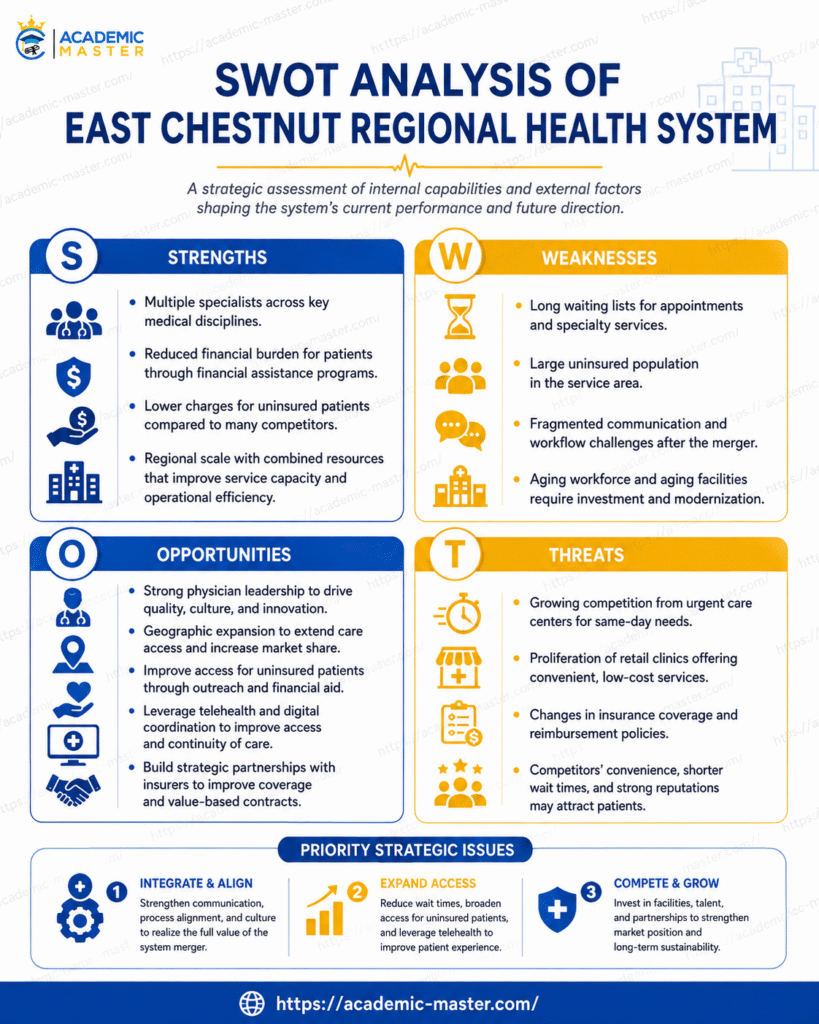
| Factor | Helpful | Harmful |
|---|---|---|
| Internal | Strengths | Weaknesses |
| Availability of multiple specialists across diverse medical disciplines | Long patient waiting lists and extended waiting times | |
| Examinations associated with some visits are offered without additional charges | Large uninsured populations place pressure on available resources | |
| Lower charges for uninsured or self-paying patients than competing healthcare units | Floating providers create difficulties with follow-up and continuity of care | |
| Large regional network created through the merger | Fragmented communication and organizational cultures | |
| Advanced trauma, emergency, air transport, and technological capabilities | Aging physicians and difficulty recruiting replacements | |
| Purchasing power and resource-sharing potential | Aging or underused facilities | |
| External | Opportunities | Threats |
| Physician groups can help shape future healthcare delivery | Competitive prices charged by other urgent care organizations | |
| Successful services may be expanded into other areas of the state | Retail clinics located in pharmacies and shopping centers | |
| Access programs can improve care for uninsured populations | Insurance-policy and reimbursement changes | |
| Partnerships with insurers and community organizations | Competitors offering greater convenience and shorter waiting times | |
| Telehealth and coordinated regional scheduling | Workforce shortages and increasing operating costs | |
| Growing demand for accessible primary and specialty care | Loss of patients because of poor service experiences |
Strengths
Availability of Multiple Specialists
The availability of multiple specialists across diversified disciplines is one of ECRH’s most important strengths. Because the organization was formed by merging several healthcare institutions, it can draw upon a much larger network of physicians, nurses, diagnostic professionals, therapists, and other healthcare experts than a small independent clinic could provide.
Patients with complicated medical conditions often require services from more than one specialist. For example, a person with diabetes and cardiovascular disease may require a primary care physician, endocrinologist, cardiologist, dietitian, pharmacist, and laboratory services. ECRH’s specialist network creates an opportunity to coordinate these services within one regional system.
The network can also support professional consultation. A physician working at a rural facility may obtain advice from a specialist at the anchor hospital without requiring the patient to begin treatment through an entirely separate organization. If ECRH develops effective referral systems and shared health records, its range of specialists can become a major competitive advantage.
However, the presence of many specialists will produce value only if patients can reach them promptly. ECRH should therefore combine specialist availability with efficient referral procedures, common clinical pathways, and coordinated scheduling.
Reduced Financial Burden on Patients
Another strength identified in the case study is ECRH’s unique offer to conduct certain examinations without charging the patient an additional amount during the visit. This arrangement reduces the financial burden placed on patients and may prevent delays in diagnosis.
Patients sometimes avoid recommended examinations because they are uncertain about the cost. When basic assessments are included within a visit, patients are more likely to complete the necessary evaluation. This can help clinicians detect illnesses earlier and develop more appropriate treatment plans.
This feature may also strengthen patient loyalty. People are more likely to return to an organization when they believe the pricing structure is transparent and the healthcare provider is concerned about affordability. Nevertheless, ECRH must ensure that the policy is financially sustainable. The organization should clearly define which examinations are included, calculate their actual costs, and avoid making promises that vary unpredictably among locations.
Lower Charges for Uninsured Patients
Compared with other healthcare organizations in the area, ECRH charges lower costs to some patients without health insurance. This is a significant community benefit because uninsured individuals often delay treatment until their conditions become severe.
The Centers for Medicare & Medicaid Services recognizes that community-based providers, rural health clinics, free clinics, and other organizations play an important role in caring for uninsured and underinsured individuals. Some providers use income-based or reduced-fee arrangements to improve access, although such services are not a complete substitute for comprehensive insurance coverage (Centers for Medicare & Medicaid Services [CMS], 2023).
ECRH’s lower self-pay charges can increase access to primary care, diagnostic services, and treatment for patients who might otherwise rely on emergency departments. This policy supports the organization’s community mission and distinguishes it from competitors that target only well-insured or higher-income patients.
The strength must still be managed carefully. A large volume of low-paying or uninsured patients may place considerable financial pressure on the health system. ECRH should therefore connect eligible patients with Medicaid, Marketplace insurance, charity-care programs, payment plans, and community assistance.
Regional Scale and Combined Resources
The merger has given ECRH access to a wide geographic area, multiple facilities, a larger workforce, and substantial purchasing power. The former Northern Mountain Hospital Consortium had already recognized the benefits of joint purchasing, shared employee benefits, and collective recruitment. These advantages can become even greater within a unified regional system.
ECRH can negotiate more favorable prices for pharmaceuticals, medical supplies, information systems, insurance, and maintenance services. It can also distribute specialized resources across its facilities instead of duplicating every service at each location.
The regional network allows ECRH to direct routine services to community facilities while reserving advanced and high-risk procedures for the anchor medical center. Such coordination can reduce duplication and improve the use of available capacity.
Weaknesses
Long Waiting Lists
A long waiting list requires many patients to wait for hours before receiving care. This is a painful and frustrating experience for patients and is one of the most important weaknesses identified in the original analysis.
Long waits can affect patient satisfaction, safety, trust, and the organization’s reputation. Patients may leave before receiving treatment, miss work, experience anxiety, or choose a competing provider during their next illness. In serious cases, delayed assessment may allow a medical condition to worsen.
The Agency for Healthcare Research and Quality identifies timeliness as one of the principal domains of healthcare quality. Timely care requires reducing unnecessary waits and potentially harmful delays for both patients and professionals (Agency for Healthcare Research and Quality [AHRQ], 2025).
ECRH should study the causes of its waiting problem rather than assuming that every delay results from insufficient staffing. Causes may include inefficient registration, poor appointment distribution, limited examination rooms, delayed discharges, repeated paperwork, provider lateness, weak triage, or uneven patient demand.
An advanced-access scheduling model may help some outpatient facilities. This model attempts to balance daily demand with available clinical capacity and preserve appointments for patients who need prompt care. AHRQ notes that advanced-access approaches can reduce delays and improve the likelihood that patients see their usual provider, although they require reliable data and careful implementation (AHRQ, 2020).
Large Uninsured Population
The locations served by ECRH include large populations without health insurance. This condition creates an important community responsibility, but it also represents an internal financial and operational weakness when the system lacks a clear strategy for managing uncompensated or reduced-cost care.
Uninsured patients may delay routine treatment and arrive with more advanced illnesses. They may also experience difficulty obtaining medications, specialist referrals, rehabilitation, or follow-up services. ECRH’s willingness to charge lower prices improves access, but the system must still cover labor, equipment, facility, and supply costs.
The health system should establish a coordinated financial-assistance process across all locations. Staff should screen patients for Medicaid, insurance subsidies, charity care, and payment-plan eligibility. The organization should also collect data on uncompensated care by location and service type so that leaders can identify where additional community partnerships or grant funding may be necessary.
Floating Providers and Follow-Up Problems
The use of floating providers at different locations creates follow-up difficulties. A patient may see one professional during the initial visit and a different person during the next appointment. The second provider may be unfamiliar with the patient’s preferences, history, and previous concerns.
Provider flexibility is useful when ECRH needs to cover staffing gaps. However, excessive rotation may weaken continuity of care. A systematic review by Pereira Gray et al. (2018) found that greater continuity with physicians was associated with lower mortality across multiple care settings. Continuity can also support trust, communication, adherence, and patient satisfaction.
ECRH does not necessarily need to eliminate floating providers. Instead, it should create stable care teams. Each patient could be assigned to a primary physician, nurse practitioner, or clinical team even when another professional occasionally conducts the appointment. A shared electronic record, clear handoff procedures, and responsibility for reviewing test results would reduce fragmentation.
Fragmented Communication After the Merger
The merger created a large organization, but its units have not always operated as a coordinated system. Individual hospitals retained different cultures, identities, practices, and leadership arrangements. Decentralization offered flexibility, yet it also produced inconsistent decision-making and weak system-wide communication.
This weakness affects patient care, marketing, staffing, technology, and financial performance. A patient referred from one facility to another should not have to repeat the entire registration process or discover that the receiving team lacks necessary information.
ECRH should establish common communication standards without ignoring legitimate local needs. System-wide protocols should cover referrals, discharge communication, test-result notification, clinical escalation, patient complaints, and emergency coordination.
Aging Workforce and Facilities
The case study identifies an aging medical staff and several facilities requiring modernization. An experienced workforce is valuable, but a high average physician age creates succession and recruitment risks. If several specialists retire within a short period, the organization may lose important service capacity and referral relationships.
Aging facilities can also affect patient perceptions, operational efficiency, safety, and maintenance expenses. ECRH should evaluate each building according to utilization, condition, location, strategic importance, and expected return on investment. Underused space may be converted into outpatient clinics, rehabilitation services, behavioral healthcare, administrative offices, or community health programs.
Opportunities
Physician Groups Can Shape Future Healthcare
The physician group has an opportunity to influence the future direction of healthcare within the region. Physicians understand patient needs, referral patterns, clinical quality, and gaps in available services. Their participation is therefore essential to successful strategic planning.
ECRH can involve physicians in the development of clinical service lines, quality-improvement initiatives, population-health programs, and referral systems. Younger primary care physicians can also help the organization develop more integrated and technology-supported approaches to care.
The organization should avoid treating physicians only as employees or revenue generators. Engaging them as strategic partners can improve implementation and reduce resistance to organizational change.
Expansion into Other Areas
The positive experience of the health units creates an opportunity to construct or develop additional centers in other parts of the state. However, expansion should not automatically involve building another full hospital. ECRH could establish smaller outpatient centers, urgent care units, diagnostic facilities, telehealth locations, or specialty clinics.
Expansion decisions should be based on population needs, travel patterns, disease prevalence, insurance coverage, competition, and projected financial performance. A new facility should solve an identified access problem rather than merely increase the system’s physical size.
The rural hospitals already associated with ECRH provide a foundation for this strategy. The organization can expand selected specialist services through rotating clinics and telehealth instead of requiring rural patients to travel repeatedly to the urban center.
Improving Access for Uninsured Patients
The opportunity for uninsured patients to visit multiple experts contributes to the well-being of a large population. ECRH can build upon this strength by developing a formal access program for uninsured and underinsured residents.
The program could combine reduced self-pay prices, charity-care screening, assistance with insurance enrollment, medication-support referrals, preventive services, and coordinated specialist appointments. Community organizations, local governments, employers, and charitable foundations may be willing to support such an initiative.
The system should also measure outcomes. It should determine whether the program reduces avoidable emergency visits, improves chronic-disease control, and connects patients with stable primary care.
Telehealth and Digital Coordination
Telehealth creates an important opportunity for a regional organization. Specialists located at the anchor hospital can support patients and clinicians in rural locations. Follow-up appointments that do not require physical examination may be conducted remotely, reducing travel and missed visits.
ECRH’s electronic health-record system can support this strategy if staff members use it consistently. The organization should invest in training, technical support, data quality, and patient education rather than treating technology as a one-time installation project.
Partnerships with Insurance Companies
The large number of patients and specialists gives ECRH an opportunity to develop stronger relationships with insurance companies. The health system can negotiate contracts based on its broad network, regional reach, trauma capacity, and ability to provide coordinated care.
However, the system should not focus only on increasing patient volume. Agreements should reward quality, continuity, prevention, and appropriate use of resources. ECRH should also examine payer policies carefully to ensure that contracts provide adequate reimbursement for complex and vulnerable patients.
Threats
Competition from Urgent Care Organizations
Competitive charges at other urgent healthcare units are a direct threat. Patients with minor illnesses and injuries may prefer organizations that provide transparent prices, short waits, evening hours, and convenient parking.
If ECRH’s facilities involve complicated registration or long waiting times, patients may choose competitors even when ECRH offers more comprehensive services. The system must therefore compete on access and convenience as well as clinical expertise.
Retail Clinics in Pharmacies and Shopping Centers
Urgent healthcare facilities located in pharmacies and major shopping centers present a growing competitive threat. Retail clinics attract patients by offering convenient locations, extended operating hours, simple pricing, and treatment without lengthy appointments.
Research indicates that retail and urgent care clinics compete with traditional practices by providing basic care at lower or more transparent prices and with shorter waiting times (Voran, 2023).
ECRH should not attempt to reproduce retail clinics without considering its broader mission. Instead, it can respond by offering same-day appointments, extended hours, online scheduling, virtual visits, and rapid referral from urgent care to specialty services.
Insurance and Reimbursement Changes
Low-premium health insurance may make treatment more affordable for patients. However, changes in insurance policies, network arrangements, prior-authorization rules, and reimbursement levels can threaten healthcare organizations.
When more patients obtain insurance, ECRH may receive fewer completely self-paying patients. This can be positive because insured patients have greater protection, but it can also alter the system’s revenue structure. Insurers may exclude ECRH from preferred networks, reduce payment rates, or direct patients to competing facilities.
This factor can therefore function as both an opportunity and a threat. ECRH should maintain expertise in payer contracting, regulatory compliance, reimbursement analysis, and insurance-policy changes.
Competitor Convenience and Reputation
Competitors may attract patients not only because of lower prices but also because they appear safer, newer, faster, or more patient-centered. ECRH’s deteriorating reputation and concerns about the environment surrounding some facilities could weaken its market position.
Marketing alone cannot correct a poor patient experience. The organization must first improve access, communication, cleanliness, safety, and follow-up. Promotional messages should then communicate improvements accurately rather than creating expectations the system cannot meet.
Prioritized Strategic Issues
ECRH should prioritize the following items:
Priority One: Reduce Waiting Times
Long waiting times directly affect safety, satisfaction, and competitive performance. ECRH should measure waiting time at every stage of the patient journey and redesign scheduling, registration, triage, staffing, and discharge processes.
Priority Two: Improve Continuity of Care
The organization should reduce the negative effects of floating providers by assigning patients to consistent care teams, strengthening handoffs, and creating clear responsibility for follow-up results.
Priority Three: Integrate the Merged Organizations
ECRH must develop a common organizational identity, communication structure, and set of performance expectations. Without integration, the system cannot fully benefit from its combined size and resources.
Priority Four: Develop a Workforce Succession Plan
The aging specialist workforce requires immediate recruitment, mentoring, and succession planning. Delaying action may result in sudden service shortages.
Priority Five: Respond to Retail and Urgent Care Competition
ECRH should improve convenience through same-day care, extended hours, transparent self-pay prices, online scheduling, and telehealth while emphasizing its ability to provide coordinated specialty and hospital care.
Priority Six: Create a Sustainable Uninsured-Patient Strategy
Affordable care for uninsured residents should remain a central organizational commitment. However, it must be supported through consistent financial-assistance policies, insurance-enrollment support, community partnerships, and careful financial monitoring.
Using Strengths to Address Weaknesses and Threats
According to the case study, ECRH was established through the merger of various organizations. The system’s strengths can help it address its weaknesses and external threats when its facilities and professionals are combined through appropriate planning.
The large number of specialists can support stable care teams and reduce dependence on individual floating providers. The regional facility network can distribute patient demand and reduce overcrowding. Purchasing power can support facility modernization and technology improvements. The system’s advanced technology can improve scheduling, referral communication, and follow-up.
Communication channels should be improved to serve the large patient population with a stronger focus on patient care. Common procedures, shared performance measures, leadership meetings, and staff-feedback systems can create greater unity across the merged institutions.
Finally, ECRH can use its large patient base and specialist network to negotiate with insurance companies. Contracts should support preventive care, coordinated treatment, and services for high-risk patients. This strategy can convert the organization’s size into greater financial stability and improved community access.
Conclusion
East Chestnut Regional Health System has substantial internal strengths, including multiple specialists, diverse disciplines, affordable services for uninsured patients, broad geographic coverage, advanced clinical capabilities, and the combined resources created by its merger.
At the same time, ECRH faces serious weaknesses involving long waiting times, inconsistent follow-up care, large uninsured populations, fragmented communication, aging professionals, and facilities requiring modernization. External competition from urgent care centers, retail clinics, insurers, and other hospitals increases the urgency of addressing these issues.
The most important priorities are to reduce waiting times, improve continuity of care, integrate the merged organizations, recruit the next generation of specialists, respond to convenient retail competitors, and create a sustainable strategy for uninsured patients.
ECRH does not need to abandon its existing mission or completely redesign every service. It should build directly upon the strengths already present within the system. With coordinated planning, better communication, patient-centered scheduling, responsible expansion, and stronger partnerships, East Chestnut Regional Health System can improve its competitive position while continuing to serve the healthcare needs of its entire region.
References
Agency for Healthcare Research and Quality. (2020). Strategy 6A: Open access scheduling for routine and urgent appointments. U.S. Department of Health and Human Services.
Agency for Healthcare Research and Quality. (2025). Six domains of healthcare quality. U.S. Department of Health and Human Services.
Centers for Medicare & Medicaid Services. (2023). Health coverage options for the uninsured. U.S. Department of Health and Human Services.
Chesley, C. G. (2020). Merging cultures: Organizational culture and leadership in a health system merger. Journal of Healthcare Management, 65(2), 135–150. https://doi.org/10.1097/JHM-D-18-00213
Gürel, E., & Tat, M. (2017). SWOT analysis: A theoretical review. The Journal of International Social Research, 10(51), 994–1006. https://doi.org/10.17719/jisr.2017.1832
Pereira Gray, D. J., Sidaway-Lee, K., White, E., Thorne, A., & Evans, P. H. (2018). Continuity of care with doctors—A matter of life and death? A systematic review of continuity of care and mortality. BMJ Open, 8(6), Article e021161. https://doi.org/10.1136/bmjopen-2017-021161
University of Phoenix. (2021). Case study: East Chestnut Regional Health System [Course case study].
Cite This Work
To export a reference to this article please select a referencing stye below:

Academic Master Education Team is a group of academic editors and subject specialists responsible for producing structured, research-backed essays across multiple disciplines. Each article is developed following Academic Master’s Editorial Policy and supported by credible academic references. The team ensures clarity, citation accuracy, and adherence to ethical academic writing standards
Content reviewed under Academic Master Editorial Policy.

- Editorial Staff
- Editorial Staff