
1.1 Logistic Management
There has been a significant revolution in logistic management since the 1950s. Logistic management has become a key element in trade during the past decades due to the trend towards globalization. In order to maximise efficiency in distribution and increase competitiveness, industries try to make the best possible use of logistic management.
The Council of Logistic Management (1991) defined logistic management as follows “part of the supply chain process that plans, implements, and controls the efficient, effective forward and reverse flow and storage of goods, services, and related information between the point of origin and the point of consumption in order to meet customers’ requirements’. Five key terms have been used by Johnson and Woods (Cited in Tilanus, 1997) to define logistic management. These are namely: logistics, materials management, inbound logistics, supply chain management, and physical distribution. The entire process of moving products in and out of the business is referred to as logistics, while materials management is related to the movement of materials within the firm. On the other hand, inbound logistics consists of the movement of materials from their source and physical distribution is the process of moving goods from the firm to the customers. Finally, supply chain management is the total communication network enabling the logistics process.
Logistics management is a function bestowed with great importance to oversee the success of a company’s operations since it has a direct impact on the end results. Logistics processes are essential in key business processes such as customer satisfaction, which is of more importance when compared to other marketing techniques such as price reductions. Professionals specialised in logistics management should picture themselves as potential customers of the company and aim to improve value addition for their customers.
1.2 Key activities and responsibilities of a logistic manager
Logistics management is a broad area that encompasses different activities undertaken to facilitate smooth operations within a company. It entails the flow of goods and materials in a business setting. Below are some of the key activities done by logistics managers as enshrined in a company policy.
1.2.1 Traffic and transportation
This is the process whereby goods and services are moved physically. Transportation plays a critical role in the supply chain as it can be associated with high costs. The logistics managers are tasked with choosing the most cost-effective combination of transport and providing value to both customers and the company. The main transportation channels are railway, sea, pipeline, air, road, etc.
1.2.2 Warehousing and storage
Warehousing involves activities such as storing goods and receiving materials to be shipped from production and distribution points. Most importantly, it includes the management of the human resource.
1.2.3 Material product handling
Material product handling involves the allocation and movement of materials and products and their distribution within the warehouse. This involves activities such as order procedures and shipment activities within a warehouse. Logistics management coordinates the equipment and storage options to be used in product handling.
1.2.4 Inventory control management
Among the key functions of a logistic manager is to ensure that inventory levels are adequate and accurate. The inventory levels are subject to inspection and replenishment by a number of activities such as monitoring the production schedule, monitoring shipments or placement of new orders. The accuracy of the inventory is subject to checking against records within a system. This is where the logistics managers are entitled to do a physical inventory check and compare it with the system data. In a situation where there are instances of inaccuracy, there will be a need for a system update and reporting. The resulting measure can be to replenish the inventory if needed. Having a proper inventory control is key as it leads to cost reduction.
1.2.5 Demand forecasting
Forecasting is a key aspect which leads to efficiency of inventory. There is a need for forecasting to be accurate and reliable. The logistics managers are supposed to develop forecasts in conjunction with the marketing department with a high level of accuracy; this is because high inventory costs are associated with poor forecasting.
1.2.6 Procurement
Procurement as a process is tasked with negotiation of contracts, deliveries and the process of picking a supplier. The logistics manager in a company is tasked with overseeing transportation activities that are based on the cost of the materials needed for production and location.
1.2.7 Customer service
Customer service is one of the most important functions under the logistics manager’s responsibilities. The logistics manager has the mandate to ensure that customers receive a product within the stipulated time and place and with uncompromised quality. There is a need for the logistic manager to be concerned with aspects such as inventory level and location and ascertain that deliveries can be made within the set timelines.
1.2.8 Reverse logistics
The main aim of reverse logistics is to facilitate cost reduction by ensuring proper management of resources is in place. Among the activities included in this area are return, recycling, and reuse policies.
1.2.9 Protective packing
Logistics managers are supposed to come up with proper packaging policies; this is because different modes of transportation will need varied packaging for a product. The packing method to be chosen should be able to mitigate any risks that would occur during the transportation and storage phases.
1.2.10 Information maintenance
Information management is a process that is critical to a company. Information can be attained from different production or business practices. Types of information likely to be attained include maintenance and data storage, analysis control data, and maintenance data. The data is critical as it enables key decisions to be undertaken.
1.2.11 Salvage and scrap disposal
The disposal of salvage or scrap items is a task that is overseen by logistics managers. Logistics managers need to ensure proper handling of these items by either disposing of them or selling them to specialized companies. This is more important as there is a growing campaign on environmental consciousness.
Question 2
Define purchasing, procurement and strategic sourcing methodology. There are some guiding principles for strategic sourcing that are recognized as key drivers to ascertain value – what are they and give a brief explanation of each. Supplier relationship management (SRM) is an important process from an organization’s perspective that is used to support procurement efficiency and improvement. There are some key operating principles that should be used in this process. Discuss what they are and explain each.
2.1 Purchasing
Purchasing is generally defined as the practice of procuring or acquiring goods and services from different external agencies to help accomplish certain goals and objectives. Therefore, purchasing departments in organizations are set up to organize the supply of items, spares, materials, raw materials, and services that are needed within the organizations to produce the required and desired finished products for external organizations (Chand, 2018). Mostly, the purchased materials and items are always specified in the required and desired quantities that are made available and approved within the timelines at competitive prices. Likewise, purchasing can be said to be the procurement of supplies, materials, tools, machines, and services needed for operations, production, and maintenance in manufacturing firms.
Other scholars in the field of supply chain management, such as Walters, have referred to the purchasing function as procurement through the purchase of proper machinery, equipment, materials, and supplies that are stored and later used in manufacturing products (Coyle & Coyle, 2009). Subsequently, products are marketed in desired quality and quantity within the required time and desired market price based on the reliable with quality wanted. As such, purchasing operates within the scope of marketing in procuring/acquiring goods and services in the desired quantity and quality, at a lower price range, within desired timelines. For this, market suppliers would offer standardized products based on competitive pricing and therefore, the ones who offer the most affordable prices are chosen (Stolle, 2008). Moreover, purchasing is related to a managerial aspect that goes far beyond just buying or acquiring. It consists of research and development (R&D), proper selection of items (materials, equipment, and raw materials), follow-up to guarantee timely delivery, and regular check-ups to ensure that the required quality and quantity are obtained, all of which are aimed at reducing losses and increasing the profitability of the organization.
2.2 Procurement
On the other hand, the definition of procurement is closely related to purchasing, and the term is frequently used incorrectly and interchangeably. Procurement has a wider array of definitions, and according to the WordWeb dictionary, it would refer to the act of getting or obtaining possession of something, such things as supplies, materials, items and so on. According to the Merriam-Webster Online Dictionary, it refers to an act or a process of procuring whereby supplies, materials and other items are obtained by the government (Military) (Merriam-Webster. 2018). Conceptually, procurement refers to the principal function, which describes the processes and activities of acquiring or obtaining goods and services. In contrast with purchasing, procurement consists of establishing key sourcing activities and requirements such as vendor evaluation, market research, and, most importantly, contract negotiation. Additionally, it basically involves purchasing activities needed in ordering and receiving goods.
Quite a number of companies use procurement since it is one of the effective tools for improving customer satisfaction and cutting costs. The term procurement can refer to involvement in the development of needs and their specifications. Further, it involves managing supplier negotiations, value analysis operations, market research, contracts, and supplier value. To add, the term is simply the acquisition process employed in securing goods, services, and other tasks from external sources; such external sources include companies, organizations, individuals, charities, and institutions (Turner, 2011). In most cases, before an agreement is reached, the external sources need to provide appropriate solutions to the problems involved. Cost and pricing decisions need to be agreeable. Procurement by larger corporations and public organizations always tries to promote greater competition and choice through acquisition and procurement programs. Both purchasing and procurement require choice and quality, which help businesses and ultimately benefit everyone in the organization.
2.3 Strategic Sourcing Methodology
As seen from most scholarly journals and books, strategic sourcing methodology refers to where an organization begins to search for quantum savings from their suppliers in supply chain management. It is defined in institutional terms of procurement as the process of continuously improving and re-evaluating the purchasing operations as well as activities in the organizations. In addition, in the services sector, it refers to service solutions that are at times known or referred to as strategic partnerships, where they are customized to meet customers’ individual needs. In production environments, the term is regularly considered a component of supply chain management.
Nowadays, supply chain management experts have defined it in quite a number of ways that differentiate procurement from strategic sourcing. In fact, procurement as seen earlier supports operations, which are tactically based on daily transactions such as ordering and issuing purchases related to suppliers. On the other hand, strategic sourcing ideally represents plans, contracts, negotiations, infrastructure, supplier development, and outsourcing models. Additionally, there are different models regarding strategic sourcing methodology. However, organizations, which try to use this philosophy, would share certain elements or works of their own performance. Strategic sourcing methodology would be applied and implemented with the objective and goals relating to purchasing savings with other distinctive of business.
In general, strategic sourcing methodology is the process of establishing certain channels within the supply chain in order to lower the total cost and the purchasing price. It expands all through the traditional purchase activities, which embrace the procurement phase; that is, from specification through receipt and payment for goods and services. It is important to note that strategic sourcing mainly focuses on reducing costs and is based upon a foundation built around long-term win-win relationships with important suppliers to offer buyers a competitive edge (In Edquist et al. 2014). The nature of the relationship is meant to emphasize the success factor of strategic initiatives. Finally, it is always critical for both suppliers and buyers to work together and share information, which will help identify opportunities that significantly increase savings over time.
2.4 Key Guiding Principles for Strategic Sourcing
Most excellent companies and organizations acknowledge the fundamental importance of strategic sourcing as a key driver of value creation and consider it an integral part of their growth strategy. For a company to excel in procurement, it needs certain guiding principles that will enable it to have efficient and effective strategic sourcing and thereby help transfer value throughout the supply chain from suppliers to customers (Lunney, 2018). Here are some of the principles that help to ascertain value in the organization and create winning success.
2.4.1 Governing Committee
In order for the strategic sourcing management team to succeed, it is important for the organization’s top level to support it. The best organizations globally have created a sanctioned supply management governing council to check and oversee various tasks relating to the outsourcing team. The team’s members would be influential in business activities and the supply chain, such as by providing goals and direction and aligning with the company’s strategies. Additionally, such a committee would have a great impact on decision-making and thereby remove certain barriers so that the sourcing team can attain their goals and objectives.
2.4.2 Research
The organization should always try to conduct both data collection and its analysis. Such research can be conducted using internal sources of data such as prices paid, number of suppliers, existing contracts, and business activities utilizing certain products and services. On the other hand, external sources of data consist of competitive benchmarks, market information, and financial information on suppliers; furthermore, for the most effective strategy, global research is required (Wisner, Tan, & Leong, 2016). Performing global research, for example, will help reveal new suppliers and enable the organization to be benchmarked as a world-class performing company. For instance, sourcing from a country such as the USA would help in global benchmarking and improve the drive of local and national suppliers.
2.4.3 Focusing on Total Cost Ownership
Cost and pricing are key components in sourcing, and members should always be focused on their acquisitions. The decisions made in strategic sourcing need trade-offs based on the price and cost. To have a valued sourcing strategy, it is important to identify the means, processes, performance and practices linked to working of suppliers. Organizations can ascertain the opportunities for collaborations resulting in total price and cost reduction through thinking with regards to total acquisitions cost and price.
2.4.4 Establishing Cross-Functional Teams
Even though most of the organizations employ cross-functional teams in their development of strategic sourcing, quite a number of functions, such as manufacturing and finance, are not reliably involved. It is important to create sourcing strategies and make sure they are viewed as future endeavors rather than purchasing tasks. The cross-functional team helps in creativity through having diversity sentiments and building organizational buy-in within the sourcing process.
2.4.5 Established Enterprise Alignment
The stakeholders and internal users involved in sourcing strategy development and supplier selection are strongly encouraged to participate. In case there is a need to drive compliance through having new contracts and achieving the true valid potential of deals, it means your new suppliers must not view their stakeholders as procurement suppliers and rather they should be regarded as their suppliers that have been collectively chosen (Wisner, Tan, & Leong, 2016). Although the idea and perception of suppliers exist in procurement departments, particularly if you have expelled a widely held incumbent, such stakeholders may try to exploit the reasons why selecting the suppliers would be a bad decision. During the course of sourcing processes, it is important to communicate with the company’s internal stakeholders, offer updates, and solicit involvement regularly. Most company stakeholders have authority in achieving cost-saving potential and therefore can prevent others from reaching their goals. Lastly, regarding value established by the enterprise, it is important to secure buy-in and working harmony.
2.5 Supplier Relationship Management (SRM) Key Operating Principles
There are many factors to consider in today’s global economy when managing and choosing a supplier who best suits the organization. New technologies have helped simplify and automate processes, thereby enabling quicker and more informed decisions regarding suppliers. Organizations or companies, which focus on supplier relationship management, lead their peers to a valued, derived toward supply base (Rizza, 2018). Simply, supplier relationship management involves strategic interaction, planning, and management with third-party tiers in the organization that supply goods and services, thus maximizing the value of such interactions. Generally, it involves creating collaborative relationships with key suppliers to reduce risk and realize new value.
Some of the principles basically used in Supplier Relationship Management in support of efficient and effective procurement are:
2.5.1 Focusing on the relationship
Nowadays, around the world, the idea of the supply base is about the consolidation of relationships that can make or break a business. Trying to earn your suppliers’ trust and honesty is important; therefore, communication, listening, and attending to their concerns are fundamental and ultimately provide them with a committed partner within the business.
2.5.2 Changes in expectations
Procurement is to understand their expected bolster and vulnerable teams/groups for success (O’Brien, 2018). Teams placing greater emphasis on quantitative and qualitative supplier data analysis are faster at identifying risks, weak spots, and opportunities within the global chain and are thereby able to improve the plans and strategies required to manage suppliers and ensure business continuity.
2.5.3 Mutual benefits
Being aligned with your suppliers as a company and treating them better can result in improved success factors, reduced risks, enhanced innovation, and collaboration (O’Brien, 2018). It has been noted in a number of studies that top procurement teams that have successfully aligned with key suppliers have greatly improved capabilities in quality, innovation, cost, reliability, and agility to minimize risk factors. Additionally, greater value in business cannot be easily achieved if one is operating individually.
2.5.4 Delivery of big opportunities
Successful Supplier Relationship Management produces quicker time to market, competitiveness, transactional efficiency, financial gains, and risk management, all of which not only contribute to the bottom line but also allow delivery of cutting-edge, quality products and help the company stay ahead in the market.
2.5.5 Simplifying processes through technology
A critical aspect of supplier relationship management is having better systems in organizations that make suppliers easier to analyze and risk factors easier to view (O’Brien, 2018). Furthermore, the technology used offers full visibility into the supplier base, thereby giving a clear and detailed picture of what has influenced the supply chain and enabling the organization to solve or mitigate the risk.
Question 3
Reverse logistics and the management of returned or used merchandise is a growing problem among manufacturers today. Explain how this can be managed efficiently. Reverse Logistics and closed loop supply chains are sometimes used interchangeably as synonyms, but there are differences – identify and explain the key differences.
3.1 Introduction
Reverse logistics refers to the supply chain process of returning products from end users back through the supply chain to either the retailer or manufacturer. Reverse logistics has received much consideration in supply chain management because it mirrors a company’s positive influence and its relationship with customers. In addition, the term results in major cost repercussions for both the suppliers and the company/organization. For instance, retailing companies that lack adequate competence in implementing reverse logistics plans/strategies experience increased financial and management problems when trying to improve customer service (Fernández, 2004). Furthermore, the idea of reverse logistics has led to competitive need within the overall supply chain plan. Thus, when reverse logistics is managed well, it can help companies achieve cost savings in areas such as transportation, inventory carriage, customer-service efficiency, and waste disposal. Ideally, in the past most companies employed forward logistics practices only. However, nowadays, organizations’ supply chains have gradually integrated more activities and operations beyond forward logistics, such as product and service recovery.
3.2 Reverse Logistics
The term refers to the management of returning items/materials from customers that includes reengineering, waste disposal, restoration, and recycling in an eco-friendly way. The whole idea behind reverse logistics is to reduce costs while maximizing the value of goods and products disposed of (Robinson, 2018). Reverse logistics hastens the logistics cycle. Furthermore, reverse logistics is simply the opposite of logistics management, where goods, items, and materials move in a different direction in the supply chain, meaning they move from customers back to suppliers.
The causes of returning products and goods to the company include damaged products, exchanges of impaired products, warranty failures, product recalls, reusable packaging, and upgrades (Robinson, 2018). Returned goods/products should be dealt with and handled in the best way possible.
3.3 Concept Based on Reverse Logistics
The concept of Logistics Management begins with the definition of reverse logistics, which refers to the supply chain process relating to the planning, implementation, and cost-effective control of the efficient flow of materials, finished goods, and information from the point of consumption to another point for purposes such as recapturing value. When products, goods or items are returned to the company, they would be assessed by checking their conditions, establishing whether such items can be sold or sent back to those vendors (Magazine & Fernandez, 2018). Another decision is to check for the particular areas or places to sell the products; for instance, selling off items to a broker who observes the centralized reverse flows allowing employees mainly to focus on the specific reverse logistics process. In addition, reverse logistics is not only about returns based on backward flow but also deals with both backward and forward information flow, thereby enabling lean and green logistics that brings about an increased competitive edge.
Ideally, reverse logistics plays a critical role in the product lifecycle in addition to the corporate strategy and plans that the company cannot ignore to attain. Based on this concept, the most important role of reverse logistics is helping in obtaining and understanding the problem as well as knowing the patterns with regard to the faults/defects, thus making way for decreasing some reversed products (Niroomand, 2018). Moreover, within its domain, some returned products are processed and emerge as vital elements that influence purchasing decisions, which touch the customer and hence are viewed as a competitive advantage based on product-return processes.
From a retailing perspective, reverse logistics is a major concern for managers because of shrinking margins caused by sales losses, storage costs, recoverable potential, product value, and the importance of channel partners and customer relations (Aït-Kadi, 2012). Likewise, it encompasses certain areas such as where products are sold after they are returned, the reprocessing process, buyer-seller relationships, and the technologies employed to support the reverse/return process. To have a successful reverse logistics process, management in the organization has to initiate and develop a logistics plan that is critical and essential to the process as a whole and provides the required urgency. Moreover, reverse logistics is quite effective at the point where there is the accuracy of information, which can flow from both sides, that is, forward and backward. With these two points in place, it will be possible to note and detect faulty/defective products when they enter the supply chain because of product pullbacks within supplies.
3.4 Management of reverse logistics
Most companies, which deal with forward-thinking ideas, always try to consider reverse logistics too in their processes. Thus, with the high time, capital spent and attention spent towards the exploration of new idea and concepts, ideally, something left to think of is simply under controlled and even overlooked within such organizations (Fleischmann, 2000). Consequently, when companies view reverse logistics, they see it as a process that covers a wide array of services, ranging from repairs, inspections, redesign, upgrades, and remanufacturing to recycling consumer-returned products within the organization. Such a reverse process tries to minimize ancillary costs and waste, generate new revenue streams, and offer sustainable practices through which the company can use outsourced lifecycle-management techniques and inbound routing guides to manage the process.
Reverse logistics becomes more and more essential when the budget tightens, the bottom line drops, and sales grow sluggish, as well as when customer service and the economy become paramount (Kleber, 2006). Within an organization or company, manufacturers are challenged to maintain higher-cost structures without risking the loss of sales because of poor customer service. In addition, the retailers, on the other hand, ought to maintain focus on outward forecast look to match the sales efforts and marketing demands. Furthermore, returns and overstock are regularly unavoidable, and this leads to a considerable expense. In order to manage such problems, companies rewire internal infrastructure besides working with partners associated with logistics to manage reverse processes and other related undertakings like having complete reverse outsourcing logistics in minimizing fixed cost/prices.
To begin with, companies manage reverse logistics problems by employing a demand-and-supply planning methodology that subsequently minimizes inventory by postponing unnecessary repairs and instead focusing on repair activities that meet the requirements for specified units (Dyckhoff, Lackes & Reese, 2004). In addition, integrating the return process and repair activities/operations greatly reduces the reverse cycle. To control such efficiency, most companies would centralize and increase the control of returning processes thereby enabling the visibility of all inventories all over the reverse cycle. This therefore eliminates unnecessary investment in systems and buildings that try to manage reverse logistics.
Another way companies manage reverse logistics is by selling their material-handling equipment and warehouse assets and outsourcing inbound and outbound distribution channels to a third-party logistics provider (Dyckhoff, Lackes & Reese, 2004). From this management point of view, there would be a reduction in warehouse labor and footprint, which requires a higher percentage of automation while improving space usage. All the capital gains recovered are invested in trying to grow the business for a better future ahead.
Finally, companies would opt for working with various logistic providers in managing networks who would identify the key elements based on returns required when trying to improve the products/items (Bonev, 2012). Therefore, the most business process would change and thereby make the company increase on its visibility to try part on hand for field services operators who radically are set to reduce costs and generally centralize each reverse return to have a single location suitable for effective and efficient control within the organization with the logistics management.
3.5 Reverse Logistics and Closed Loop Supply Chains
The concepts of reverse logistics and the closed-loop supply chain have been given great attention over the years in both business and market models. The reasons why such recognition is because this to the process has brought about increased value in technology and products, which have been made directly in the supply chain in most companies are the world based on their impacts. It is to be noted that the concern and problem of the ultimate disposal of trash, scrap, and waste have over time has been a problematic issue within urbanization as its function as well as the increased population density around the metropolitan area (Blumberg, 2005). Industries revolutionizing has brought with its problem of which have increased and intensified because of harmful materials together with the environmental impacts, which are based on growing need to manage and dispose of animal and human waste in protecting safety and health with countries and organization around the world. For years now, companies have brought about a new array of goods and services that have completely ended the traditional direct supply chain whereby such have included:
a) Products that can be reused and repaired
b) Those that are obsolete
c) Goods and products that are able to be recalled
d) Finally, subassemblies and parts that are created by replacing and pull and repaired thus retain the value
Therefore, the idea of this product, items, subassemblies generally has rapidly represented the value and helped in the economic growth towards the end of the supply chain (Coyle & Coyle, 2009). Both reverse logistics and closed-loop supply-chain processes have helped towards the realization of economic value that is quite critical in the aid of environmental concerns.
When it comes to their definitions, reverse logistics, as seen above, refers to the supply-chain process of transporting and moving goods from the final destination point in order to restore or capture their proper disposal value. On the other hand, closed-loop supply chain simply refers to designing and managing both the reverse and forward flow of activities in the supply chain (Coyle & Coyle, 2009). As suggested by many scholarly books and journals, the two terms are interchangeable and are synonyms, though they do have quite some differences. The suggestion is true in that, in reverse logistics, the process involves bringing back and forth used and new items/products for refurbishment, salvage, resale, reuse, repairs, and other recycling processes. Here, in reverse logistics, items would usually be sent to a centralized place for dispensation or processing. In addition, at that point, the process would involve receiving, transportation, inspection, testing, and sorting in an appropriate manner (Lebreton, 2007). Such a facility may be offered to a third-party logistics provider who is linked to the process of the company. Additionally, reverse logistics processes are independently done with the original retailer and manufacturer, that is, this structure is managed and designed for reverse and forward flow.
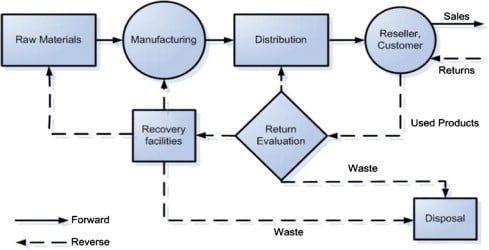
On the other hand, closed loop supply chain is different from reverse logistics in that it is designed as well as managed for both flows. Contrary to reverse logistics, closed-loop manufacturers are quite proactive in their processes and they are set to capture the value and reduce costs (Lopez & McKevitt, 2018). Both processes’ ultimate goals are set to recycle and reuse waste products/items. Concisely, to keep our environment safe and secure from pollution, organizations’ senior-most managers are supposed to ensure that they bring about the implementation of processes such as reverse logistics and closed loop supply chain to help dispose of and recycle goods and products within the organization and thereby enrich an eco-friendly system. Additionally, with such implementations, organizations may as well profit from the resale, recycle, and reuse of products, thereby succeeding and achieving their competitive advantage within the markets and businesses (Ferguson & Souza, 2010). Remember that customers would always desire the best out of the organization in terms of standardized products, quantity and quality, and fair pricing based on desired goods and services, and as such, companies/organizations should always try to satisfy customers through such supply chain processes. Finally, companies/organizations should always try to find value in dying/dead products, like prioritizing this idea too because of the organization’s sustainable economic benefits.
Question 4
“Standardization of work is made plausible through use of a WMS” Explain this statement. There are several economic benefits associated with the use of a WMS in large warehousing environments. Identify and briefly explain these.
4.1 Warehouse Management System
Warehouse Management Systems are described as systems for warehousing operations and technologies that optimize functions in a warehouse. Ideally, these functions start at the point of issuing a receipt from the trader and end with the consignment to customers, where there is a movement of inventories as well as information flow (Rozanski & Woods, 2011). In order to get a successful warehouse management system, it is important to design it with both computer hardware and software together with peripheral equipment containing advanced operating practices for space, inventory, labor management, and capital equipment in the distribution of warehouses.
Warehouse Management Systems can be defined as highly specialized business systems whose purpose is to enable control of the flow of inventory in and around the company supply center. It is typically an application controlling the inventory based on the warehouse with the supply center. Most warehouse systems track inventory in real time and by discrete location; that is, they identify where all goods/items and products are situated at any time (Hompel & Schmidt, 2007). Additionally, any type of warehouse system is generally sufficiently independent, with clearly set responsibilities/tasks. In addition, the efficiency in solving and tackling the problem is understood through having a rational organization within an intra-warehouse process.
The idea of logistics functions offers fundamental new prospects toward the rationalized warehouse practices. To begin with, most of the warehouse is made or designed to relate to the part of the overall process of goods flow. Here the requirement is communicated after which there are formulated based on the authentic warehouse process. Furthermore, logistic optimization towards warehouse process is to plan the whole process. Most of the inconsistency traditionally would happen in a streaming process that it happens in a warehouse that therefore opens resource to increase efficiency by using logistics. Moreover, through having warehouse management system implemented, there would be enhancement/boost in terms of competitive advantage at improving customer’s service, reducing labor cost and raising inventory accuracy as well as improving flexibility and responsiveness.
Operations within the chain leading inside a warehouse may be designed in internal manufacturing processes to function exclusively. Additionally, the technological practices in the warehouse related to material flow requisite to meet ideal limitations in terms of promptness of the process to ensure the cost-effectiveness and the safety of goods. Moreover, the turnover would demonstrate time with which inventory period is available to be resumed and sold. Normative expenses of goods hang on the responsibilities and purposes of the warehouse, regarding delivery of merchandises and some other detached factors.
The quickening of costs is largely safeguarded by the level of workforce efficiency of warehouse labor. The safeguarding of consumer material goods is communicated in reasonable indicators of the extent of commodity damage, and the redeemable of natural loss, and determined by on the technological procedure, the state of the technical and material the base of the warehouse as well as the quality of work of its workforces.
Together, the essential packing for the safeguarding of the quality of properties must be guaranteed. The idea of economic technological procedure and the level of competence of the warehouse are stated in terms of the cost intensity of dispensation a unit of consignment. However, a company can enhance this indicator individual within the outline of optimization of the whole commodity flow system, subsequently from the perspective of logistics; the competence of the technological procedure in any part of the logistics chain is strong-minded by the side by side of total costs for encouraging material flow along the entire chain.
The most common causes for poor competence and value in the warehouse assembly are the shortage of standardization. Having lack of using best practice and sort ideal standard for each procedure that a business can guarantee in several ways achieving the process as workforces.
The best approach to standardize a practice is to use paramount practice with staff to discovery out the ideal procedure concerning quality and competence features. It is vital to pay attention to the staff’s point of view since they are professionals in the warehouse because they will achieve the process time after time on a daily base (Iskakov, 2018). Lacking the participation of employees, standardization will not feel believable. It is also essential to document the whole lot and make a route guide for respectively each warehouse task. Thus, this will make certain that new staffs are continuously being trained in a similar manner. It is a big task to create a process guide but it means the period it will take. Keep informed on changing procedures does not yield so much period.
In addition, trying to avoid sub-optimization through using the labor force optimally and; thereby, recommending the move resources as well as job rotation regularly in the organization. In case the company warehousing managers do that, they will need employees with more multi-competence and from time to time, there possibly will be long period intervals in advance, where an employee in the similar department twice will be required. In a case similar to that, process guides are quite helpful to avoid inferiority deviations (Schuster, Allen & Brock, 2007). For instance, some individuals I encountered in high-ranking positions in logistics have confidence in that standardization is routinely done while employing a Warehouse management system. Nobody can be further wrong. Warehouse management system is a difficult environment and repeatedly they can task in diverse ways (Emmanouilidis, Taisch & Kiritsis, n.d.). It may have all probable consequences if one does not understand what it is all concerned. Generally, it is would be said that it is also more vital to standardize and file all the implemented Warehouse management systems. In manufacture environs, standardization has been employed for a long time where it in the same way important in the warehouse surroundings. Standardization is likewise one of the essential constituents of lean.
4.1.1 Real Life Example
A good example would be RedPrairie, which has been situated as one of the finest breeds in the supply chain, labor force, and all network retail answers for over 35 years around the world. Additionally, this firm has helped place business for the world’s principal corporations on the move like DHL. Moreover, RedPrairie has its existence in approximately over 60,000 customers establishes through more than 50 nations (Globally, Globally, Meryn, Joel Ewanick, Computing & Prospect, 2018). Likewise, RedPrairie works hard concerning meeting its clients’ future and current wants. Here, it employs several supply alternatives, 24/7 processes, client backing, and flexible responsibility surroundings. Finally, its mission is to benefit and ensure distinguishability and association concerning suppliers, producers, retailers, and customers.
4.2 Benefits of Warehousing Management System
A warehouse management system ensures that a company is able to manage its inventory in real time together with information as current as the most recent order, receipt, and movement (Jalalian, 2018). Below are some of the benefits of the use of Warehouse Management Systems in large warehousing environments to aid in the economic notion.
Improvement of labor productivity: – The system helps optimize material flow; this is done through incorporating some of the inventory picks through cross-docking (Mertins, Krause & Schallock, 1999). Here the term cross docking refers to a routing process for incoming shipments to the area located closer to outbound shipment docks that helps to reduce warehouse managing.
The Reduction of Dependency on Warehouse Workforces: – The workforce should implement a comprehensive warehouse system that will help in facilitating standardized inventory locations, picking methods as well as inventory movement in the warehouse (Sullivan, Barthorpe & Robbins, 2010). Furthermore, having standardized systems helps in reducing training costs and reliance on informal practices, thereby lowering faulty costs.
The reduction of paperwork on inventories: – Management is able to significantly reduce paperwork through implementing real-time warehousing management systems that are based on traditional connections on warehousing operations (Coyle, 2011). Together with ensuring accurate flow of inventory, timely deliveries, and information flow too; for instance, picking tickets, packing lists and receiving reports, etc., should be maintained in hard copies and stored elsewhere, like in electronic backups.
Improvement of progressive counting: – Most companies use the warehouse management system to obtain significant data such as specific locations, movement frequency, and product data and so on to schedule the personal cycle counts (Coyle, 2011). This type of cycle count would not only improve accuracy within the inventory records when planning but also eliminate the reduction required through completion as well as the physical cost of inventories.
Enhancement of customer services: – Most companies can more accurately determine realistic delivery dates and product availability through streamlining processes (Richards, 2011). Using a warehouse management system, a company can automatically release back-ordered inventory and reduce returns because of increased shipping accuracy.
Proper and more efficient use of space available in the warehouse: – To minimize safety stock requirements, the warehousing system can frequently increase warehousing space through available locating products/items relating to packing, receiving, shipping point and assembly (Logistics management, 2002). This increased efficiency can help improve productivity and lower inventory holding costs quite significantly.
Quicker inventory turns: – The warehousing management system can generate reduced lead times through improved accuracy and inventory-movement records, thus supporting just-in-time environments; as a result, the need for safety stocks is minimized, increasing inventory turnover as well as the use of working capital (Lai & Cheng, 2016).
References
Chand, S. (2018). Purchasing: it’s Meaning, Definition, Importance and Objectives | Material Management. Your Article Library. Retrieved 28 March 2018, from https://www.yourarticlelibrary.com/material-management/purchasing-its-meaning-definition-importance-and-objectives-material-management/27936
Coyle, J. J., & Coyle, J. J. (2009). Supply chain management: A logistics perspective.
In Edquist, C., In Vonortas, N. S., In Zabala-Iturriagagoitia, J. M., & In Edler, J. (2014). Public procurement for innovation.
Lysons, K., & Farrington, B. (2006). Purchasing and supply chain management. Harlow [u.a.: FT Prentice Hall.
Merriam-Webster. (2018). Definition of PROCUREMENT. Merriam-webster.com. Retrieved 28 March 2018, from https://www.merriam-webster.com/dictionary/procurement
O’Brien, J. (2018). Supplier relationship management: Unlocking the hidden value in your supply base. Kogan Page
Parniangtong, S. (2016). Supply Management: Strategic Sourcing.
Pooler, V. H., & Pooler, D. J. (1997). Purchasing and supply management: Creating the vision. New York [etc.: Chapman & Hall.
Stolle, M. A. (2008). From Purchasing to Supply Management: A Study of the Benefits and Critical Factors of Evolution to Best Practice.
Turner, R. W. (2011). Supply management and procurement: From the basics to best-in-class. Fort Lauderdale, FL: J. Ross Pub.
Wisner, J., Tan, K., & Leong, G. (2016). Principles of supply chain management. Boston, MA: Cengage Learning.
Aït-Kadi, D. (2012). Sustainable Reverse Logistics Network: Engineering and Management. London: ISTE.
Blumberg, D. (2005). Introduction to management of reverse logistics and closed loop supply chain processes. Boca Raton: CRC Press.
Bonev, M. (2012). Managing reverse logistics using system dynamics: A generic end-to-end approach. Hamburg: Diplomica Verlag.
Coyle, J. J., & Coyle, J. J. (2009). Supply chain management: A logistics perspective.
Dyckhoff, H., Lackes, R., & Reese, J. (2004). Supply chain management and reverse logistics.
Ferguson, M., & Souza, G. (2010). Closed-loop supply chains. Boca Raton: CRC Press.
Fernández, I. (2004). Reverse logistics implementation in manufacturing companies. Vaasa: Universitas Wasaensis.
Kleber, R. (2006). Dynamic inventory management in reverse logistics. Berlin: Springer.
Lebreton, B. (2007). Strategic Closed-Loop Supply Chain Management. Berlin, Heidelberg: Springer-Verlag Berlin Heidelberg.
Lopez, E., & McKevitt, J. (2018). How a closed loop supply chain can help reduce product waste. Supply Chain Dive. Retrieved 29 March 2018, from https://www.supplychaindive.com/news/supply-chain-sustainability-closed-loop-recycling-packaging/434989/
Hompel, M., & Schmidt, T. (2007). Warehouse Management: Automation and Organisation of Warehouse and Order Picking Systems.
Coyle, J. J. (2011). Transportation: A supply chain perspective. Australia: South-Western Cengage Learning.
Emmanouilidis, C., Taisch, M., & Kiritsis, D. (n.d.). Advances in Production Management Systems. Competitive Manufacturing for Innovative Products and Services [recurso electrónico]: IFIP WG 5.7 International Conference, APMS 2012, Rhodes, Greece, September 24-26, 2012, Revised Selected Papers, Part I.
Globally, D., Globally, D., Meryn, R., Joel Ewanick, M., Computing, M., & Prospect, T. (2018). DHL To Standardize Warehouse Operations Globally – Industry Leaders Magazine. Industry Leaders Magazine. Retrieved 29 March 2018, from https://www.industryleadersmagazine.com/dhl-to-standardize-warehouse-operations-globally/
Iskakov, Y. (2018). Logistics management. Academia.edu. Retrieved 29 March 2018, from https://www.academia.edu/33188661/Logistics_managment
Lai, K., & Cheng, T., (2016) Just-in-time logistics.
Logistics management. (2002). Highlands Ranch, CO: Reed Business Information.
Mertins, K., Krause, O., & Schallock, B. (1999). Global Production Management: IFIP WG5.7 International Conference on Advances in Production Management Systems September 6-10, 1999, Berlin, Germany. Boston, MA: Springer US.
Richards, G. (2011). Warehouse management: A complete guide to improving efficiency and minimizing costs in the modern warehouse. London: Kogan Page.
Rozanski, N., & Woods, E. (2011). Software systems architecture: Working with stakeholders using viewpoints and perspectives. Boston, Mass: Addison-Wesley.
Schuster, E. W., Allen, S. J., & Brock, D. L. (2007). Global RFID: The Value of the EPCglobal Network for Supply Chain Management. Berlin, Heidelberg: Springer-Verlag Berlin Heidelberg.
Sullivan, G., Barthorpe, S., & Robbins, S. (2010). Managing Construction Logistics. New York, NY: John Wiley & Sons.
Council of Logistics Management (1991) “Definition of Logistics”.
Tilanus, B. (1997) “Information Systems in Logistics and Transportation”. Elsevier Science Ltd., UK.
Cite This Work
To export a reference to this article please select a referencing stye below:

Academic Master Education Team is a group of academic editors and subject specialists responsible for producing structured, research-backed essays across multiple disciplines. Each article is developed following Academic Master’s Editorial Policy and supported by credible academic references. The team ensures clarity, citation accuracy, and adherence to ethical academic writing standards
Content reviewed under Academic Master Editorial Policy.





