
 Economics
Engineering & TechnologyTextbook
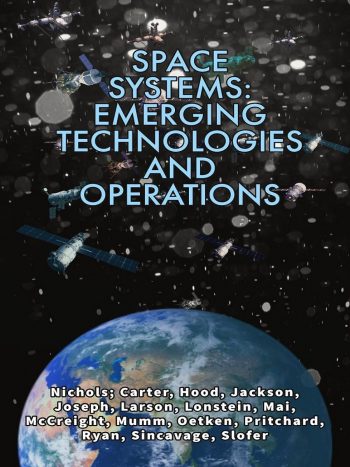
Space Systems: Emerging Technologies and Operations
Not rated yetRate this bookThis edited volume examines technologies and operations associated with space and the upper-air environment. Its introductory framework links technical possibilities with operational challenges and humanitarian applications.
Read on the publisher’s website. Opens in a new tab.
 Free
About this book
About this book
Published by New Prairie Press in 2022 and edited by Randall K. Nichols, the book brings together contributions on several aspects of space-related systems. Its contents divide discussion into emerging technologies, challenges and operations, and humanitarian uses. The preface uses DREAMERS as an author-defined framing term. This page explains that organization without treating the term as a standard scientific classification. It does not validate numerical limits, policy statements, or technical proposals as current.
Sources and reading coverage
Title, rights, contents, and selected preface passages on PDF sheets 35–36 of the publisher-hosted online edition were reviewed. Individual technical chapters were not fully reviewed.
See the official publication record for edition details. Read the publisher’s online edition. The external PDF provides the available source text.
The consulted PDF contains 757 sheets, including preliminary material; this count can differ from printed pagination.
Book summary
Guide to the reviewed opening
The preface situates the volume within a series that began with unmanned aircraft and related systems. Moving toward space introduces a wider range of physical settings, institutions, and technological questions. The framing is explicitly interdisciplinary.
The three-part structure distinguishes different purposes for studying a technology. Operational vulnerability and an environmental application are different questions, requiring different evidence. The humanitarian contents include mapping, environmental observation, and food-related applications. These are verified topics rather than chapters fully reviewed here. Detailed coverage remains with the introductory scope.
How to study this book
Create a reading map with columns for technology, problem or purpose, and evidence. Add a chapter’s date and operating assumptions before comparing it with another contribution. Use the author’s definition of a broad term rather than assuming it has a standard meaning elsewhere.
Choose one chapter relevant to your course and read its methods and references. Separate demonstrated capability from projection. For a current operating or policy question, consult contemporary authoritative sources independently of this historical overview.
Questions for reflection
- How does a chapter’s purpose affect the evidence it needs?
- Which claims demonstrate a capability and which propose one?
- What changes when a technology is considered for humanitarian use?
The study suggestions and questions are independent Academic Master editorial material.
About access & copyright
This page provides book information and study material. Full-text access is provided by the original publisher or authorised source; a listing does not grant permission to republish the book.
Read our Library Access & Copyright policyScope
Connect technologies with purposes and institutions.
Organization
Distinguish the three thematic sections.
Evidence
Separate demonstration from projection.
Terminology
Use the author’s stated framework.
Reader ratings & reviews
Share your thoughts
Your review helps other students choose the right resources.
KEEP LEARNING
Your next great read
Economics Engineering & Technology
Dinámica poblacional de Spodoptera frugiperda, Diatraea saccharalis y Dalbulus maidis en el cultivo de maíz (Zea mays L.) durante la época seca en cinco localidades del cantón Mocache
View Dinámica poblacional de Spodoptera frugiperda, Diatraea saccharalis y Dalbulus maidis en el cultivo de maíz (Zea mays L.) durante la época seca en cinco localidades del cantón Mocache — book Engineering & Technology
Petroleum Reservoir Dynamics
View Petroleum Reservoir Dynamics — book Engineering & Technology
Ethics in Technology
View Ethics in Technology — book Civil Engineering
The Design of the Built Environment: The University of Illinois Urbana-Champaign Campus and Its Context
View The Design of the Built Environment: The University of Illinois Urbana-Champaign Campus and Its Context — book Contract Law
Construction Contracting: Business and Legal Principles, Second Edition
View Construction Contracting: Business and Legal Principles, Second Edition — book Engineering & Technology
Introduction to Engineering Thermodynamics
View Introduction to Engineering Thermodynamics — book Engineering & Technology
Engineering Mechanics: Statics
View Engineering Mechanics: Statics — book Analysis
Basic Engineering Data Collection and Analysis
View Basic Engineering Data Collection and Analysis — bookBiomedical Engineering Lab Manual



