
 Engineering & Technology
Textbook
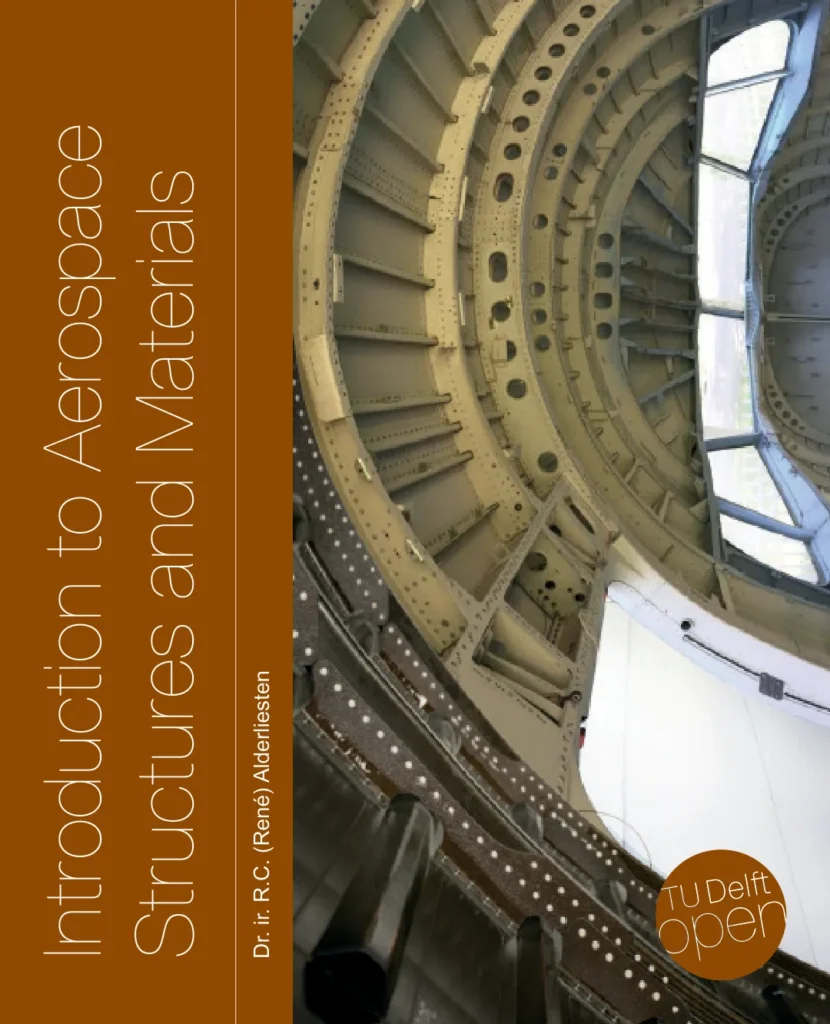
Introduction to Aerospace Structures and Materials
Not rated yetRate this bookRené Alderliesten’s Introduction to Aerospace Structures and Materials connects material behavior, manufacturing, aircraft and spacecraft construction, loads, certification, fatigue, and joints. Its central argument is that a good structural decision must satisfy several interacting constraints: a favorable strength figure alone cannot establish the best material or design. This guide follows the 2018 TU Delft source PDF and all eleven numbered chapters. It is intended for introductory aerospace study, with basic mechanics and algebra supporting the quantitative sections. Engineering examples explain concepts rather than provide a stand-alone basis for designing or approving flight hardware.
Free reading is available at the official source. Opens in a new tab.
 Free
About this book
René Alderliesten’s Introduction to Aerospace Structures and Materials connects material behavior, manufacturing, aircraft and spacecraft construction, loads, certification, fatigue, and joints. Its central argument is that a good structural decision must satisfy several interacting constraints: a favorable strength figure alone cannot establish the best material or design. This guide follows the 2018 TU Delft source PDF and all eleven numbered chapters. It is intended for introductory aerospace study, with basic mechanics and algebra supporting the quantitative sections. Engineering examples explain concepts rather than provide a stand-alone basis for designing or approving flight hardware.
Book summary
René Alderliesten’s Introduction to Aerospace Structures and Materials connects material behavior, manufacturing, aircraft and spacecraft construction, loads, certification, fatigue, and joints. Its central argument is that a good structural decision must satisfy several interacting constraints: a favorable strength figure alone cannot establish the best material or design. This guide follows the 2018 TU Delft source PDF and all eleven numbered chapters. It is intended for introductory aerospace study, with basic mechanics and algebra supporting the quantitative sections. Engineering examples explain concepts rather than provide a stand-alone basis for designing or approving flight hardware.
Chapter-by-chapter summaries
Introduction: An integrated engineering problem
Alderliesten positions the book between a broad introduction to aviation and specialist texts in materials or structural analysis. The purpose is to connect disciplines that students may otherwise study separately. Geometry, manufacturing, durability, availability, cost, and safety affect which technically possible solution becomes a practical aircraft structure. The introduction therefore asks readers to develop judgment as well as calculation skills. A material that performs well in a laboratory test may be difficult to join, inspect, repair, or produce consistently. Keep a running decision record throughout the book: whenever a chapter introduces a benefit, add the conditions and competing requirements that could limit it. This creates a framework for the later design and certification discussion.
Chapter 1: Material physics & properties
The opening chapter separates a specimen’s load–extension response from material descriptions based on stress and strain. Dividing force by area and extension by original length helps compare specimens of different geometry. Engineering and true stress use different area conventions and should not be interchanged silently. Elasticity, yielding, normal and shear response, biaxial loading, and Poisson effects lead to the distinction between isotropic and direction-dependent materials. Stiffness is also distinguished from apparent structural stiffness, which incorporates geometry, and toughness concerns energy absorption rather than simply the largest stress reached. Compare two differently shaped specimens of the same material: explain which measured responses can differ even though the underlying material properties are unchanged. This prevents later confusion between selecting a material and sizing a component.
Chapter 2: Environment & durability
Material behavior depends on temperature, moisture, exposure time, and the service environment. Elevated temperature can change stiffness and strength and introduce time-dependent deformation; low temperature can create different limitations, including brittle behavior in susceptible materials. Humidity affects metals and polymer composites through different mechanisms. Corrosion can remove effective metallic section, while moisture can alter a polymer matrix and its connection with reinforcing fibers. Environmental considerations also extend to the wider consequences of material and manufacturing choices. A room-temperature property measured on a new specimen is therefore not automatically an allowable for a component after years of service. Build a table linking each environmental condition to a physical degradation mechanism, affected property, and relevant protection or inspection question, rather than treating durability as a single generic reduction factor.
Chapter 3: Material types
Metals, polymers, ceramics, and composites offer distinct combinations of properties and manufacturing possibilities. Alloying and microstructure influence metallic behavior, while polymer structure affects processing and service response. Ceramics can offer useful temperature or stiffness characteristics but require attention to brittleness. Composites combine constituents so that orientation, arrangement, and the interface influence the resulting response. The rule of mixtures gives useful estimates under specified loading and compatibility assumptions; it is not an unrestricted formula for every direction or failure mode. Structural requirements then provide a basis for comparing these material families. Explain why low density alone cannot determine the best airframe material, and distinguish an intrinsic material property from a performance measure that incorporates loading, geometry, or the intended service conditions.
Chapter 4: Manufacturing
Manufacturing is part of structural design because the chosen process determines attainable shapes, material states, defects, repeatability, and cost. Metallic processing and composite production follow different physical routes, and a design that suits one may be inappropriate for another. Composite manufacture must coordinate the reinforcement architecture and matrix process, while the distinction between thermosets and thermoplastics affects forming, joining, and later processing possibilities. The process also influences quality control and the properties that analysis may legitimately assume. Sketch the sequence from raw material to a finished part and mark where geometry, microstructure, or fiber orientation becomes established. Then ask how a defect introduced at that stage could affect load carrying. Comparing only nominal material data while ignoring the manufacturing route misses a central message of this chapter.
Chapter 5: Aircraft & spacecraft structures
Airframes distribute structural functions among skins, stiffeners, frames, ribs, spars, and other members. Thin sheet can carry membrane loads efficiently but may need geometric stiffening to resist compression without premature instability. Fuselage and wing examples show how multiple elements share loads and maintain shape, while the torsion box makes a closed structural arrangement especially important. Structural details transfer forces between major members and cannot be dismissed as minor accessories. Spacecraft and launch vehicles introduce additional configurations and mission requirements. Draw a cross-section and assign a role to each component: carrying tension, compression, shear, maintaining geometry, or providing a pressure or fuel boundary. The same piece can perform several functions, so a realistic design evaluation must consider their interaction rather than optimize each function independently.
Chapter 6: Aircraft & spacecraft loads
External actions must travel through a structure to reactions and supports along identifiable load paths. Aircraft loads include more than a single aerodynamic force; distributed lift, weight, inertia, landing conditions, and other cases create different internal demands. The load path depends on the arrangement and stiffness of the members that connect them. Spacecraft experience mission-specific conditions, including launch-related loads, that differ from their orbital environment. A load case specifies a situation to be assessed rather than an arbitrary force chosen for convenience. Trace one applied force through several structural members and mark where its direction or mode of transfer changes. This helps reveal why a local attachment can be critical even when the total load appears modest, and why the most severe case can differ between components.
Chapter 7: Translating loads to stresses
The chapter converts structural actions into local quantities through fuselage pressurization, torsion, and wing bending examples. Pressure on a thin-walled fuselage generates membrane stresses whose directions and magnitudes depend on geometry and equilibrium. Closed-section torsion leads to shear-flow reasoning, while wing bending requires a consistent relationship among distributed loading, shear force, bending moment, and sectional stress. The wing-spar case connects spar caps and webs with their different contributions to bending and shear resistance. State the idealization before using a formula: thin walls, simplified load distribution, and beam assumptions define the problem being solved. Draw the internal-resultant diagrams before calculating stress at a chosen point. A correct numerical substitution cannot compensate for using the wrong section, axis, or governing load component.
Chapter 8: Considering strength & stiffness
A component can be strong enough against one failure criterion yet deform too much or possess an unsuitable natural frequency. The chapter distinguishes structural performance criteria and shows how geometry, structural arrangement, and material properties combine in selecting a solution. Some situations are controlled by stress, others by deflection, instability, vibration, or mission-specific requirements. Space-structure examples connect sizing to both quasi-static loading and natural frequency. A stiffness improvement can sometimes be achieved through shape changes more effectively than by changing material, but those changes may introduce manufacturing or packaging constraints. For a comparison, state what is held constant—mass, dimensions, load, or allowable deflection—before ranking materials. Without that common basis, a claim that one material is superior may compare fundamentally different structures.
Chapter 9: Design & certification
Safety requirements, specifications, and design philosophies turn a promising structural concept into a demonstrably acceptable solution. The discussion contrasts approaches such as safe-life, fail-safe, and damage-tolerant thinking, each of which makes different demands on assumptions, redundancy, inspection, or service life. Analysis, manufacturing control, tests, and operational provisions need to support a coherent argument rather than function as unrelated checks. A calculated reserve against one load case is not equivalent to certification of a complete structure. Read the regulatory discussion as the framework presented in the 2018 textbook; actual projects require the applicable current requirements. Construct a simple evidence map linking a requirement to the analysis or test that addresses it, and identify which service or manufacturing assumptions must remain valid for the conclusion to hold.
Chapter 10: Fatigue & durability
Repeated loading can initiate and grow damage even when individual cycles do not cause immediate static failure. Stress and strain concentrations explain why local geometry and detail design matter, while reinforcement can sometimes introduce new load-transfer problems rather than simply improve performance. S–N curves connect constant-amplitude cyclic stress with life, and mean stress affects how such data should be interpreted. Realistic service spectra require more than treating every flight as one identical cycle. Damage tolerance shifts attention toward the presence, growth, detection, and residual consequences of damage, connecting the chapter with certification philosophies. Separate initiation, propagation, and final failure in your notes. Then explain how environment, manufacturing quality, inspection capability, and load history can alter the structural assessment over its lifetime.
Chapter 11: Structural joints
Joints introduce local load transfer into a structure and can govern performance even when the adjoining members are adequately sized. Mechanically fastened joints require attention to bearing, bypass load, net section, local stress concentration, and load distribution. Composites and sandwich structures add concerns associated with their layered architecture and local support. Welded and adhesively bonded joints use different transfer mechanisms and impose their own material and process requirements. Bonded joints are generally arranged to favor appropriate load transfer and limit damaging peel or opening stresses; the discussion should not be read as a universal claim that adhesives have no tensile capacity. Compare two ways to join the same members, describing their inspection, repair, manufacturing, and durability implications alongside static strength. This brings the book’s material–process–structure argument to a practical conclusion.
References and Definitions
The references document the technical and historical material supporting the text, while the definitions section helps maintain consistent engineering terminology. Use the glossary to distinguish terms that ordinary language can blur, such as stiffness, strength, toughness, fatigue, and durability. When a historical failure or material comparison is used as evidence, follow the cited source to understand its specific conditions rather than treating the example as a universal ranking. For a design exercise, record the origin and conditions of any property data instead of copying an isolated value. These back sections support the eleven chapters; they do not replace an engineering standard, a current certification basis, or project-specific substantiation.
Study instructions
- Work through Chapters 1–4 before the main structural applications. Build a glossary that distinguishes material properties from geometry-dependent structural performance.
- Choose a simple aircraft component and maintain one decision sheet across the book: environment, material, process, geometry, loads, joining, inspection, and likely failure modes.
- For Chapters 6–7, draw free-body diagrams and load paths before stress calculations. State each idealization and verify units and equilibrium.
- When comparing materials, specify the common design requirement and quantities held constant. Explain how the ranking could change under a different stiffness, strength, or manufacturing constraint.
- After Chapters 9–10, connect a design philosophy with the evidence, inspection assumptions, and service conditions it requires.
- Conclude with a reasoned comparison of two joint concepts. Include durability and production considerations as well as nominal static capacity.
Questions for reflection
- Why is a high-strength material not automatically the lightest structural solution?
- How can changing geometry improve stiffness without changing material?
- Which component carries a particular load at each stage of the load path?
- How does fatigue assessment differ from a single static-strength calculation?
- What evidence would justify the inspection assumptions in a damage-tolerant design?
Sources and coverage
This original reading guide follows the linked source edition’s chapter, module, unit, or lesson structure. Consult the source for full arguments, cases, worked examples, exercises, illustrations, and references. Coverage follows the introduction, all eleven numbered chapters, and supporting references/definitions in the 2018 source edition. The original cover and its existing credits are retained through format conversion. Read the source edition.
About access & copyright
This page provides book information and study material. Full-text access is provided by the original publisher or authorised source; a listing does not grant permission to republish the book.
Read our Library Access & Copyright policyExplore the contents
Check the chapters covered in this edition.
Visit the official source
See reading, preview or purchase options.
Save for later
Keep this textbook in your saved collection.
Reader ratings & reviews
Share your thoughts
Your review helps other students choose the right resources.
KEEP LEARNING
Your next great read
Engineering & Technology Civil Engineering
Traffic Flow Theory: An introduction with exercises
View Traffic Flow Theory: An introduction with exercises — book Civil Engineering
Ports and Waterways: Navigating the changing world
View Ports and Waterways: Navigating the changing world — book Engineering & Technology
Building with Nature & Beyond: Principles for designing nature based engineering solutions
View Building with Nature & Beyond: Principles for designing nature based engineering solutions — book Applied
Introduction to Probability
View Introduction to Probability — book Civil Engineering
Basics of Fluid Mechanics
View Basics of Fluid Mechanics — book Business
Developing New Products and Services
View Developing New Products and Services — book Engineering & Technology
Notes on Diffy Qs: Differential Equations for Engineers
View Notes on Diffy Qs: Differential Equations for Engineers — book Electrical Engineering
Introduction to Linear, Time-Invariant, Dynamic Systems for Students of Engineering
View Introduction to Linear, Time-Invariant, Dynamic Systems for Students of Engineering — book Electrical Engineering



