
The Adventure of Physics – Vol. I: Fall, Flow, and Heat
BiologyTextbook
General Biology
Not rated yetRate this bookGeneral Biology is a collaborative Wikibooks text spanning chemical foundations, cells, metabolism, genetics, diversity, and animal tissues and systems. The linked PDF contains thirty-two main numbered headings followed by supplementary material, glossary, contributor records, and licenses. Its development is uneven: several headings are short transitions or placeholders, while others contain substantial explanations. This guide follows that actual structure and marks those transitions honestly. Its purpose is to connect concepts and support study, not to present the historical compilation as a fully updated or uniformly complete biology course.
Free reading is available at the official source. Opens in a new tab.
 Free
About this book
General Biology is a collaborative Wikibooks text spanning chemical foundations, cells, metabolism, genetics, diversity, and animal tissues and systems. The linked PDF contains thirty-two main numbered headings followed by supplementary material, glossary, contributor records, and licenses. Its development is uneven: several headings are short transitions or placeholders, while others contain substantial explanations. This guide follows that actual structure and marks those transitions honestly. Its purpose is to connect concepts and support study, not to present the historical compilation as a fully updated or uniformly complete biology course.
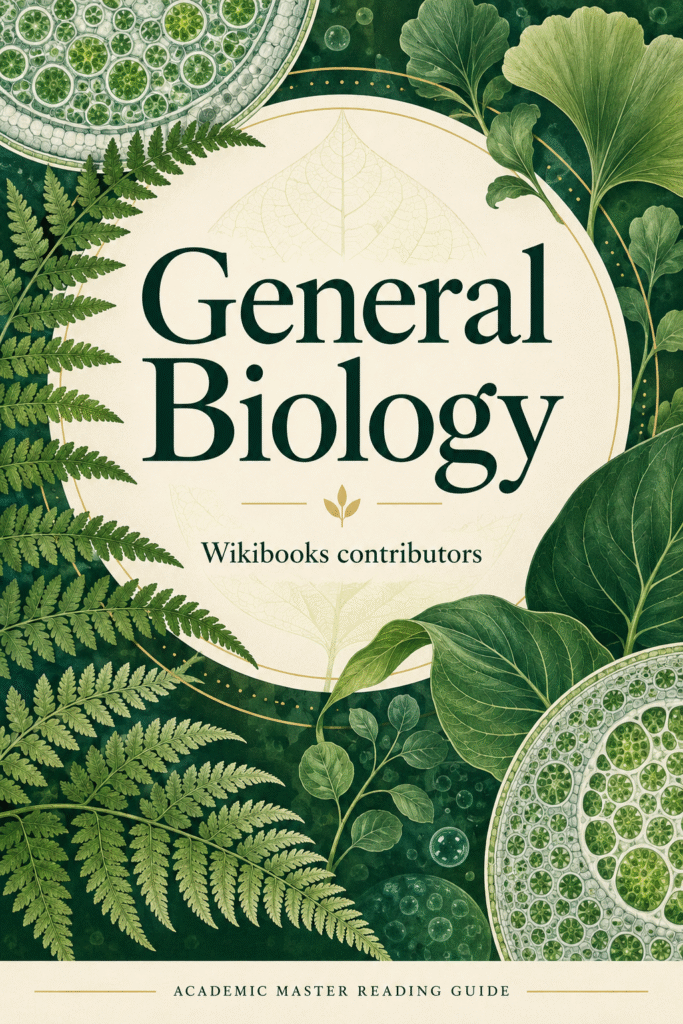
Cover: original Academic Master reading-guide design. The linked textbook remains the source edition described above.
Book summary
About this book
General Biology is a collaborative Wikibooks text spanning chemical foundations, cells, metabolism, genetics, diversity, and animal tissues and systems. The linked PDF contains thirty-two main numbered headings followed by supplementary material, glossary, contributor records, and licenses. Its development is uneven: several headings are short transitions or placeholders, while others contain substantial explanations. This guide follows that actual structure and marks those transitions honestly. Its purpose is to connect concepts and support study, not to present the historical compilation as a fully updated or uniformly complete biology course.
Chapter-by-chapter summaries
1. Getting Started
The opening orients readers to a collaboratively developed learning resource. Identify the scope and how to navigate the source before treating it as a conventional single-author textbook. Record where explanations, external links, and exercises are located. The collaborative format makes source and revision awareness part of responsible study.
2. Biology: The Life Science
Biology investigates living systems through observation, explanation, and evidence. Characteristics of life provide starting concepts without settling every boundary case by a checklist. Distinguish an observation from a hypothesis and a testable prediction. The chapter prepares readers to ask how an explanation is supported rather than simply memorize its conclusion.
3. The Nature of Molecules
Atomic structure, bonding, and molecular properties support later biological explanations. Compare the properties of components with the properties of the molecules they form. Relate water and chemical interactions to cellular conditions. A chemical formula identifies composition but does not by itself explain a molecule’s shape, behavior, or biological role.
4. Chemical Building Blocks of Life
Carbohydrates, lipids, proteins, and nucleic acids perform different structural and informational functions. Compare subunits, bonding, and biological roles. Avoid assuming that a named class has only one purpose. This chapter provides a vocabulary for understanding membranes, enzymes, energy storage, and heredity in the following material.
5. Life: History and Origin
The source considers life through historical and explanatory questions. Distinguish evidence about the history of organisms from hypotheses about early origins. Identify what a particular observation can support and what remains uncertain. The chapter should be read as part of its edition, with current scientific details checked through an approved modern reference where needed.
6. Cells: Transition Heading
This heading is a short organizational divider in the PDF, not a developed standalone chapter. It introduces the cellular block that follows. Use it to organize notes on shared cellular features, internal organization, membranes, and interactions. Do not attribute detailed explanations to this placeholder; the substantive discussion begins in the subsequent sections.
7. Cell Structure
Cell theory and shared features connect diverse organisms through a basic organizational unit. Compare prokaryotic and eukaryotic arrangements without treating one as merely an incomplete version of the other. Identify membranes, genetic material, cytoplasm, and protein-making machinery. Explain what each contributes to cellular activity and what evidence a diagram actually shows.
8. Eukaryotic Cells
Internal compartments support specialized processes. Compare nucleus, mitochondria, membrane networks, and other structures by function and interaction. Draw one pathway involving several organelles. A list of parts is insufficient if it does not explain how material and information move among them. Include plant-animal differences where the source presents them.
9. Membranes
Membrane organization supports selective exchange and the maintenance of different internal conditions. Distinguish diffusion, facilitated movement, and energy-dependent transport. Predict movement from a stated gradient and permeability rather than from concentration alone. The chapter connects molecular properties with cell-level behavior.
10. Cell-Cell Interactions
Cells communicate, attach, and coordinate through contacts and signals. Identify the signal, receptor, and response in an example. A signal’s presence does not mean every nearby cell responds identically. The chapter extends biology beyond isolated cells to the relationships needed for organized tissues and multicellular activity.
11. Energy and Metabolism
Metabolic pathways transform matter and energy through linked reactions. Enzymes influence reaction processes without making every energetically unfavorable change occur spontaneously. Distinguish energy transfer from the matter being transformed. Draw a pathway and identify coupling and regulation rather than memorizing reactions as an unrelated list.
12. Respiration
Cellular respiration transfers energy from molecules into usable forms through staged processes. Track carbon and electron transfers separately from ATP accounting. Distinguish cellular respiration from breathing. The chapter connects earlier membrane and enzyme concepts with energy transformation, while reminding readers that simplified yields depend on the model and conditions used.
13. Photosynthesis
Light capture and carbon fixation connect energy input with synthesis. Separate the role of light reactions from the use of their products in later processes. Trace matter and energy independently. Plants do not create energy from nothing, and the oxygen released should not be confused with the carbon source for organic material.
14. Sexual Reproduction
Gamete formation and fertilization connect chromosome behavior with genetic variation. Compare a reduction in chromosome number with the restoration of a paired complement. Explain the difference between cellular division and the life cycle containing it. This prepares for inheritance without assuming that offspring simply receive an unchanged visible mixture of parental traits.
15. Genetics: Transition Heading
The PDF uses this short heading to introduce the inheritance block. Its function is organizational rather than a complete exposition. Build a concept map linking Mendelian patterns, DNA, expression, regulation, mutation, and biotechnology. Use the developed chapters for evidence and detail rather than treating the divider as additional substantive coverage.
16. Mendel and Inheritance
Segregation and the relationships among alleles provide models for selected inheritance patterns. Distinguish genotype from phenotype and probability from a guaranteed small-family outcome. Work a cross by stating assumptions before constructing the grid. The model is powerful within its conditions but should not be extended to every trait without considering other mechanisms.
17. DNA as Genetic Material
Evidence and molecular structure connect DNA with inherited information. Distinguish the historical experiments from the broader conclusions drawn from them. Explain how complementary relationships support copying while preserving the distinction between a molecule and its information. The chapter prepares for expression rather than implying that DNA acts independently of cellular processes.
18. Gene Expression
Transcription and translation connect genetic sequences with functional products through intermediate steps. Trace the direction of information and distinguish the roles of DNA, RNA, and protein. A sequence change may have different effects depending on context. The chapter develops a process explanation rather than a simplistic assumption that every gene maps directly to one visible trait.
19. Gene Regulation
Cells can differ in activity despite sharing much genetic information. Regulation changes when and how products are made. Identify the regulatory signal and level of control in a source example. Distinguish possession of a sequence from its expression. The chapter connects genetic information with changing cellular needs and developmental conditions.
20. Mutation
Changes occur at different scales, from sequence substitutions to chromosome-level alterations. Their consequences depend on location, function, and environment. Distinguish the origin of variation from its later selection or inheritance. Not every mutation is harmful, visible, or passed to offspring. The chapter’s examples encourage describing the specific change before predicting its effect.
21. Recombinant DNA Technology
Biotechnological methods manipulate and analyse genetic material through identifiable operations. Explain the purpose of each step rather than treating technique names as results. Distinguish finding a sequence, copying it, placing it in a new context, and demonstrating expression. The source offers foundational concepts; contemporary methods should be checked separately where course requirements demand them.
22. Classification of Living Things
Classification organizes diversity and expresses proposed relationships. Distinguish a taxonomic category from the evidence supporting a relationship. Compare systems and note that scientific classification changes with new evidence. The historical compilation’s labels should not automatically be treated as a current consensus for every group.
23. Multicellular Photosynthetic Autotrophs
Plant diversity connects form, life cycles, reproduction, and evolutionary relationships. Compare groups using explicit features such as vascular tissue, seeds, and alternation of generations. Trace one life cycle and label the stages. Avoid turning the sequence of groups into a ladder of progress; the task is explaining differences and relationships.
24. Chordates
Shared chordate features introduce diversity within a broad animal lineage. Compare the defining characteristics with the more restricted traits of vertebrate groups. A representative example does not display every possible arrangement. Use a comparison table to distinguish shared ancestry, functional similarity, and features specific to a subgroup.
25. Tissues and Systems: Transition Heading
This short divider introduces the body-organization material that follows. It does not supply a complete account of all systems. Organize notes from cell types to tissues, organs, and functions, and identify systems absent from the compilation. Honest mapping of coverage is more useful than assuming every familiar textbook topic appears in the source.
26. Epithelial Tissue
Epithelial arrangements relate to covering, exchange, secretion, and protection. Compare shape, layering, and location with the function performed. A microscopic appearance should be interpreted in context rather than identified by one feature alone. The chapter begins the tissue sequence by connecting cellular arrangement with the demands of a body surface or boundary.
27. Connective Tissue
Matrix and cells vary across connective tissues, producing different support and transport roles. Compare the relative contribution of extracellular material with the tightly packed arrangements of epithelium. Explain a structure-function relationship using one example. The category includes substantial diversity, so one description should not be applied unchanged to every connective tissue.
28. Muscle Tissue
Different muscle types support movement and physiological work through distinct arrangements and control. Compare skeletal, cardiac, and smooth muscle by organization and role. Separate tissue properties from the movement of an entire limb or organ. This connects cellular activity with the coordinated behavior of larger body systems.
29. Vertebrate Digestive System
Digestion, absorption, and elimination involve connected structures and processes. Trace a nutrient through the tract and identify accessory contributions. Mechanical breakdown differs from chemical processing. The chapter shows how organ specialization supports the transfer of food materials into forms that cells can use.
30. Circulatory System
Circulation connects transport with the needs of tissues. Compare the roles of the pump, vessels, and transported fluid, and trace a complete route rather than listing structures. Relate exchange sites to the material being moved. This chapter complements respiration and digestion by showing how local uptake and release depend on a transport system.
31. Respiratory System
Respiratory structures support exchange between an organism and its surroundings. Distinguish ventilation, diffusion across a surface, and delivery to tissues. Identify how surface area, distance, and gradients affect the explanation. A higher breathing rate alone does not establish effective exchange without considering the system’s operation.
32. Sensory Systems and Regulation
Chemical, mechanical, and light-related reception connect stimuli with responses. The chapter also considers homeostasis and osmotic conditions. Distinguish detection from interpretation and a regulated variable from its control mechanism. The closing instructional material connects information and response with the maintenance of internal conditions, while supplementary sections supply references, glossary material, contributor information, and licenses.
Study instructions
- Create a concept map connecting chemistry, cells, metabolism, heredity, diversity, and systems.
- Explain diagrams through inputs, processes, outputs, and assumptions rather than labels alone.
- Use crosses and pathway exercises to distinguish probability, matter flow, energy transfer, and information flow.
- Mark transition headings and incomplete areas so your notes do not imply coverage the PDF lacks.
- Consult the contributor and license sections for provenance, and use current approved references to check dated scientific classifications or methods.
Questions for reflection
- Why does a named component not explain a whole process?
- How do matter and energy follow different paths in metabolism?
- What assumptions make a Mendelian prediction useful?
- How can a historical collaborative text be used critically?
Sources and coverage
This original study guide covers all main chapters of the linked edition, or all instructional sections where the work has no numbered chapters. The explanations and suggested practice are written for study; consult the full source for cases, worked examples, illustrations, exercises, and references. Follows the linked historical Wikibooks compilation. Short transition headings and uneven coverage are explicitly identified. Read the source edition.
About access & copyright
This page provides book information and study material. Full-text access is provided by the original publisher or authorised source; a listing does not grant permission to republish the book.
Read our Library Access & Copyright policyExplore the contents
Check the chapters covered in this edition.
Visit the official source
See reading, preview or purchase options.
Save for later
Keep this textbook in your saved collection.
Reader ratings & reviews
Share your thoughts
Your review helps other students choose the right resources.
KEEP LEARNING
Your next great read
Natural Sciences
The Adventure of Physics – Vol. VI: The Strand Model – A Speculation on Unification
The Adventure of Physics - Vol. VI: The Strand Model - A Speculation on Unification
View The Adventure of Physics - Vol. VI: The Strand Model - A Speculation on Unification — bookMind, Body, World: Foundations of Cognitive Science
Mind, Body, World: Foundations of Cognitive Science
View Mind, Body, World: Foundations of Cognitive Science — book Biology
Anatomy and Physiology of Animals
View Anatomy and Physiology of Animals — book Chemistry
 of Cooking
View Chemistry of Cooking — book Biology
Cells: Molecules and Mechanisms
View Cells: Molecules and Mechanisms — book Biology
A Student's Guide to Tropical Marine Biology
View A Student's Guide to Tropical Marine Biology — book Anthropology
Explorations: An Open Invitation To Biological Anthropology
View Explorations: An Open Invitation To Biological Anthropology — book Biology
Biochemistry: Free For All
View Biochemistry: Free For All — book Chemistry



