
The Adventure of Physics – Vol. I: Fall, Flow, and Heat
BiologyTextbook
Cells: Molecules and Mechanisms
Not rated yetRate this bookEric V. Wong’s Cells: Molecules and Mechanisms connects molecular properties with the organization and activity of cells. The linked compilation, with a 2009 copyright and versioned chapter material, contains sixteen chapters. It moves from cell anatomy and chemistry through energy, membranes, metabolism, genetic information, intracellular organization, signaling, and division to selected advanced topics. Study mechanisms as linked processes: identify components, locations, inputs, outputs, and regulation. Diagrams should become explanations you can reconstruct, not pictures recognized without understanding the relationships they depict.
Free reading is available at the official source. Opens in a new tab.
 Free
About this book
Eric V. Wong’s Cells: Molecules and Mechanisms connects molecular properties with the organization and activity of cells. The linked compilation, with a 2009 copyright and versioned chapter material, contains sixteen chapters. It moves from cell anatomy and chemistry through energy, membranes, metabolism, genetic information, intracellular organization, signaling, and division to selected advanced topics. Study mechanisms as linked processes: identify components, locations, inputs, outputs, and regulation. Diagrams should become explanations you can reconstruct, not pictures recognized without understanding the relationships they depict.
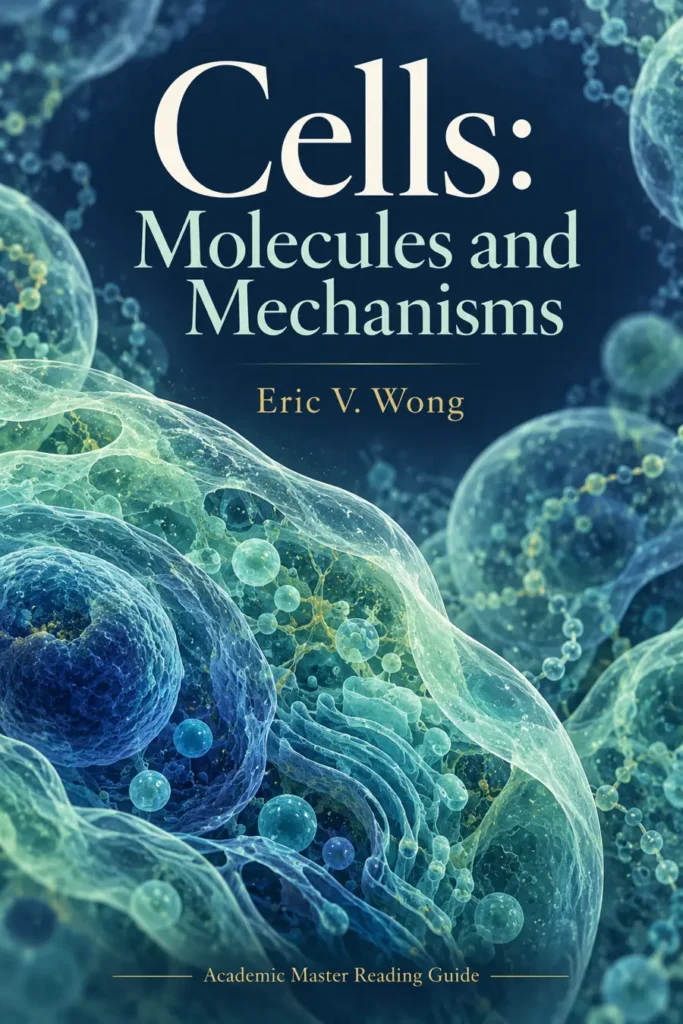
Cover: original Academic Master reading-guide design. The linked source remains the edition described above.
Book summary
About this book
Eric V. Wong’s Cells: Molecules and Mechanisms connects molecular properties with the organization and activity of cells. The linked compilation, with a 2009 copyright and versioned chapter material, contains sixteen chapters. It moves from cell anatomy and chemistry through energy, membranes, metabolism, genetic information, intracellular organization, signaling, and division to selected advanced topics. Study mechanisms as linked processes: identify components, locations, inputs, outputs, and regulation. Diagrams should become explanations you can reconstruct, not pictures recognized without understanding the relationships they depict.
Chapter-by-chapter summaries
1. The cell
Cellular organization connects compartments and structures with functions while distinguishing common features from differences among cell types. A diagram is a model whose omissions matter. Compare prokaryotic and eukaryotic organization without treating either as a single uniform design. Trace a molecule between relevant compartments and ask which boundaries it must cross. The chapter establishes a spatial framework for later mechanisms, preventing a pathway’s components from being imagined as freely mixed throughout an undifferentiated cell.
2. Cell chemistry
Water, acids and bases, carbon chemistry, sugars, nucleotides, amino acids, chirality, and fatty acids supply the molecular foundation. Structure influences interactions and reactivity. Distinguish a covalent change from a noncovalent association and relate pH to protonation rather than a general label of acidity. Compare molecules differing in one functional group or stereochemical arrangement. This prepares readers to explain biological specificity through chemistry instead of treating every named molecule as a unique exception requiring separate memorization.
3. Bioenergetics and enzymes
Energy relationships constrain reactions, while enzymes alter reaction rates without changing the equilibrium relationship in the same way. Activation barriers differ from the overall energetic change. Kinetics and regulation explain how pathways respond to conditions. Compare the effects of an enzyme, a changed substrate concentration, and coupling with another process. Identify what is measured in a rate experiment. The chapter connects thermodynamic possibility with the separate question of how rapidly and under what regulation a cellular event occurs.
4. Membranes
Bilayer structure, permeability, transport proteins, and electrical behaviour connect boundary organization with selective exchange. A concentration gradient and an electrical potential contribute differently to movement of a charged species. Distinguish passive transport from processes requiring an energy source and channels from carriers. Trace the logic of a neuronal action potential at the conceptual level. A membrane is neither an impermeable wall nor an unrestricted opening; its functional properties depend on composition, proteins, gradients, and changing states.
5. Metabolism I
Glycolysis, fermentation, oxidation, electron transport, and breakdown of stored or dietary molecules connect fuel processing with energy capture. Track carbon and electron carriers separately. Producing ATP, regenerating a carrier, and transferring carbon are different purposes that may be linked in one pathway. Compare fermentation with oxidative pathways through their constraints rather than a simple more-or-less-energy ranking. Explain how an uncoupling affects the relationship between electron transport and ATP synthesis. A pathway map is useful when its accounting and connections are explicit.
6. Metabolism II
Photosynthesis and biosynthetic processes illustrate how cells construct molecules and organize energy inputs. The Calvin cycle, gluconeogenesis, glycogen production, and fatty-acid or amino-acid synthesis require resources and regulation. An anabolic pathway is not always the exact reversal of breakdown. Identify shared intermediates and the steps requiring distinct control. Compare the source of carbon with the source of energy. This prevents the common mistake of treating incorporation of carbon and capture of light energy as one undifferentiated reaction.
7. DNA
Replication, damage, repair, and telomeres connect information storage with continuity and maintenance. Semiconservative copying requires coordinated enzymes and directional synthesis. Compare leading- and lagging-strand requirements, then distinguish a replication error from damage introduced later. Repair mechanisms differ according to the problem recognized. The chapter’s prokaryotic and eukaryotic comparisons show how a shared chemical problem can require different organizational solutions. Accuracy is an active process of copying and correction rather than a passive property of the DNA molecule.
8. Transcription
RNA synthesis reads a template under initiation, elongation, termination, and processing constraints. Prokaryotic and eukaryotic systems organize these stages differently. Distinguish a primary transcript from a mature RNA and transcription from translation. Trace strand direction carefully and specify the RNA product before interpreting a sequence. Processing is part of information use, not merely cleanup. The chapter explains why gene-to-protein relationships cannot always be reduced to a direct one-step reading of an uninterrupted DNA sequence.
9. Gene regulation
Cells regulate gene expression through interactions among sequence elements, proteins, chromatin, and cellular conditions. Compare prokaryotic transcriptional control with eukaryotic organization rather than transferring one model unchanged. A regulator can have different consequences depending on its context and interacting components. Draw the pathway from a signal to a change in transcription and identify each causal step. Correlation between a factor and expression is not by itself proof of direct control; specify the experiment that would test the proposed relationship.
10. Translation
Ribosomes, tRNAs, the genetic code, initiation, elongation, termination, and regulation connect RNA sequences with polypeptides. Reading frame and direction matter. Distinguish codon recognition from the chemical formation of the peptide bond. Compare prokaryotic and eukaryotic features while retaining the shared logic. A sequence predicts a primary product only under stated assumptions about the transcript and translation process. Later folding, processing, location, and regulation are separate requirements for functional protein activity.
11. Post-translation, ER, Golgi, and vesicles
Folding, cleavage, glycosylation, trafficking, and vesicular transport organize proteins after or during synthesis. Targeting information and compartment identity determine a molecule’s route. Trace a secreted protein and distinguish its path from a cytosolic one. N-linked and O-linked glycosylation involve different processing contexts. Receptor-mediated uptake connects membrane traffic with external material. The chapter shows why making the right sequence is insufficient if the protein fails to fold, reach its location, or receive appropriate processing.
12. Cytoskeleton
Actin, microtubules, intermediate filaments, organizing centres, motors, and dynamics support shape, movement, and intracellular organization. These systems differ in structure and roles rather than forming one generic scaffold. Compare assembly dynamics with motor-driven transport. A static image can conceal continual turnover and force generation. Explain the directionality and track required for one transport event. The chapter connects molecular interactions with cell-scale motion without assuming that all movement is caused by the same machinery.
13. Extracellular matrix and adhesion
Collagen, proteoglycans, fibronectin, laminins, integrins, and cell-cell junctions connect cells with surroundings and neighbours. Adhesion also participates in organization and signaling, not only attachment. Compare a cell-matrix connection with a cell-cell junction and trace how forces are transmitted. Distinguish an extracellular ligand from its receptor and intracellular linkage. The chapter makes tissue organization a mechanistic problem involving coordinated molecular systems rather than an arrangement imposed on otherwise isolated cells.
14. Signaling
Receptors and intracellular pathways transform information into cellular responses through amplification, integration, feedback, and regulation. Distinguish signal presence from receptor activation and downstream effect. The same molecule can produce different responses in cells with different components. Draw a pathway with activating and inhibitory relationships and identify where specificity enters. A named cascade is not a complete explanation until its inputs, targets, timing, and termination are clear. Compare a short response with a longer change in expression or state.
15. Cell cycle
DNA duplication, checkpoints, cyclin-related control, mitosis, cell death, and meiosis connect regulated transitions with faithful inheritance. A checkpoint is a decision mechanism, not a guarantee that errors never occur. Compare mitotic and meiotic purposes before memorizing stage names. Track chromosome and DNA content carefully because the two are not interchangeable counts. The chapter links division with broader cellular conditions, showing why progression and stopping require coordinated regulation rather than a self-running sequence of pictures.
16. Advanced topics
Viruses, cancer, and immune mechanisms extend earlier molecular and cellular concepts. Viral strategies depend on host processes, while oncogenes and tumour-suppressor pathways connect altered regulation with proliferation and other disease properties. Antibody and immune examples illustrate specificity and molecular diversity. Reuse earlier mechanism maps to explain these topics rather than memorizing them as disconnected exceptions. The material is a foundational, source-era introduction; present clinical or therapeutic conclusions require current specialized evidence beyond this textbook.
Study instructions
- Create pathway maps showing components, compartments, energy or information inputs, products, and regulation.
- Trace atoms, electrons, or sequence direction separately when several processes share one diagram.
- Use comparison tables for similar systems, including transport mechanisms and prokaryotic versus eukaryotic processes.
- Explain perturbations by predicting what changes first and which downstream effects require additional assumptions.
Questions for reflection
- Why does an enzyme change rate without supplying the reaction’s net energy?
- How can the same signal produce different cellular responses?
- What additional steps separate a translated sequence from a functional protein?
Sources and coverage
This original reading guide follows the linked source edition’s chapter, module, unit, or lesson structure. Consult the source for full arguments, cases, worked examples, exercises, illustrations, and references. The guide covers the sixteen chapters in the linked versioned compilation. Advanced disease examples are educational and reflect the source period. Read the source edition.
About access & copyright
This page provides book information and study material. Full-text access is provided by the original publisher or authorised source; a listing does not grant permission to republish the book.
Read our Library Access & Copyright policyExplore the contents
Check the chapters covered in this edition.
Visit the official source
See reading, preview or purchase options.
Save for later
Keep this textbook in your saved collection.
Reader ratings & reviews
Share your thoughts
Your review helps other students choose the right resources.
KEEP LEARNING
Your next great read
Natural Sciences
The Adventure of Physics – Vol. VI: The Strand Model – A Speculation on Unification
The Adventure of Physics - Vol. VI: The Strand Model - A Speculation on Unification
View The Adventure of Physics - Vol. VI: The Strand Model - A Speculation on Unification — bookMind, Body, World: Foundations of Cognitive Science
Mind, Body, World: Foundations of Cognitive Science
View Mind, Body, World: Foundations of Cognitive Science — book Biology
Anatomy and Physiology of Animals
View Anatomy and Physiology of Animals — book Biology
General Biology
View General Biology — book Chemistry
 of Cooking
View Chemistry of Cooking — book Biology
A Student's Guide to Tropical Marine Biology
View A Student's Guide to Tropical Marine Biology — book Anthropology
Explorations: An Open Invitation To Biological Anthropology
View Explorations: An Open Invitation To Biological Anthropology — book Biology
Biochemistry: Free For All
View Biochemistry: Free For All — book Chemistry



