
 Engineering & Technology
Textbook
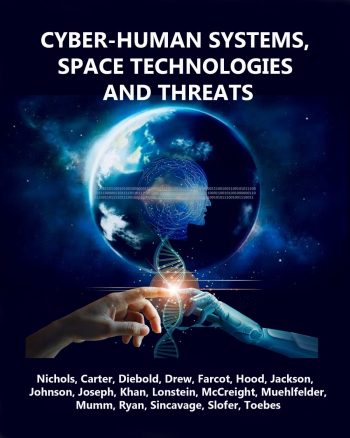
Cyber-Human Systems, Space Technologies, and Threats
Not rated yetRate this bookThis collection considers relationships between people, computing, and space-related technologies. Its preface connects autonomy and human-machine systems with applications, infrastructure, and potential threats.
Read on the publisher’s website. Opens in a new tab.
 Free
About this book
Cyber-Human Systems, Space Technologies, and Threats is a seventeen-chapter edited volume examining human-machine integration, AI, management, biology, space security, manufacturing, quantum technology, and power transfer. Its contributions mix established technical foundations with historical examples, threat scenarios, and forecasts. The guide follows each chapter while identifying that difference explicitly. An author’s proposed future or risk model is not presented as a scientifically demonstrated capability. The strongest way to use the collection is to compare claims, assumptions, evidence, and system dependencies across disciplines, rather than treat every contribution as one settled account of current technology.
The detailed guide below follows the book’s chapter, unit, or section structure. Read it alongside the study instructions and the complete official text.
Book summary
Chapter-by-chapter summaries
Chapter 1: The Technological Future—Merging with Machines
The chapter surveys ways humans and machines can interact or become physically integrated, ranging from existing assistive technologies to longer-term possibilities. Different levels of integration create different technical and ethical questions. A targeted device or experimental result should not be generalized into a claim that an unrestricted autonomous system already exists. The source itself distinguishes some research-stage possibilities. Readers should classify examples by maturity, purpose, evidence, and dependence on human oversight. This makes the chapter a framework for examining trajectories rather than a list of predictions accepted as fact.
Chapter 2: Technology, Ethics, Law, and Humanity
Technical change can outpace institutions' ability to assign responsibility and protect affected people. The chapter examines concerns surrounding AI, robotics, data, and other emerging areas. Ethical acceptability, legal permission, and technical feasibility are separate questions, even when they influence one another. The author's discussion invites scrutiny of human decisions and incentives rather than attributing every consequence to technology itself. Historical and legal examples belong to the source's context. A critical reader asks who makes a decision, who bears the risk, and what mechanisms allow challenge, oversight, or correction.
Chapter 3: Artificial Brains and Body
This survey connects AI, robotics, and bodily or service applications through examples of automation. A system can perform a narrow task without possessing a general human-like understanding. The chapter's varied examples therefore require comparison of task, environment, and evidence rather than one broad claim about artificial intelligence. Commercial demonstrations and company claims are not equivalent to independent evaluation. The educational value is recognizing the range of applications and the constraints on transferring a capability from a controlled setting into daily use, where people and conditions vary.
Chapter 4: AI and ML in Agriculture and Food Industries
Agricultural and food-system applications include sensing, analysis, prediction, automation, and resource management. The chapter surveys these possibilities in relation to challenges such as production, sustainability, and environmental variation. Model performance depends on the data and setting in which it is evaluated. A system trained under one crop, climate, or management pattern may not transfer without further evidence. The chapter encourages connecting a prediction with an actionable decision and the resources needed to implement it. Adoption should be distinguished from demonstrated improvement in the outcome that matters.
Chapter 5: Cyborgs and Future Enhancement
The chapter considers assistive, medical, commercial, and military ideas involving bodily enhancement and human-machine interfaces. These categories differ substantially in evidence, goals, and acceptable risks. A therapeutic device and a speculative enhancement should not be treated as interchangeable examples. The source discusses future directions, which need to remain identified as such. A useful analysis considers reliability, feedback, user experience, access, and meaningful control. The chapter's broad question is how integration changes human capabilities and dependencies, not whether every imagined enhancement has already become practical.
Chapter 6: Machines Hacking Machines—Turing's Legacy
The chapter uses historical computing and codebreaking to frame later questions about automated systems and security. Turing's legacy connects formal reasoning, computation, and the development of machine capabilities, but historical analogy does not establish every future claim. The reader should distinguish what a historical case demonstrates from what an author extrapolates. The contribution encourages considering how machines change the scale and organization of information processing and conflict. This guide summarizes that intellectual connection without reproducing intrusion methods or treating a narrative history as a current technical standard.
Chapter 7: Managing Mixed Human-Machine Teams
Human-machine teams require decisions about roles, authority, communication, performance, and accountability. The chapter argues that management must account for both human capabilities and automated systems rather than treat software as an interchangeable employee. A nominally human-controlled process may offer little meaningful oversight if the person cannot understand or intervene in time. Conversely, automation can support human judgment when its limits are clear. The chapter's practical analytical task is to identify how responsibilities and information flow through a team and how failures or disagreements are handled.
Chapter 8: NeuroStrike and the Metaverse
This contribution advances a speculative threat framing involving cognitive, cyber, electronic, and other technologies in immersive environments. Its proposed connections should be evaluated as the author's hypotheses and scenarios rather than accepted as demonstrated medical or technical mechanisms. Readers need to separate established concerns such as privacy, manipulation, and user vulnerability from broader claims requiring independent evidence. The chapter is useful for practicing critical appraisal: identify the claim, its supporting sources, the inferential steps, and what observation would be needed to establish the proposed effect. This summary does not endorse unverified capabilities.
Chapter 9: Biological Threats and Growth in Space
Space environments create biological questions involving human health, microbial growth, contamination, and environmental control. The chapter also discusses speculative possibilities beyond established observations. Known mission risks, laboratory findings, and hypothetical extraterrestrial pathogens are different categories of evidence. A useful reading keeps those categories separate and asks how a biological claim was tested. The systems perspective connects life-support conditions, monitoring, crew health, and mission duration. The guide remains at that educational level and does not supply biological experimentation or medical procedures.
Chapter 10: Space Electronic Warfare
Space systems rely on links that carry commands, telemetry, and payload information, with different consequences if each function is disrupted or made untrustworthy. The chapter surveys electronic-warfare concepts and signal dependencies. Detection of an anomaly is distinct from confident attribution of its cause. This guide emphasizes architecture and resilience rather than operational interference techniques. The chapter's examples should be assessed in their publication context, with attention to whether a claimed capability is demonstrated, modeled, or proposed. Understanding the service affected is essential to evaluating the significance of a threat.
Chapter 11: Space Systems Modeling and Simulation
Models simplify a system for a purpose, while simulations explore behavior under selected assumptions. The chapter examines their use across engineering and organizational contexts. A detailed model can still omit the factor that matters to a decision, and a visually convincing simulation can be poorly validated. The reader should identify inputs, boundaries, uncertainty, and the evidence used to check results. The chapter connects modeling with planning, but its broader lesson is methodological: simulation output is conditional evidence, not an independent observation that a real system will behave exactly as shown.
Chapter 12: Deep Space Warfare and Space Dominance
This chapter develops the author's strategic interpretation of space competition and potential conflict. It combines historical references, contemporary observations from its writing period, and future scenarios. The guide treats those as arguments to assess rather than verified predictions or a current intelligence report. Concepts such as dominance require clear definitions and evidence about dependencies, capabilities, and consequences. A critical reading asks whether an example supports the stated conclusion or merely illustrates a possibility. The chapter also raises the wider issue that conflict affecting shared space infrastructure can have consequences beyond the original participants.
Chapter 13: Hypersonics and Space Defense
The contribution surveys hypersonic systems and supporting developments in materials, electronics, design, and other fields. High-speed operation creates coupled constraints rather than one simple speed threshold determining effectiveness. The chapter's program descriptions and forecasts are time-bound and should not be treated as a current inventory. Its educational value is recognizing the multidisciplinary nature of a claimed capability and the difference between a component advance, a test, and a reliable integrated system. The guide does not reproduce weapon-design or targeting procedures.
Chapter 14: Cyber Threats in Space
The chapter connects the historical development of space systems with growing software, network, and organizational dependencies. Ground infrastructure, supply chains, control processes, and data services can matter as much as an orbital platform. A cyber-risk claim should identify the relevant function and the evidence for the proposed failure mode. The guide focuses on that conceptual understanding and the need for resilience, not exploitation. The source's examples reflect its period, while the lasting lesson is to evaluate the complete service and its trust relationships rather than assume physical distance provides security.
Chapter 15: Strategy and Economics of Space Missions
A mission's feasibility depends on resources, logistics, manufacturing, quality, and the value of its objective. The chapter connects strategy with economic and production choices, including manufacturing processes and their tradeoffs. A process that works technically may still be inappropriate when material supply, maintenance, transport, or demand are considered. The reader should distinguish an engineering possibility from a sustainable operating model. Comparing alternatives requires consistent assumptions about time, cost, performance, and risk. The chapter brings attention back to the system supporting an ambitious mission rather than the appeal of the ambition alone.
Chapter 16: The Quantum Future of Space Warfare
Quantum computing, communication, and sensing rely on different physical and engineering ideas and should not be collapsed into one universal capability. The chapter introduces distinctions and possible space-related implications through research examples and forecasts. A detector milestone does not demonstrate a complete operational network, and a theoretical advantage does not remove implementation constraints. The contribution is best used to identify questions and dependencies for further study. This guide preserves the future-oriented character of the chapter rather than presenting its scenarios as current established performance.
Chapter 17: Wireless Power for Space Applications
Wireless power transfer examines how energy can move between components without a conventional wired connection. The chapter discusses near-field arrangements, coupling, configuration, and comparison of proposed systems. Efficiency depends on geometry, alignment, loading, and the conditions used for evaluation, so a reported value needs its context. A component experiment is different from a complete space-qualified application. The chapter's technical contribution is to compare alternatives through a defined model and performance criteria. It completes the volume with a concrete example of how a promising idea must be examined through assumptions and system-level constraints.
Appendix A: Mathematical Reference
The appendix supports selected calculations through decibel mathematics and plane or spherical trigonometry. Reference formulas require consistent definitions, units, and geometry. Their presence does not validate every scenario in the volume. Use the appendix to reconstruct a stated calculation and identify its assumptions, while evaluating empirical and strategic claims through the evidence supplied in the relevant chapter.
Study instructions
For each contribution, label the central claim as descriptive, evaluative, or predictive. Identify the role assigned to people, the task assigned to technology, and the assumptions about oversight. Keep a proposed benefit separate from evidence of a demonstrated result.
When comparing chapters, note differences in discipline and evidence. Check current capabilities, laws, and policies through appropriate primary sources. Use this reading framework to evaluate arguments rather than as a source of operating instructions.
Questions for reflection
- What responsibility remains with people in a proposed autonomous system?
- How is a prediction different from an observed capability?
- What evidence would strengthen a cross-disciplinary claim?
The study suggestions and questions are independent Academic Master editorial material.
Sources and coverage
Coverage follows all seventeen chapters and the mathematical appendix. The volume includes forecasts and speculative threat arguments; these are distinguished from established mechanisms and are not independently endorsed as demonstrated capabilities. These original summaries draw on the source text, including chapter or section introductions and selected explanations, examples, exercises, and review material. They are condensed study guides, not a page-by-page account or a replacement for the complete resource. Additional synthesis sections are identified separately.
About access & copyright
This page provides book information and study material. Full-text access is provided by the original publisher or authorised source; a listing does not grant permission to republish the book.
Read our Library Access & Copyright policyRoles
Distinguish human and technological responsibilities.
Claim types
Separate description, judgment, and prediction.
Evidence
Examine support for capabilities.
Context
Read claims in their publication period.
Reader ratings & reviews
Share your thoughts
Your review helps other students choose the right resources.
KEEP LEARNING
Your next great read
Engineering & Technology Civil Engineering
Traffic Flow Theory: An introduction with exercises
View Traffic Flow Theory: An introduction with exercises — book Civil Engineering
Ports and Waterways: Navigating the changing world
View Ports and Waterways: Navigating the changing world — book Engineering & Technology
Building with Nature & Beyond: Principles for designing nature based engineering solutions
View Building with Nature & Beyond: Principles for designing nature based engineering solutions — book Applied
Introduction to Probability
View Introduction to Probability — book Civil Engineering
Basics of Fluid Mechanics
View Basics of Fluid Mechanics — book Business
Developing New Products and Services
View Developing New Products and Services — book Engineering & Technology
Notes on Diffy Qs: Differential Equations for Engineers
View Notes on Diffy Qs: Differential Equations for Engineers — book Electrical Engineering
Introduction to Linear, Time-Invariant, Dynamic Systems for Students of Engineering
View Introduction to Linear, Time-Invariant, Dynamic Systems for Students of Engineering — book Electrical Engineering



