
Intro to Optics and Photonics
Natural SciencesTextbook
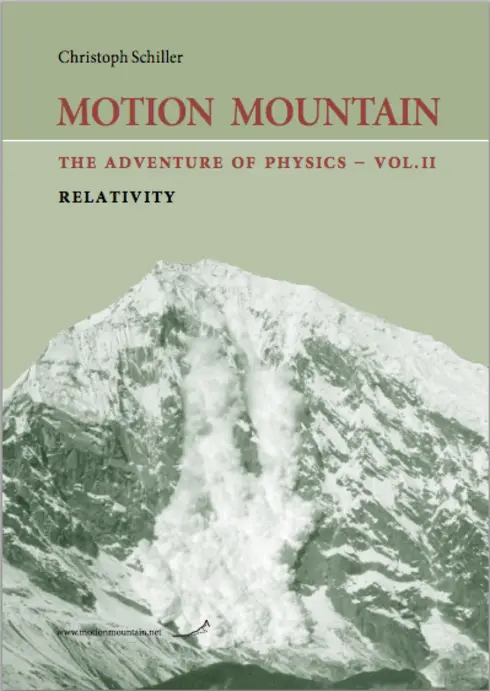
The Adventure of Physics - Vol. II: Relativity
Not rated yetRate this bookThe Adventure of Physics - Vol. II: Relativity develops special and general relativity through thought experiments, physical reasoning and increasingly mathematical descriptions. Christoph Schiller connects light, clocks, energy and spacetime to gravitation, cosmology and black holes. This guide follows the eleven main chapters and measurement appendix of Motion Mountain Volume II, distinguishing the book’s organising arguments from the observations they are used to explain.
Free reading is available at the official source. Opens in a new tab.
 Free
About this book
The Adventure of Physics - Vol. II: Relativity develops special and general relativity through thought experiments, physical reasoning and increasingly mathematical descriptions. Christoph Schiller connects light, clocks, energy and spacetime to gravitation, cosmology and black holes. This guide follows the eleven main chapters and measurement appendix of Motion Mountain Volume II, distinguishing the book’s organising arguments from the observations they are used to explain.
Chapter-wise summaries and study tasks
1 Maximum speed, observers at rest and motion of light
The opening chapter builds special relativity around the invariant speed of light and the observations available to different inertial observers. Aberration, Doppler shifts, velocity composition and thought experiments challenge everyday assumptions about simultaneous events and universal time. The key step is operational: define what clocks and measurements do before comparing their results. Time dilation and length contraction concern relationships between specified measurements, not arbitrary visual distortions. Keep emission, reception and coordinate assignment separate in a diagram. This helps avoid treating the delayed appearance of an object as identical to its measured length in a reference frame.
Study task. Draw two light-clock diagrams for relatively moving observers. State the events being compared and explain why simultaneity must be specified before measuring length.
2 Relativistic mechanics
Relativistic mechanics replaces separately conserved Newtonian quantities with a unified energy–momentum description. Mass, energy, collisions and four-vectors are developed together, showing why familiar low-speed rules are approximations. Four-velocity and proper acceleration distinguish quantities attached to a particle’s worldline from coordinate-dependent descriptions. The mass–energy relation must be interpreted for a defined system; energy contributions and the system’s rest frame matter. Use conservation laws to analyse interactions before reaching for a formula. The chapter’s examples encourage checking dimensions, invariant quantities and the low-speed limit of a result.
Study task. Compare an elastic collision in two inertial frames. Track total energy and momentum and identify the invariant mass of the complete system.
3 Special relativity in four sentences
The short consolidation chapter compresses special relativity into a small set of organising statements and asks where the framework applies. Its brevity is an invitation to reconstruct the earlier reasoning, not to replace that reasoning with slogans. Questions about varying light speed and the limits of the theory require distinguishing a measured local invariant from coordinate descriptions or proposed extensions. Identify which assumptions underlie each conclusion and where additional physical ingredients become necessary. This is a useful checkpoint before the book moves from inertial motion to gravitation.
Study task. Write the chapter’s organising statements in your own words. Attach one thought experiment, one measurable consequence and one limitation to each.
4 Simple general relativity: gravitation, maximum speed and maximum force
Schiller introduces general relativity through a proposed maximum-force and maximum-power organising principle alongside the invariant speed. The chapter explores horizons, thought experiments and the conditions under which these bounds are stated. Read this as the author’s route into the theory and examine the definitions carefully, especially local versus extended systems and what counts as a measurable force. It should not be used as a substitute for understanding the metric and field equations developed later. Distinguish the argument’s assumptions, supporting examples and claims of equivalence rather than treating a dimensional expression as proof.
Study task. List the stated validity conditions for the force bound. Analyse one apparent counterexample and identify exactly which assumption the book uses to resolve it.
5 How maximum speed changes space, time and gravity
Gravity changes the comparison of clocks and the geometry of motion. The discussion develops free fall, gravitational time differences, tides and geodesics, using them to motivate curved spacetime. A freely falling observer can remove some local effects of gravity, but tidal differences reveal structure that cannot be eliminated over an extended region. Keep this distinction in view when interpreting analogies such as a curved mattress. A geodesic describes locally unforced motion within the relevant geometry; it is not simply a curved path drawn in ordinary space.
Study task. Compare two nearby falling objects and two clocks at different heights. Explain which observation concerns tidal curvature and which concerns the comparison of elapsed proper times.
6 Open orbits, bent light and wobbling vacuum
Weak-field effects turn relativity into testable deviations from simpler gravitational descriptions. Light bending, propagation delays, orbital precession, geodesic and frame-dragging effects, and gravitational waves provide different observational windows. The chapter distinguishes motion around gravitating bodies from changing disturbances in the gravitational field. Read each example by identifying the measured quantity, the approximation used and the reference prediction being tested. Wave detection involves extremely small relative changes, so an account of a detector must connect its physical response to the signal rather than merely state that spacetime ripples.
Study task. Make an evidence table for light bending, orbital precession and gravitational waves. Record the observable, the relevant approximation and one important source of measurement difficulty.
7 From curvature to motion
The mathematical chapter develops curvature from lower-dimensional examples toward spacetime tensors and the Einstein field equations. The metric describes interval measurements, while curvature quantities capture geometrical information that coordinates alone cannot remove. Ricci curvature, the scalar curvature and the Einstein tensor enter a relation with the energy–momentum content. The Schwarzschild solution supplies a concrete application. Learn what each object represents before manipulating its components, and distinguish a solution of the equations from the equations themselves. Coordinate singularities must also be separated from physically divergent curvature.
Study task. Create a dependency map from metric to connection, curvature and field equations. Use the Schwarzschild example to explain why a coordinate problem is not automatically a physical singularity.
8 Why can we see the stars? – Motion in the universe
Cosmology connects local observations of stars and galaxies to the large-scale history of spacetime. The chapter uses the night sky, redshift, expansion, transparency and the early universe to develop questions about geometry and cosmic evolution. Distinguish light-travel time from a simple static notion of distance, and separate expansion of the cosmological model from motion through a fixed background. The darkness of the night sky becomes a physical question about the universe’s age and history. Treat numerical cosmological statements as belonging to the source edition rather than silently replacing them with present-day values.
Study task. Explain why an infinite, static, uniformly star-filled universe creates a night-sky problem. Identify which assumptions an evolving cosmological account changes.
9 Black holes – falling forever
Black holes are developed through mass concentration, horizons, orbital motion, formation and the extraction of energy. An event horizon is a causal boundary, not a material surface, and the experience of an infalling observer must be distinguished from the coordinates used by a distant observer. The discussion of singularities raises limits of the classical description rather than providing a complete quantum account. The no-hair theme concerns restricted idealised descriptions, so identify the conditions under which it is invoked. Use causal diagrams and scales to organise the arguments instead of relying on dramatic images of an object swallowing everything.
Study task. Compare a horizon, a singularity and a photon orbit. State how each is defined and explain which can be identified by a local measurement alone.
10 Does space differ from time?
Questions about the difference between space and time probe the meaning of coordinates, measurements and physical events. Closed timelike curves, locality and the hole argument test how to interpret a generally covariant theory. Coordinates label events; they are not automatically independently observable entities. The chapter asks readers to distinguish mathematical possibilities, physical interpretation and evidence. Preserve the difference between a solution allowed by a set of equations and a realistic process that could occur under known conditions. This interpretive work connects directly to earlier questions about clocks and reference frames.
Study task. Explain the hole argument using two coordinate descriptions of the same physical situation. Identify what must remain unchanged for them to represent the same observations.
11 General relativity in a nutshell – a summary for the layman
The final main chapter summarises general relativity for a broad audience and reviews accuracy, research questions and limitations. Reconstruct the path from measured intervals and free fall to geometry and gravitational dynamics. The theory’s successful tests do not imply that it answers every question about singularities, quantum behaviour or cosmology. Conversely, an open problem does not erase its established domain of success. Use this chapter to distinguish observations, models and speculative extensions, and to check whether you can explain the physical meaning of the mathematics introduced earlier.
Study task. Give a five-minute explanation of general relativity using one clock experiment, one orbital test and one unresolved problem. Label what is observed and what the theory infers.
A Units, measurements and constants
The appendix develops units, measurement, precision, accuracy and physical constants. These foundations are essential when comparing relativistic predictions with observations across radically different scales. A numerical value has meaning only with units, conventions and an account of uncertainty. Distinguish uncertainty in a measurement from a theoretical limit on what can be measured, and distinguish precision from closeness to an accepted value. Dimensional analysis provides a fast way to detect an invalid formula, although matching dimensions alone cannot establish a physical law.
Study task. Check the dimensions of energy–momentum, gravitational-radius and maximum-force expressions. For one numerical estimate, state the units and the precision justified by the input data.
How to study this book
- Work through special relativity before the gravitational chapters. Draw spacetime diagrams and label events, frames and clock readings.
- Maintain a glossary of proper time, coordinate time, invariant mass, metric, curvature, geodesic and horizon.
- Solve selected source challenges before consulting the provided hints. Check units and limiting cases in every calculation.
- For Chapters 4 and 8–11, distinguish the author’s interpretive arguments, observational evidence and questions that remain open.
Questions for reflection
- Why can two observers disagree on elapsed coordinate time while agreeing on a spacetime interval?
- What distinguishes a tidal effect from an acceleration that can be removed locally?
- Which black-hole statements depend on coordinates, and which describe causal structure?
Source edition and coverage
This guide follows the verified Motion Mountain Volume II PDF, with eleven main chapters and Appendix A. The book’s maximum-force presentation is identified as its organising approach; numerical and observational discussions retain the source edition’s scope. These are original study explanations and learning tasks. Read the complete book at the official source.
About access & copyright
This page provides book information and study material. Full-text access is provided by the original publisher or authorised source; a listing does not grant permission to republish the book.
Read our Library Access & Copyright policyExplore the contents
Check the chapters covered in this edition.
Visit the official source
See reading, preview or purchase options.
Save for later
Keep this textbook in your saved collection.
Reader ratings & reviews
Share your thoughts
Your review helps other students choose the right resources.
KEEP LEARNING
Your next great read
Physics
Electricity and Magnetism with Applications to Amateur Radio and Wireless Technology
Electricity and Magnetism with Applications to Amateur Radio and Wireless Technology
View Electricity and Magnetism with Applications to Amateur Radio and Wireless Technology — bookPhysical Science for Educators (CID: PHYS 14)
Physical Science for Educators (CID: PHYS 14)
View Physical Science for Educators (CID: PHYS 14) — bookGeneral Physics I: Classical Mechanics
General Physics I: Classical Mechanics
View General Physics I: Classical Mechanics — bookGSU-TM-Physics II (2212)
GSU-TM-Physics II (2212)
View GSU-TM-Physics II (2212) — book Physics
Electromagnetics I
View Electromagnetics I — book Physics
 156 - A Cosmology Workbook
View Physics 156 - A Cosmology Workbook — book Physics
Gettysburg College Physics for Physics Majors
View Gettysburg College Physics for Physics Majors — book Physics
GSU-TM-Introductory Physics II (1112)
View GSU-TM-Introductory Physics II (1112) — book Physics



