
Introduction
Sociology deals with the methods through which social organization and principles are linked. Social organization is defined by numerous thoughts. The configuration of a society can be understood as the culture’s organization, for example, its spiritual, radical, or efficient organizations, instructions, practices, and interactions that make the culture. Social-culture is dealing further with the principles and standards of the culture. Some people perceive sociology as a science, where evidence can be attained by gathering statistics, and theories can be transformed into theorems. In terms of science, sociology could have to be value-free, and sociologists, as experts, must not be absorbed in altering society; rather, they should be involved in perceiving and enlightening it.
Others consider that sociology, as a research of the collections of individuals, must be used to assist in the formation of an improved society, and consequently, sociologists must be obliged to change and perhaps reform society. Sociology must endure being a science that pursues to enlighten the world. The notion of sociology as a science is reinforced both by the founding fathers of this field and by modern-day concentrations. These crucial sociologists, for example, Max Weber, Emile Durkheim, and Peter Berger, support the technical features of sociology. Likewise, sociology should remain impartial to the spiritual, radical, and ethical standards which it pursues to label. The area of cosmology, the study of the cosmos and the universe, in specific, its source could be used as a prototype for the effort of sociology into a putative, value-free discipline. Sociology is one of the fundamental subjects of the social sciences, along with political science, finance, and anthropology. So one could visualize that it is an intelligible, amalgamated, and extensive science with discrete topic stuff and a clear set of methods. But as most physicians will decide, this is not this circumstance. It is a moral mechanism, as the social biosphere is not a united scheme that can be abridged to minor numbers of hypothetical sites (Merton, The Sociology of Science: Theoretical and Empirical Investigations).
Health and Illness Aspects of Sociology of Science
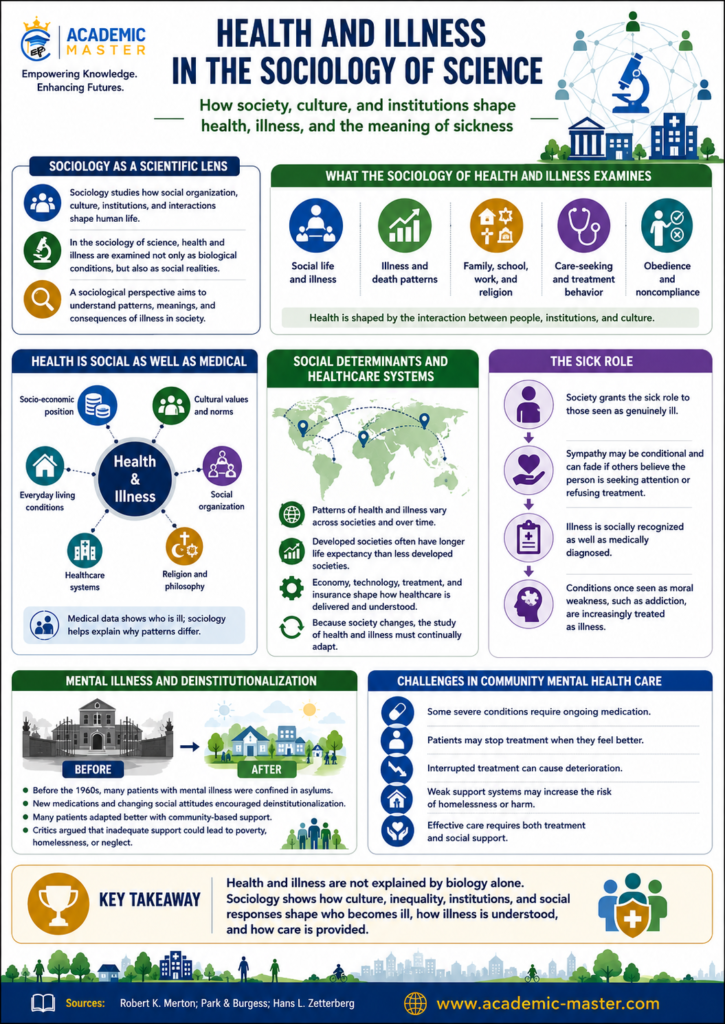
The sociology of health and illness deals with the communication between culture and health. In specific, sociologists inspect how social life influences illness and death rates and how illness and death rates change society. This subject also examines aspects of disease and health and their relation to social organizations, for example, the family, school, work, and faith, in addition to the sources of illness and disease, reasons for pursuing certain kinds of care, and enduring compliance and noncompliance (Park and Burgess).
Health, or deficiency of health, was once simply credited to organic or normal circumstances. Sociologists have confirmed that the spreading of illnesses is deeply prejudiced by the socio-economic position of persons, cultural civilizations or principles, and other social issues. Where medicinal study may collect figures on an illness, a sociological viewpoint of disease will deliver awareness on what peripheral issues instigated the demographics who contracted the disease to be ill.
The sociology of well-being and illness needs a worldwide tactic of study since the impact of social issues differs in the whole world. Illnesses and diseases are inspected and related and based on customary medicine, religion, economics, and philosophy that are specific to every area or region. For example, HIV/AIDS serves as a common basis for comparison among different places. While it is very challenging in some parts, in other regions it has a comparatively small fraction of the populace.
Sociological features can assist in clarifying why these inconsistencies exist.
Social Determinants and Healthcare Systems
There are noticeable variations in patterns of health and illness across societies, over time, and among specific types of societies. There has been a long-lasting decrease in humanity inside modern cultures, and as usual, life expectancy is significantly higher in developed rather than emerging or immature cultures (Park and Burgess).
Configurations of global variation in healthcare schemes make studying and understanding the sociology of illness and health more important. Nonstop changes in the economy, treatment, skill, and assurance can disturb the mode-specific society’s opinion and reply to the medical care obtainable. These quick variations source the matter of illness and health in social life to be very active in the meaning. Proceeding evidence is important because as designs progress, the learning of the sociology of disease and health is continually required to be modernized (Merton, “Priorities in Scientific Discovery: A Chapter in the Sociology of Science”).
The Sick Role and Social Recognition of Illness
The sociology of illness and health is not to be jumbled with medicinal sociology, which emphasizes medical organizations, for example, infirmaries, hospitals, and doctor workplaces in addition to the dealings with the physicians.
Society lets those who accomplish these standards undertake the sick part, but society loses consideration for and refutes the part to those who seem to like it or those who do not pursue the treatment. In other words, friends and family may display compassion for a moment but lose patience with the person and assume he or she is looking for attention or is neurotic.
Though several consider that science only concludes illness, these sociological interpretations point out that society controls sickness too. For instance, the ethos describes illnesses as sincere if they have a high technical or workshop analysis, for example, cancer or heart-related disease. Earlier, society regarded situations such as chemical dependence, whether drug- or alcohol-related, as character weakness and refused those who suffered from addiction the sick role. Nowadays, drug reintegration packages and the wider culture mostly identify addictions as an illness, although the word disease is pathologically challenged. In today’s ethos, devotees might take on the sick part on the condition that they pursue assistance and progress to get out of the sick part.
Mental Illness and Deinstitutionalization
Individuals with mental diseases similarly make efforts for gratitude and consideration. Though treatment conditions and understanding of mental illness have remarkably improved, critics and mental health sources contend that substantial work remains. Previous to the 1960s, most mentally ill patients were locked away in the spaces mentioned as insane asylums, in which patients were frequently numb for the calm regulator. Because of new medications that reduce or eliminate numerous symptoms and altered attitudes toward mental disease brought about by the efforts of psychologists and sociologists, many asylums shut, and hundreds of patients moved to group homes, halfway houses, or independent living. This move to community care produced diverse consequences, with some mental health specialists concluding that most deinstitutionalized patients acclimate well with suitable community placement and treatment. Critics point to an increase in poverty overlapping with deinstitutionalization. They have claimed that numerous homeless people are mentally ill patients who require institutionalization or, at minimum, an improved mental healthcare system (Zetterberg).
Challenges in Community Mental Health Care
Certain mental diseases, for example, paranoid schizophrenia, need drug action for normal operations. Patients in the community occasionally stop taking their medicine when they start feeling healthier, opting out of sustained treatment and subsequently deteriorating. Patients who stop taking their medicines are the ones most likely to become homeless or pose a hazard to themselves or other people. These patients do not represent most people being treated for mental illness, though.
Works Cited
Merton, Robert K. “Priorities in Scientific Discovery: A Chapter in the Sociology of Science.” American Sociological Review, vol. 22, no. 6, 1957, pp. 635–59.
—. The Sociology of Science: Theoretical and Empirical Investigations. University of Chicago press, 1973.
Park, Robert Ezra, and Ernest Watson Burgess. Introduction to the Science of Sociology. University of Chicago Press Chicago, 1921.
Zetterberg, Hans L. On Theory and Verification in Sociology. 1966.
Cite This Work
To export a reference to this article please select a referencing stye below:

Academic Master Education Team is a group of academic editors and subject specialists responsible for producing structured, research-backed essays across multiple disciplines. Each article is developed following Academic Master’s Editorial Policy and supported by credible academic references. The team ensures clarity, citation accuracy, and adherence to ethical academic writing standards
Content reviewed under Academic Master Editorial Policy.





