
Introduction
East Chestnut Regional Health System (ECRH) is a regional healthcare organization formed through the merger of institutions with different facilities, patient populations, professional cultures, financial conditions, and strategic priorities. The combined system includes East River Medical Center, Archway Hospital, and hospitals formerly associated with the Northern Mountain Hospital Consortium, giving ECRH a broad geographic presence, specialist expertise, trauma and emergency capability, and substantial purchasing power. The merger also created weaknesses that can undermine those advantages, including long waiting times, inconsistent continuity of care, aging facilities, fragmented leadership, workforce succession risk, and uneven public confidence. A SWOT analysis separates internal strengths and weaknesses from external opportunities and threats so that leaders can distinguish resources they control directly from environmental conditions that require adaptation. For ECRH, the purpose is not to produce a static list but to identify how existing strengths can address operational problems and competitive pressure. The central strategic challenge is integration: the organization already possesses many valuable clinical and financial assets, but their value depends on coordinated scheduling, referral pathways, communication, workforce planning, facility investment, and a patient experience consistent across the regional system (University of Phoenix, 2021).
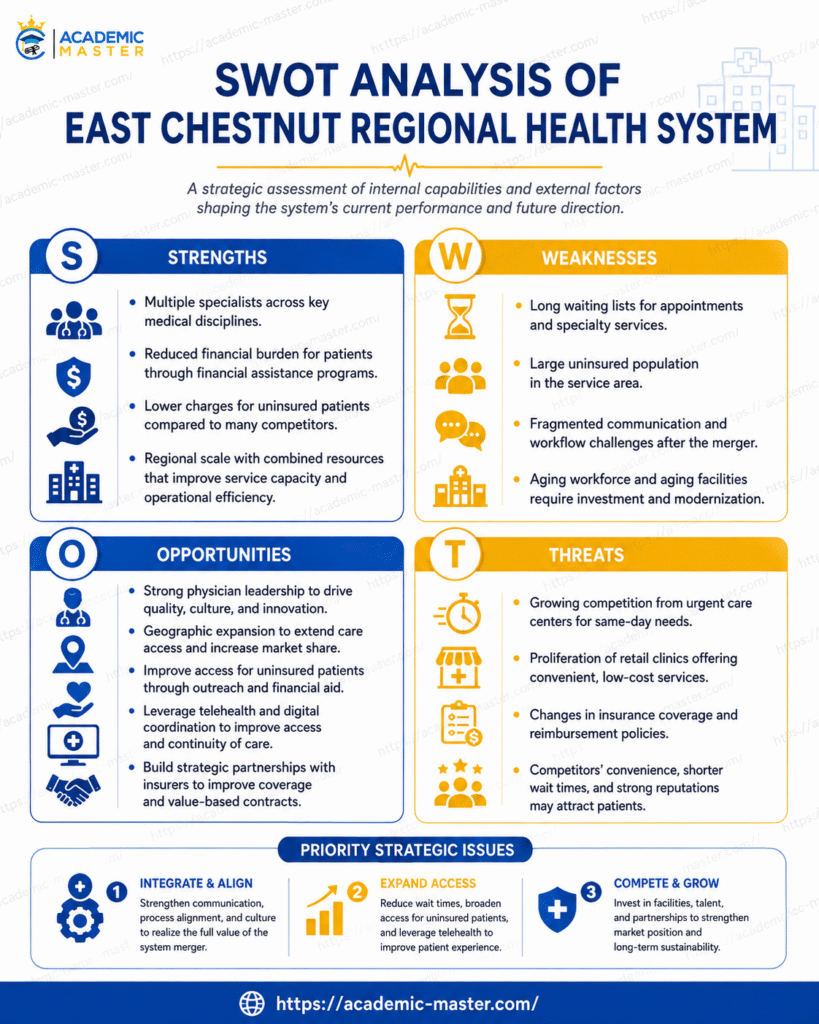
SWOT Framework
| Factor | Helpful | Harmful |
|---|---|---|
| Internal | Strengths | Weaknesses |
| Multiple specialists and diverse clinical disciplines | Long waiting lists and extended waiting times | |
| Lower financial burden for some uninsured or self-paying patients | High uncompensated-care pressure | |
| Large regional network and purchasing power | Floating providers and inconsistent continuity | |
| Trauma, emergency, air transport, and advanced technology | Fragmented communication and organizational cultures | |
| Resource-sharing potential across facilities | Aging workforce and facilities | |
| External | Opportunities | Threats |
| Telehealth and coordinated regional scheduling | Urgent-care and retail-clinic competition | |
| Partnerships with insurers and community organizations | Reimbursement and insurance-policy changes | |
| Expansion of successful outpatient and specialty services | Workforce shortages and rising operating costs | |
| Improved access programs for underserved patients | Loss of patients after poor service experiences |
Internal Strengths
ECRH’s strongest internal advantage is the breadth of clinical capacity created by the merger. Multiple specialists, primary-care professionals, diagnostic services, trauma capability, air transport, and regional facilities allow the system to coordinate care that smaller independent providers cannot easily reproduce. A rural patient may receive routine care locally while being connected to advanced specialists at the anchor hospital, provided referrals and records move reliably across locations. The system’s scale also creates purchasing leverage for pharmaceuticals, equipment, information technology, employee benefits, and maintenance, potentially reducing duplication and allowing specialized resources to be distributed according to demand. Affordability is another important strength because reduced self-pay costs and selected services offered without additional charges can improve access for uninsured patients and support patient loyalty when pricing is transparent and consistent. These advantages reinforce broader strengths and weaknesses of the U.S. healthcare system: large organizations can offer sophisticated care and economies of scale, but those benefits matter only when patients can navigate the system without fragmentation or unaffordable delays.
Internal Weaknesses
ECRH’s most immediate internal weaknesses involve access, continuity, integration, and aging resources. Long waiting times can reduce satisfaction, delay assessment, cause patients to leave before receiving care, and make convenient competitors more attractive. The correct response is to measure each stage of the patient journey—registration, triage, room placement, clinician availability, testing, discharge, and follow-up—rather than assuming that every delay results from insufficient staffing. Floating providers help cover shortages but can weaken continuity when responsibility for results and follow-up is unclear. Stable care teams, shared records, explicit handoffs, and assigned ownership can preserve flexibility without abandoning continuity. The merger also joined different organizational cultures and leadership practices, creating inconsistent communication and decision-making. An aging physician workforce and older facilities add succession and capital-planning risk. Research on healthcare mergers emphasizes that financial combination does not automatically create cultural integration, while continuity research has associated sustained clinician relationships with better outcomes (Chesley, 2020; Pereira Gray et al., 2018). ECRH therefore needs system-wide standards without erasing legitimate local flexibility.
External Opportunities and Threats
ECRH has several opportunities to convert regional scale into more accessible care. Telehealth can connect rural patients with specialists, coordinated scheduling can reduce unnecessary travel, and outpatient or diagnostic centers may expand reach without the expense of building full hospitals. Physician groups can help shape the future direction of healthcare by identifying service gaps, improving referral pathways, and developing population-health programs. Partnerships with insurers, community organizations, employers, and local governments can support uninsured and underinsured patients through enrollment assistance, charity care, medication support, and preventive services. The threats are equally concrete. Urgent-care centers and retail clinics compete through convenient locations, extended hours, simple scheduling, and transparent prices, while insurers can change network participation, prior-authorization rules, and reimbursement. Workforce shortages and rising costs can constrain expansion, and poor patient experiences can weaken reputation regardless of clinical sophistication. ECRH should therefore compete on access and coordination rather than attempting to imitate every retail model. Same-day appointments, virtual follow-up, clear self-pay pricing, and rapid escalation to specialty services can use the system’s existing clinical depth as a differentiated advantage.
Strategic Priorities
The SWOT findings point to a focused sequence of priorities. First, ECRH should reduce waiting times through demand-and-capacity analysis, better scheduling, streamlined registration, appropriate triage, and discharge coordination (Agency for Healthcare Research and Quality, 2020, 2025). Second, it should strengthen continuity by assigning patients to stable teams and creating clear responsibility for test results and follow-up. Third, leadership should integrate the merged institutions through common referral standards, communication protocols, performance definitions, and cross-site governance while preserving local practices that genuinely improve care. Fourth, workforce succession requires recruitment, mentoring, and advance planning for specialties vulnerable to retirement or shortage. Fifth, the system needs a sustainable access strategy for uninsured patients that connects reduced pricing with Medicaid or Marketplace screening, financial assistance, community partnerships, and measurement of uncompensated care (Centers for Medicare & Medicaid Services, 2023). Finally, facility investment should follow utilization and community need rather than institutional history; underused sites may be renovated, repurposed, or consolidated when another configuration improves access and financial sustainability. These priorities convert the SWOT framework from a descriptive matrix into a practical management agenda with measurable responsibilities and timelines.
Conclusion
East Chestnut Regional Health System possesses substantial strengths: specialist breadth, advanced clinical services, regional reach, purchasing power, and an established commitment to serving uninsured and underserved patients. Its weaknesses are not a lack of resources so much as difficulty coordinating them. Long waits, inconsistent follow-up, fragmented post-merger communication, aging facilities, and workforce succession risks can prevent patients from experiencing the benefits that the combined organization should provide. External competition from urgent-care and retail clinics increases pressure to improve convenience, while reimbursement changes and workforce shortages require disciplined financial planning. ECRH can respond by using its scale more intelligently: stable care teams can improve continuity, telehealth can extend specialist access, shared protocols can connect facilities, and transparent access programs can support vulnerable patients without disguising their financial cost. The SWOT analysis therefore points toward integration rather than indiscriminate expansion. If ECRH measures waiting, continuity, workforce capacity, facility utilization, patient experience, and access consistently across sites, it can turn merger-created scale into a coordinated regional system rather than a collection of institutions operating under one name.
References
Agency for Healthcare Research and Quality. (2020). Strategy 6A: Open Access Scheduling for Routine and Urgent Appointments.
Agency for Healthcare Research and Quality. (2025). Six Domains of Healthcare Quality.
Centers for Medicare & Medicaid Services. (2023). Health Coverage Options for the Uninsured.
Chesley, C. G. (2020). Merging cultures: Organizational culture and leadership in a health system merger. Journal of Healthcare Management, 65(2), 135–150. https://doi.org/10.1097/JHM-D-18-00213
Pereira Gray, D. J., Sidaway-Lee, K., White, E., Thorne, A., & Evans, P. H. (2018). Continuity of care with doctors—A matter of life and death? BMJ Open, 8(6), e021161. https://doi.org/10.1136/bmjopen-2017-021161
University of Phoenix. (2021). Case Study: East Chestnut Regional Health System.
Cite This Work
To export a reference to this article please select a referencing stye below:

Academic Master Education Team is a group of academic editors and subject specialists responsible for producing structured, research-backed essays across multiple disciplines. Each article is developed following Academic Master’s Editorial Policy and supported by credible academic references. The team ensures clarity, citation accuracy, and adherence to ethical academic writing standards
Content reviewed under Academic Master Editorial Policy.





