
Renewable energy comes from naturally replenished flows such as sunlight, wind, moving water, organic material, and heat within the Earth. These resources differ fundamentally from coal, oil, and natural gas, which are finite and release large quantities of greenhouse gases when burned. However, the word renewable does not mean unlimited, perfectly clean, or suitable in every location. A solar farm, wind project, dam, geothermal plant, or biomass facility must still be manufactured, financed, connected to an energy system, maintained, and eventually replaced. A realistic assessment therefore has to consider the complete lifecycle of each technology rather than treating renewable energy as either an ideal solution or an impractical experiment.
The global shift toward renewable energy is accelerating because the technologies can address several problems at once: climate change, exposure to air pollution, dependence on imported fuels, and volatile energy prices. The International Energy Agency projects that global renewable power capacity will rise by almost 4,600 gigawatts between 2025 and 2030, with solar photovoltaic systems accounting for nearly 80% of that expansion (International Energy Agency, 2025). Falling costs are an important part of this growth. In 2025, the global average cost of electricity from new utility-scale solar photovoltaic projects remained about USD 44 per megawatt-hour, while onshore wind declined to roughly USD 33 per megawatt-hour (International Renewable Energy Agency, 2026). These figures demonstrate the commercial strength of renewables, but cost alone does not resolve questions about reliability, land, materials, transmission, and community impacts.
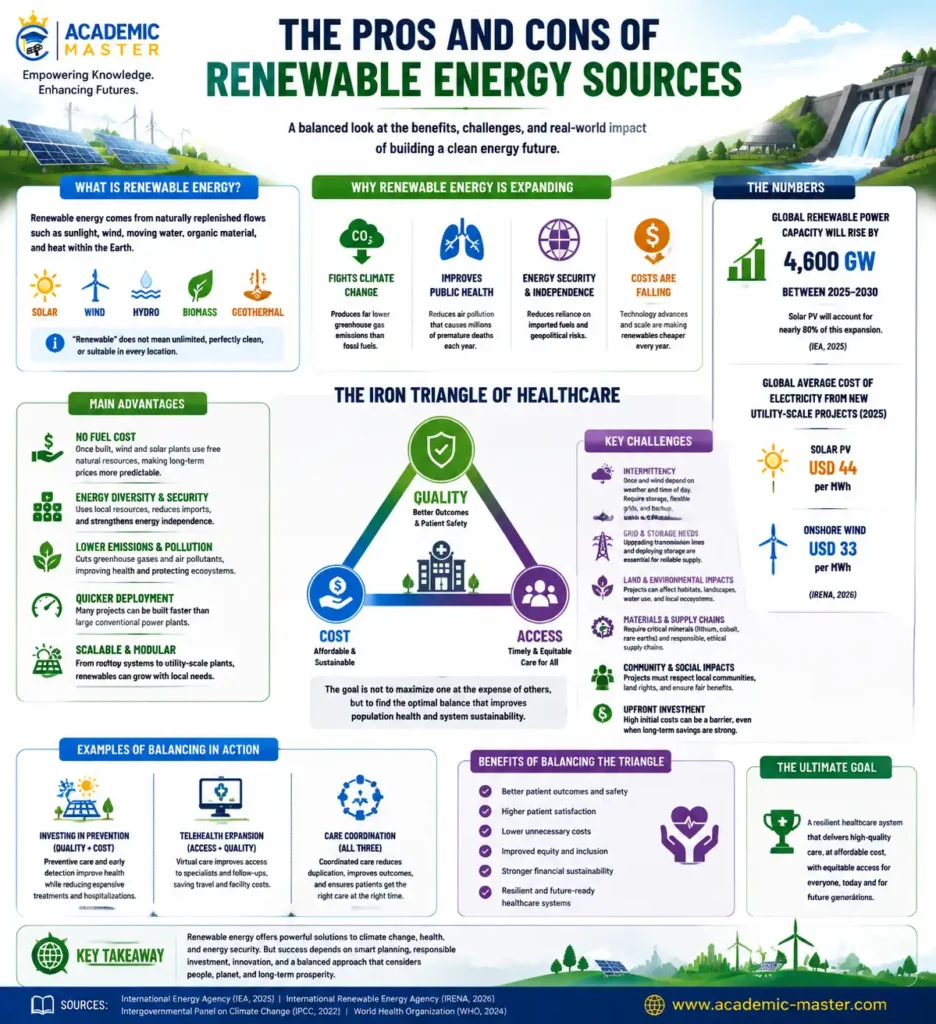
Why Renewable Energy Is Expanding
The most important reason for expanding renewable energy is its ability to produce electricity with much lower greenhouse gas emissions than fossil-fuel generation. Solar panels and wind turbines do not burn fuel while operating, and hydropower and geothermal systems can also provide low-emission electricity under suitable conditions. Emissions still arise when raw materials are extracted, equipment is manufactured, projects are constructed, and components are transported or disposed of. Even after those lifecycle effects are considered, the Intergovernmental Panel on Climate Change identifies renewable electricity as a central part of pathways that limit global warming, particularly when it is combined with electrification, energy efficiency, storage, and improved power networks (Intergovernmental Panel on Climate Change, 2022). The climate advantage is therefore substantial, but it depends on responsible project design and on renewables actually replacing high-emission energy rather than simply being added to growing fossil-fuel consumption.
Renewable energy can also improve public health by reducing combustion-related pollution. Power stations and household fuels that burn coal, oil, gas, or unsustainably harvested biomass can release fine particles, nitrogen oxides, sulfur dioxide, and other harmful substances. The World Health Organization estimates that the combined effects of ambient and household air pollution are associated with approximately 6.7 million premature deaths each year (World Health Organization, 2024). Replacing polluting generation with low-emission electricity cannot eliminate every source of air pollution, but it can reduce exposure near power plants, industrial areas, and densely populated communities. These health gains are especially important when clean electricity supports cleaner cooking, heating, and transportation.
The Main Advantages of Renewable Sources
One major advantage is that renewable technologies avoid continuous fuel consumption. Once a wind turbine or solar installation is operating, it does not need a daily supply of coal or gas, so its electricity cost is less exposed to international fuel-price shocks. This does not make renewable power free: projects still require land, equipment, financing, maintenance, grid connections, and eventual decommissioning. Nevertheless, the absence of fuel costs can make long-term prices more predictable. Solar energy is also highly modular. A system may consist of a few panels on a building or millions of panels in a utility-scale project, allowing development to match local demand and investment capacity. Wind and solar plants can often be built more quickly than large conventional power stations, although permitting and transmission delays may still slow completion.
A second advantage is greater energy diversity and security. Countries with good solar, wind, water, geothermal, or sustainable biomass resources can reduce their dependence on imported fuels and the geopolitical risks attached to those imports. Distributed generation can bring electricity closer to consumers, reduce some transmission losses, and support remote communities that would otherwise wait years for a conventional grid connection. Renewable systems can also be combined rather than developed in isolation. Solar generation is strongest during daylight, wind output may rise at different times, reservoir hydropower can respond rapidly to changing demand, and geothermal or carefully managed bioenergy can provide steadier output. A diverse portfolio, supported by interconnection and storage, is more useful than relying on a single resource.
Renewable investment can also create economic opportunities through construction, manufacturing, operations, engineering, and local services. The quality and distribution of those benefits are not automatic: employment may be temporary, equipment may be imported, and communities hosting projects may receive fewer benefits than distant consumers. Policies that support training, domestic supply chains, community participation, and fair compensation can improve outcomes. When these safeguards are present, renewable development can connect climate goals with regional investment and wider access to modern energy.
The Main Disadvantages and Constraints
The most familiar limitation is variability. Solar output changes with the time of day, season, cloud cover, dust, and shading, while wind generation changes with weather conditions. This does not mean that wind or solar electricity cannot be stored. Rather, the electricity system needs batteries, pumped-storage hydropower, thermal storage, flexible demand, stronger transmission, or other sources that can balance supply and demand when weather-dependent generation falls. Modern inverters and control systems can allow renewable plants to provide grid services that were once supplied mainly by conventional generators. Demonstration projects combining wind, solar, and energy storage show how these technologies can operate together, but large-scale integration still requires careful planning and investment (U.S. Department of Energy, 2023). Regions with weak grids or limited access to finance may find those supporting investments more difficult than installing generation itself.
Renewable projects also occupy land and affect ecosystems. Large solar developments can fragment habitat if they are poorly located, and wind turbines can harm birds and bats when migration routes and local ecology are ignored. Hydropower reservoirs may alter river flow, sediment movement, fish migration, water quality, and surrounding communities; some projects have displaced people or submerged culturally important land. Geothermal development can bring drilling risks, water-management concerns, mineral-laden fluids, and, in some settings, induced seismicity. Biomass can be renewable when feedstocks regrow and supply chains are carefully managed, but burning it still produces air pollution and carbon dioxide. Its climate value can be weak or even negative when forests are cleared, regrowth is slow, or usable timber is diverted into fuel. Ocean technologies offer predictable tidal resources in some locations, yet high costs, corrosion, maintenance, and uncertain marine effects have limited widespread deployment.
Material demand creates another significant trade-off. Solar panels, turbines, transmission networks, electric vehicles, and batteries require copper, aluminium, steel, silicon, lithium, nickel, cobalt, rare-earth elements, and other resources. Mining and processing these materials can consume energy and water, damage habitats, pollute land, and expose workers or nearby communities to unsafe conditions. The United Nations Environment Programme argues that the energy transition must combine responsible extraction with material efficiency, recycling, product longevity, and more equitable sharing of benefits (United Nations Environment Programme, 2024). This is not an argument for continuing fossil-fuel dependence, which also causes extensive extraction damage and ongoing pollution. It is a reminder that a clean-energy system should be designed around circular use of materials instead of replacing one wasteful model with another.
Finally, low average generation costs do not guarantee that every project is affordable. Renewable facilities are capital-intensive: much of their lifetime cost is paid before electricity is produced. High interest rates, weak currencies, uncertain policies, slow permitting, and costly grid connections can make an otherwise efficient project financially unworkable. The International Energy Agency identifies grid integration, financing difficulties, supply-chain vulnerabilities, and permitting delays among the challenges accompanying rapid renewable expansion (International Energy Agency, 2025). These barriers are often more severe in developing economies, even where renewable resources are excellent. Sound regulation, transparent procurement, dependable transmission planning, and access to lower-cost finance are therefore as important as technological improvements.
Different Technologies Offer Different Trade-Offs
There is no single renewable source that performs best in every category. Solar power is scalable, increasingly inexpensive, and widely available, but it produces no electricity at night and requires storage or complementary generation. Wind can provide large amounts of low-cost electricity while leaving much of the surrounding land available for farming, although strong resources are location-specific and projects can raise ecological, transmission, and community concerns. Hydropower offers long-lived generation, rapid response, and storage, but it can disrupt rivers and communities and may become less dependable during drought. Geothermal plants provide steady electricity with a modest surface footprint, yet suitable resources are geographically limited and drilling remains expensive and uncertain.
Biomass and marine energy require equally careful distinctions. Agricultural residues, organic wastes, landfill gas, and sustainably produced fuels may provide useful energy, but biological material is not automatically carbon neutral. Its effects depend on the feedstock, land-use change, regrowth time, transport, and pollution controls. Tidal and wave resources can be predictable, yet their technologies remain less commercially mature than solar, wind, or hydropower. Technologies should therefore be selected according to local resources, ecological limits, community priorities, grid needs, and full lifecycle costs rather than assuming that every project carrying the renewable label is equally beneficial.
Conclusion
Renewable energy offers clear advantages: substantially lower greenhouse gas emissions than fossil-fuel generation, reduced exposure to harmful air pollution, protection from fuel-price volatility, improved energy diversity, and increasingly competitive electricity costs. These strengths explain why renewable capacity is expanding rapidly across the world. At the same time, renewable energy has genuine disadvantages. Weather-dependent output must be balanced, networks must be expanded, projects require major initial investment, and careless development can damage ecosystems or communities. Equipment production also creates mineral demand and end-of-life waste that must be managed responsibly.
The relevant choice is not between a flawless renewable system and an impact-free conventional system, because neither exists. It is between energy pathways with very different long-term consequences. Renewable sources are most beneficial when projects are selected for local conditions, assessed across their full lifecycle, supported by storage and modern grids, and governed by strong environmental and social standards. Under those conditions, their limitations can be reduced without losing their central advantages, making them an essential part of a cleaner, more secure, and more resilient energy system.
References
Intergovernmental Panel on Climate Change. (2022). Climate change 2022: Mitigation of climate change. Cambridge University Press. https://www.ipcc.ch/report/ar6/wg3/
International Energy Agency. (2025). Renewables 2025. https://www.iea.org/reports/renewables-2025
International Renewable Energy Agency. (2026). Renewable power generation costs in 2025. https://www.irena.org/Publications/2026/Jul/Renewable-Power-Generation-Costs-in-2025
United Nations Environment Programme. (2024). Critical transitions: Circularity, equity, and responsibility in the quest for energy transition minerals. https://www.unep.org/resources/publication/critical-transitions-circularity-equity-and-responsibility-quest-energy
U.S. Department of Energy. (2023, May 10). Solar and wind grid services and reliability demonstration funding program. https://www.energy.gov/cmei/systems/solar-and-wind-grid-services-and-reliability-demonstration-funding-program
World Health Organization. (2024, October 24). Ambient (outdoor) air pollution. https://www.who.int/news-room/fact-sheets/detail/ambient-(outdoor)-air-quality-and-health
Cite This Work
To export a reference to this article please select a referencing stye below:

Academic Master Education Team is a group of academic editors and subject specialists responsible for producing structured, research-backed essays across multiple disciplines. Each article is developed following Academic Master’s Editorial Policy and supported by credible academic references. The team ensures clarity, citation accuracy, and adherence to ethical academic writing standards
Content reviewed under Academic Master Editorial Policy.





