
Introduction
A spark plug is a compact electrical and thermal device fitted into the cylinder head of a spark-ignition engine. Its most visible task is to create a precisely timed electrical discharge that ignites the compressed air-fuel mixture, but it also seals the combustion chamber and conducts heat away from its firing tip. These functions must be repeated millions of times while the plug is exposed to rapidly changing pressure, vibration, corrosive gases, and temperatures that vary from a cold start to intense combustion. A modern gasoline engine therefore depends on the spark plug not merely to produce “a spark,” but to produce a reliable spark of the correct energy at the correct crankshaft position without overheating, fouling, leaking compression, or causing abnormal combustion (DENSO, 2023).
The original discussion correctly identifies the spark plug as part of the ignition system and notes that electricity jumps between two electrodes. However, several details require clarification. The plug does not convert battery power by itself, and the combustion event is not simply an uncontrolled explosion. The battery or generator supplies low-voltage electrical energy, the ignition coil transforms it into a short high-voltage pulse, the engine control unit determines the timing, and the plug provides a controlled gap across which the pulse can ionize gas. The resulting flame then travels through the compressed mixture in a rapid but organized combustion process.
The Construction of a Spark Plug
A conventional spark plug contains a terminal, ceramic insulator, metal shell, sealing surfaces, resistor, center electrode, and ground electrode. The terminal connects to an ignition lead or, in many current engines, directly to a coil-on-plug unit. The insulator is normally made from a high-grade ceramic such as aluminum oxide because it must electrically isolate tens of thousands of volts while resisting thermal and mechanical shock. Ribs molded into the outer insulator lengthen the surface path that electricity would have to follow, reducing the risk that voltage will leak outside the combustion chamber (Niterra Co., Ltd., 2023).
The threaded steel shell secures the plug in the cylinder head and provides both a gas-tight seal and a heat-conduction path. The center electrode carries the ignition pulse to the firing end. It may use a copper core for thermal conductivity and an outer material such as nickel alloy, platinum, or iridium for durability. The ground electrode is welded to the shell and bends toward the center electrode. The small distance between them is the electrode gap. Spark-plug designs differ in thread diameter, reach, seat type, projection, resistance, gap, electrode geometry, and heat range, so the correct plug must be selected for the particular engine rather than treated as a universal component.
Where the Spark Fits into the Four-Stroke Cycle
In a typical four-stroke gasoline engine, the piston first moves downward during the intake stroke while air and fuel enter the cylinder. During the compression stroke, the piston rises and compresses that mixture. Shortly before the piston reaches top dead center, the engine control system commands the ignition coil to release a high-voltage pulse. Ignition normally begins before the piston reaches its highest point because the flame needs time to develop and spread. The exact timing changes with engine speed, load, temperature, fuel quality, knock detection, and other operating conditions.
Once combustion begins, expanding gases exert force on the piston during the power stroke. The piston later rises during the exhaust stroke and expels the combustion products. The spark plug fires once per cycle in most four-stroke systems, although some older “wasted spark” arrangements fire paired plugs when one cylinder is on its compression stroke and the other is on its exhaust stroke. Precise timing is crucial. A spark that is too late wastes energy and raises exhaust temperature; one that is too early can create excessive cylinder pressure and knock.
How High Voltage Becomes an Electrical Spark
Under normal conditions, the gas between the electrodes acts as an electrical insulator. The ignition coil changes this condition by producing a steep high-voltage pulse. The voltage needed to bridge the gap is not fixed. It depends on gap width, cylinder pressure, mixture composition, electrode shape, temperature, deposits, and wear. A compressed mixture is harder to ionize than ordinary air, so an engine may require many thousands of volts. Modern ignition systems are designed with sufficient reserve voltage to fire the plug under demanding conditions such as acceleration and cold starting.
As the electric field becomes strong enough, electrons accelerate across the gap and collide with gas molecules. These collisions create additional charged particles, producing an ionized channel. Current can then flow through this channel, and the electrical energy creates an extremely hot, very brief plasma. DENSO explains that the center of the spark may momentarily exceed 10,000°C. The important result is not a large explosion at the electrodes but the formation of a small flame kernel. If the mixture, pressure, turbulence, and ignition energy are suitable, that kernel grows into a flame front that travels through the chamber (DENSO, n.d.).
Flame Development and Efficient Combustion
The earliest stage of flame growth is vulnerable. Metal electrodes absorb heat from the flame kernel, a phenomenon often described as quenching. If the electrodes are too large, the mixture is excessively lean, fuel droplets are poorly vaporized, or turbulence displaces the kernel, combustion may be delayed or may fail altogether. Fine-wire iridium or platinum electrodes can reduce the voltage requirement and expose more of the kernel to the mixture, supporting consistent ignition. Manufacturers also use grooves, tapered ground electrodes, multiple ground paths, or projected tips to improve ignitability for particular engine designs.
A successful ignition event contributes to stable torque, fuel efficiency, and lower emissions. A misfire leaves some fuel unburned, reduces power, and sends excess oxygen and hydrocarbons into the exhaust. Repeated misfires may overheat and damage the catalytic converter. The engine control module detects many misfires by monitoring tiny changes in crankshaft speed, which is why a flashing or illuminated malfunction indicator may accompany a failing ignition component.
Heat Transfer and the Meaning of Heat Range
The spark plug does not add significant heat to the chamber after initiating ignition. Instead, it must remove heat from its firing end. Heat travels from the insulator nose and electrodes through the internal structure and shell into the cylinder head, where the engine cooling system carries it away. The rate at which the plug transfers heat is called its heat range. A “hot” plug retains more heat at the firing tip because it has a longer or less direct heat path. A “cold” plug transfers heat more rapidly.
The correct operating temperature is a balance. If the tip stays too cool, fuel, oil, and carbon deposits can accumulate and create a conductive leakage path, causing fouling and misfire. NGK notes that a plug generally needs to reach approximately 450°C for deposits to begin burning away through self-cleaning. If the tip becomes too hot, it can ignite the mixture before the commanded spark. This pre-ignition may create destructive pressure and temperature and can melt electrodes or damage a piston. Heat range is therefore an engineering match to the engine, not a performance ranking. Installing a colder plug does not automatically increase power, and installing a hotter one does not improve every cold start (Niterra Co., Ltd., n.d.).
Electrode Materials and Service Life
Traditional nickel-alloy plugs are durable enough for many engines but their comparatively larger electrodes gradually erode. Copper is often present as an internal core because it conducts heat well; the phrase “copper plug” usually refers to a nickel-alloy firing surface with a copper core rather than exposed copper electrodes. Platinum and iridium resist erosion at high temperature and can be formed into finer tips. These characteristics can extend service life and reduce the voltage needed for reliable ignition, but they do not make every precious-metal plug interchangeable.
Replacement intervals vary widely. The original claim that plugs usually require replacement after 15,000 to 20,000 kilometers is too broad. Some conventional plugs may have relatively short intervals, while specified long-life iridium or platinum plugs may remain in service for many tens of thousands of kilometers. The vehicle manufacturer’s maintenance schedule is the controlling source. Engine design, operating conditions, oil consumption, fuel quality, and the exact plug specification all influence life.
Common Failure Patterns and What They Indicate
A spark plug can provide useful evidence about conditions inside a cylinder, although visual inspection should not be treated as a complete diagnosis. Dry black carbon may indicate repeated short trips, an overly rich mixture, weak ignition, extended idling, or an unsuitable heat range. Wet oily deposits can point to oil entering the chamber through worn rings, valve guides, seals, or other mechanical faults. A white, blistered, or melted firing end may indicate overheating, incorrect tightening, cooling-system trouble, an unsuitable plug, or abnormal combustion. Cracked ceramic can result from impact, incorrect installation, detonation, or thermal stress.
Normal electrode wear enlarges the gap and increases the voltage required to fire it. The engine may then hesitate under load, idle roughly, consume more fuel, or become difficult to start. Similar symptoms can also arise from a failing coil, damaged wiring, injector problem, vacuum leak, low compression, or sensor fault. Replacing plugs without diagnosis may temporarily mask the issue. A competent inspection considers fault codes, live engine data, coil output, plug condition, compression, and the manufacturer’s technical information.
Correct Installation
Installation affects both sealing and heat transfer. A plug should be the specified type, installed into clean threads, and tightened to the manufacturer’s torque or angle. Under-tightening can allow compression leakage and interfere with heat dissipation. Over-tightening can stretch the shell, damage cylinder-head threads, crack the insulator, or distort the designed heat path. Anti-seize compound should not be applied automatically because many modern plugs have plated threads and manufacturers may prohibit extra lubricant; lubrication changes the relationship between tightening torque and clamping force.
The gap should be checked only in accordance with the plug maker’s guidance. Aggressively bending a fine-wire electrode can damage it. Dirt must be kept out of the plug well, and the ignition boot or coil should be inspected for carbon tracking, moisture, and deterioration. These precautions are more important than choosing a plug on the basis of advertising claims.
The Spark Plug in Changing Vehicle Technology
Battery-electric vehicles do not use spark plugs because they have no internal combustion process. Diesel engines normally rely on compression ignition and may use glow plugs for cold starting rather than spark plugs. Nevertheless, spark plugs remain important in gasoline vehicles, hybrid vehicles whose gasoline engines start and stop frequently, motorcycles, small engines, and some gaseous-fuel engines. Advanced ignition systems may use higher energy, multiple sparks, or alternative discharge technologies, but the basic requirement remains the same: initiate combustion reliably under changing cylinder conditions.
Conclusion
A spark plug works at the intersection of electricity, combustion, materials science, and heat transfer. The ignition coil supplies a high-voltage pulse; the voltage ionizes the compressed gas across the electrode gap; the discharge creates a flame kernel; and the growing flame releases chemical energy that drives the piston. At the same time, the plug seals the cylinder and conducts heat into the head. Electrode material, gap, heat range, installation torque, and engine condition determine whether the component can repeat this process reliably. Understanding these linked functions explains why the correct spark plug and proper service matter for starting, power, fuel use, emissions, and engine durability.
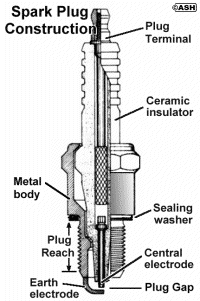
Figure: Spark plug construction retained from the original post.
References
DENSO. (2023, October 13). What does a spark plug do and how does it work? https://www.denso-am.eu/news/what-does-a-spark-plug-do-and-how-does-it-work
DENSO. (n.d.). How DENSO spark plugs work. https://www.denso-am.eu/products/ignition/spark-plug
Niterra Co., Ltd. (2023). Parts of a spark plug explained. https://www.ngkntk.com/newsroom/feature/emea/deconstructing-a-spark-plug/
Niterra Co., Ltd. (n.d.). NGK spark plugs. https://www.ngkntk.com/products/spark-plugs/

Academic Master Education Team is a group of academic editors and subject specialists responsible for producing structured, research-backed essays across multiple disciplines. Each article is developed following Academic Master’s Editorial Policy and supported by credible academic references. The team ensures clarity, citation accuracy, and adherence to ethical academic writing standards
Content reviewed under Academic Master Editorial Policy.




