
 Analysis
Textbook
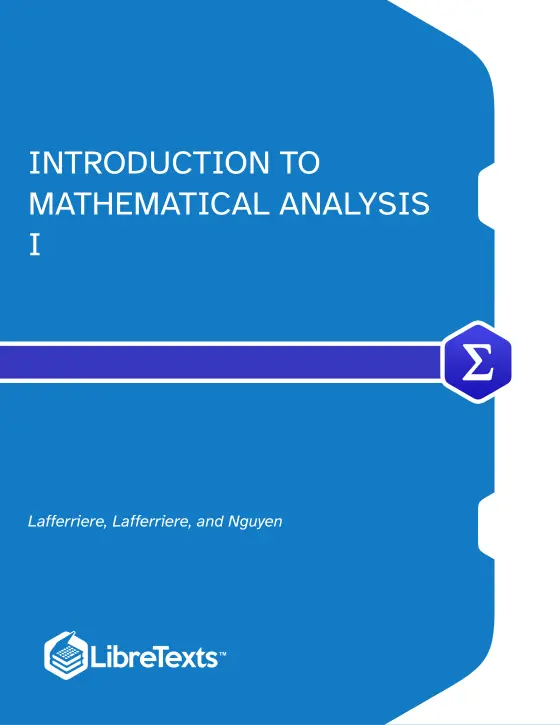
Introduction to Mathematical Analysis I
Not rated yetRate this bookMove from computational calculus to proof-based analysis through real-number foundations, sequences, limits, continuity and differentiation. The guide follows four theoretical chapters and a separate collection of hints and selected solutions.
Read on the publisher’s website. Opens in a new tab.
 Free
About this book
Introduction to Mathematical Analysis I by Lafferriere, Lafferriere and Nguyen develops the proof-based foundations behind familiar calculus ideas. Sets, functions, induction and properties of the real numbers prepare a rigorous treatment of sequences. Completeness is a central organizing idea rather than an assumption left in the background.
Limits and continuity then extend the language of approximation from sequences to functions. Differentiation is developed from its limit definition and connected with the mean value theorem, Taylor’s theorem and convexity. The source’s fifth chapter collects hints and selected solutions rather than introducing another main theory topic. The book is appropriate for students moving from computational calculus into mathematical argument. Readers should be prepared to unpack definitions, track quantifiers and explain where a hypothesis enters a proof. This guide follows the four theoretical chapters and the solution resource, using selected opening text and the verified subsection sequence for orientation.
AI-assisted book summary
Reading guide
Study the set and real-number foundations before convergence. Use sequences to practice precise approximation arguments, then move to function limits and continuity. Approach differentiation through its definition before applying the later theorems.
Chapter-by-chapter study guide
1: Tools for Analysis
The opening establishes sets, membership, subsets and ways to specify a collection. Functions, induction, ordered-field axioms and completeness then form the verified foundation sequence. These tools supply the vocabulary and assumptions used in later analysis arguments.
Study task: Prove a basic set inclusion and identify where the definition of membership is used.
2: Sequences
Convergence is introduced through a precise eventual-closeness condition for a sequence and its proposed limit. The chapter develops limit theorems, monotone sequences, subsequences and topological concepts. Numerical evidence can suggest a limit, but the definition supplies the proof standard.
Study task: Prove convergence of a simple reciprocal sequence by choosing a suitable index for each positive tolerance.
3: Limits and Continuity
The opening defines a function limit at a limit point, noting that the point need not belong to the domain. Continuity, uniform continuity and related limiting concepts follow. The distinction between approaching a point and evaluating at it is therefore essential.
Study task: Give a function with a limit at a missing domain point and explain why the limit still makes sense.
4: Differentiation
The derivative is defined as a limit of difference quotients on an appropriate domain. The chapter proceeds to the mean value theorem, its applications, L’Hopital’s rule, Taylor’s theorem and convexity. The sequence develops reasons behind familiar calculus tools rather than only computational rules.
Study task: Derive the derivative of a simple polynomial directly from the limit definition.
5: Solutions and Hints for Selected Exercises
The final chapter provides selected hints and solutions for the four theory chapters. The reviewed opening works with set and function arguments. Use this resource to compare proof structure after an independent attempt, not merely to match a final expression.
Study task: Attempt one exercise, then identify the first justification missing from your proof when comparing the available hint.
How to study this book
Rewrite definitions with every quantifier visible. Separate the statement to prove from the hypothesis you may use. Construct a simple example and a boundary case, then explain exactly how a proposed proof meets the definition.
Reflection questions
- How does the order of quantifiers affect a convergence statement?
- Where is completeness used in an argument about real numbers?
- What extra condition distinguishes uniform continuity from pointwise continuity?
Sources and coverage
Original book and chapter navigation on LibreTexts
This original guide uses the verified contents and selected opening text or stated learning objectives from each listed chapter. It is not a complete review of every explanation, example, proof or exercise. Check mathematical symbols, diagrams, software steps and full derivations in the original source; PDF text extraction does not preserve every element. The study tasks are supplementary practice, not official solutions.
About access & copyright
This page provides book information and study material. Full-text access is provided by the original publisher or authorised source; a listing does not grant permission to republish the book.
Read our Library Access & Copyright policyFoundations
Sets and real-number properties support later proofs.
Limits
Precise approximation definitions organize convergence and continuity.
Proof practice
Hypotheses and quantifiers matter as much as calculations.
Reader ratings & reviews
Share your thoughts
Your review helps other students choose the right resources.
KEEP LEARNING
Your next great read
Analysis Analysis
A Primer of Real Analysis
View A Primer of Real Analysis — book Analysis
Basic Engineering Data Collection and Analysis
View Basic Engineering Data Collection and Analysis — book Geosciences
An Introduction To Geology
View An Introduction To Geology — book Geosciences
Physical Geology (Sierra College Edition)
View Physical Geology (Sierra College Edition) — book Geosciences
Introduction to Oceanography (Sierra College Edition)
View Introduction to Oceanography (Sierra College Edition) — book Geosciences
Physical Geography: our Beautiful World
View Physical Geography: our Beautiful World — book Communication
Professional Communications Foundations
View Professional Communications Foundations — book Statistics
PSY 190: Statistics for the Behavioral Sciences
View PSY 190: Statistics for the Behavioral Sciences — book Statistics



